Schools Weigh Digital Report Cards Against Paper Records
By Atlantic Reports
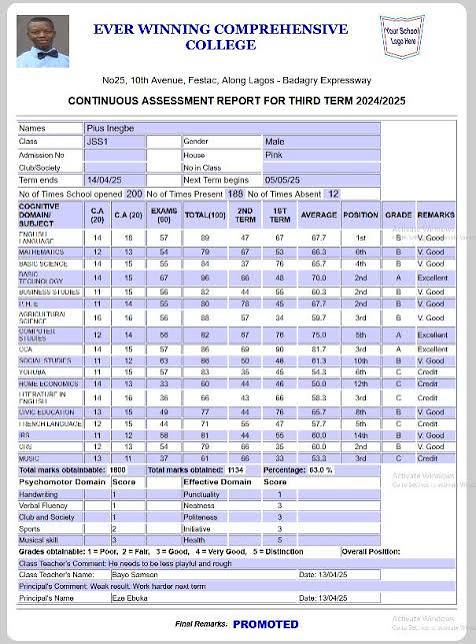
Education stakeholders in Abuja have called for wider use of digital report cards in primary and secondary schools, while retaining paper records to help families monitor pupils’ progress.
In separate interviews on Tuesday, school representatives and parents highlighted the convenience of online results, alongside concerns about access charges, password recovery and the ability of some families to use digital platforms.
Their views point towards a combined approach that improves record keeping without making access to a child’s results dependent solely on technology.
Online Access and Record Preservation
Ms Lois Tofumi, a member of the Board of Directors of St. Philip’s Academy, Abuja, said the school had introduced a portal accessed through assigned Personal Identification Numbers (PINs).
She said the system was intended to reduce errors during result collation and prevent pupils from altering grades on paper report cards.
Parents and pupils could access results through mobile phones or computers, she explained.
Tofumi acknowledged concerns about access charges, particularly for families with several children, but described the fees as affordable relative to the cost of operating the platform. She did not specify the charges.
Malam Idris Alhassan, Principal of Zinaria International School, said his school had used a digital results system for seven years.
The platform, he said, allowed parents outside Abuja or abroad to monitor their children’s performance without visiting the school. It also supported the retrieval and printing of older academic records.
“Even if you come to the school 20 years from now, the database can still provide the result for printing,” he said.
That expectation depends on the continued maintenance and preservation of the database. The interviews did not detail backup arrangements or long-term access policies.
Alhassan acknowledged that parents unfamiliar with technology, or without functional email addresses, could initially struggle to use the system. He said schools should guide them patiently.
Parents Raise Practical Concerns
Mrs Mimidoo Tile, a parent in Abuja, supported digital report cards because physical documents could be misplaced, damaged or lost during relocation or fire outbreaks.
However, she identified password recovery and limited digital literacy as potential difficulties.
Tile said some schools provided online access to results without charging separately from tuition, illustrating differences in how schools fund the service.
Mrs Onyinyechi Otie, an education stakeholder, favoured retaining hard-copy report cards, arguing that properly maintained physical records helped parents compare performance across terms and academic sessions.
She expressed concern that loose printouts obtained from cybercafés could be misplaced and might not contain a pupil’s complete academic history.
Her concern centres on how records are organised and retained. The interviews did not establish whether the digital platforms discussed provided cumulative results across multiple terms.
Results Must Support Parent–Teacher Engagement
Otie also said some underperforming pupils avoided collecting their report cards, while outstanding school fees could discourage parents from visiting schools.
She urged parents to collect results regularly and speak directly with teachers about their children’s progress and areas needing improvement.
Taken together, the stakeholders’ views support keeping both digital and paper options available. Online access can make results easier to retrieve, while organised physical copies can serve families who prefer them or face difficulties using a portal.
For either system, the practical test is whether parents can obtain reliable records, understand their children’s performance and engage teachers when support is needed.
Atlantic Reports: Voices. People. Facts.
Written by
Atlantic Reports Admin
Comments
- Be the first to comment.