Anambra, Ebonyi Communities Demand Emergency Action on Erosion
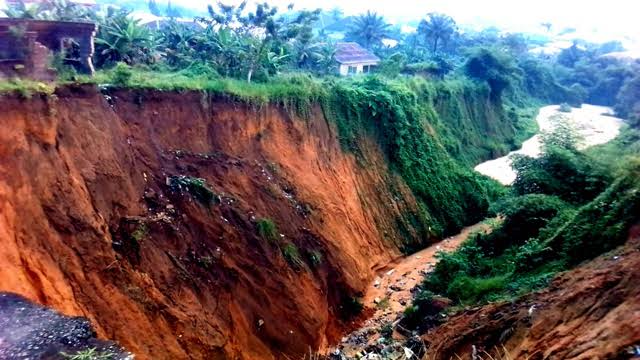
Communities across Anambra and Ebonyi states have appealed to the Federal and State Governments to declare a "state of emergency" over worsening erosion and flooding that continues to threaten lives and property.
Some of the worst-hit communities in Anambra include Obiofia Ibolo in Oraifite (Ekwusigo Local Government Area), Ugamuma in Obosi (Idemili North LGA), Ezi-Awka in Awka, and Enugwu Agidi in Njikoka council area, alongside areas surrounding Iyienu University Teaching Hospital in Ogidi.
Communities Report Widespread Destruction
Speaking in Obiofia Ibolo, President-General of Oraifite, Mr Vincent Dike, said at least seven houses have already been destroyed by erosion, with roads, schools, and other community facilities currently under serious threat. He attributed the erosion menace to inadequate drainage during the construction of the Onitsha-Owerri Expressway, warning that a World Bank-assisted hanging bridge serving the community risks collapsing if urgent measures are not implemented.
In Ugamuma, residents said that an expanding gully near the road leading to the Anambra State School of Health Technology, the Anti-Cult Police Station, and Union Secondary School could cut off the area entirely at any moment. The Principal of Union Secondary School, Mrs Ebele Onugha, said nearby homes and public facilities remain under serious threat, while resident Mr Stanley Abanofor said the erosion has destroyed farmlands and residential property over the years. Another resident, Mrs Deborah Okeke, noted that property owners have spent significant resources attempting, unsuccessfully, to control the menace.
At Ezi-Awka Community Secondary School, Principal Mrs Eucharia Ogbunyi said erosion has already destroyed two classroom blocks and threatens four others, along with the staff room. She noted that the situation has forced some students to withdraw entirely, while remaining students and teachers continue to face danger from the threatened structures. An engineer, Mr Alex Chukwunwike, has proposed an integrated erosion-control project involving landscaping, concrete works, and drainage construction to channel floodwater toward Obibia Stream, roughly 1.25 kilometres from the school.
Residents of Enugwu-Agidi reported that erosion has severely affected the Mgbachala and Irugaga areas of Ifite village, making movement difficult during the rainy season. Mr Benjamin Ejinaga, Vice Chairman of Ifite village, warned that continued degradation could eventually force residents to abandon their ancestral lands.
Report also showed that erosion at Iyienu University Teaching Hospital has destroyed sections of the perimeter fence and now threatens about 10 buildings, including male and female hostels and administrative blocks. Mr Humphrey Udechukwu, Legal Secretary of the Diocese on the Niger, attributed the erosion to illegal stone-mining activities near the institution and called on government to take action against those responsible.
Government Response in Anambra
Mr Ifeanyi Nwasinoke, Acting Managing Director of the Anambra State Erosion, Watershed and Climate Change Agency (ANSEWCCA), said the agency has assessed the affected sites and will forward its findings and recommendations to relevant authorities. He disclosed that the agency has proposed five solar-powered catchment pits to redirect floodwater away from the hospital environment.
Mr Vincent Ezekwueme, Chairman of the Civil Liberties Organisation (CLO), Anambra Branch, called for aggressive government intervention. "I am calling on President Bola Tinubu to urgently declare a 'state of emergency' on erosion in Anambra state," he said, identifying Ugamuma, Ekwulobia, Oba, Ogidi, and Umuchu as areas requiring urgent attention. The organisation urged the Federal Government to provide emergency palliative measures and called on the National Emergency Management Agency (NEMA) to assess the situation and offer relief to affected communities, while also advocating for stronger collaboration among government agencies, traditional rulers, town unions, civil society groups, and residents on environmental protection, waste disposal, and tree planting.
Similarly, Dr Chioma Awuzie, Rector of the Federal Polytechnic, Oko, appealed for Federal Government intervention, describing erosion as a serious threat to the institution's infrastructure.
Commissioner Details Scale of the Crisis
State Commissioner for Environment, Dr Clem Aguiyi, categorised the causes of gully erosion and landslides in Anambra into natural and human factors. He listed friable, highly erodible soils, high rainfall intensity, topography, geology, and poor soil structure as natural causes, while identifying poor waste management, drainage blockage, construction on waterways and floodplains, deforestation, bush burning, unregulated sand mining, and poor farming practices as human-driven contributors.
According to Aguiyi, Anambra has approximately 1,000 geo-referenced erosion sites, with recent figures citing 62 critical sites, 550 very active sites, and over 1,000 total sites. "Over 70 per cent of the state's land is either ravaged or threatened by erosion, with about 500 gullies spread across rural communities," he said, citing the Agulu-Nanka-Oko-Ekwulobia corridor — with gullies reaching 120 metres deep and two kilometres wide — and Ebenato in Nnewi South, home to a gully measuring 250 metres long, 25 metres wide, and 15 metres deep, as notable hotspots.
He warned that without stringent enforcement of environmental laws and a shift in public behaviour toward compliance, the state's natural vulnerability to erosion would persist. Aguiyi said tackling the crisis requires a multilayered response involving federal, state, and international partners, as the scale of the problem exceeds what the state government can manage alone.
He disclosed that Federal Government interventions under the Ecological Fund Office had awarded a ₦1.4 billion contract to address gully erosion at Alor and Nnobi in Idemili South Local Government Area, with a 16-month timeline. Separately, under the NEWMAP programme, the state partnered with the World Bank, Federal Government, and contractors on a ₦9 billion erosion control project covering Enugwu-Ukwu, Abidi-Umuoji, Nnewi-ichi, Ojoto, Nkpor Flyover, and Ire-Obosi, with a 24-month timeline.
According to Aguiyi, 13 sites were addressed under the 10-year NEWMAP programme, with about eight fully delivered. "This saved 36,959 houses from collapse, reclaimed 4,255.4 hectares of land, and protected 350,677 people in erosion corridors from displacement. A total of 33,881 people benefited directly and indirectly from the project," he said. He added that the state would need over N17 billion to address just the 62 critical sites among its 1,000 active sites, stressing that state finances alone cannot bear this cost — hence the need for partnerships with bodies such as the European Investment Bank (EIB) and other global partners.
Ebonyi Experts Push for Awareness, Early Intervention
Meanwhile, experts and community members in Ebonyi State have called for intensified awareness campaigns to help control the erosion crisis across the state, stressing the need to educate residents in erosion-prone areas about the associated dangers and consequences. They also urged both Federal and State Governments to map out erosion and landslide-prone areas and enforce relocation where necessary to prevent deaths and other disasters.
Prof. Chima Njoku, Head of the Department of Environmental Management at Ebonyi State University, urged government to intensify efforts to curb erosion in the state. "Why people still live in such prone areas even after compensation is because they were not followed up to leave the area. Erosion is a serious disaster but could be controlled before it gets to gully erosion," he said, describing early intervention as the most cost-effective approach to land management. He noted that severe gullies require heavy emergency intervention, which could be avoided through timely action, and advocated for tree replanting following deforestation to help reduce and control erosion.
Njoku commended the Federal Government's NEWMAP intervention for recovering Nguzu Edda, Azuiyoku, Iyiudele, and other erosion and flood-prone areas in the state. "Nguzu-Edda was taken over by gully erosion as a result of development. It started with tree cutting and erosion erupted," he said.
Another expert, Mr Chijioke Ama, warned that unchecked gully erosion often escalates into landslides, urging residents to regularly clear refuse from drainage systems to help prevent erosion. Resident Mr Darlington Ekuma noted that seasonal downpours have caused structural sinkholes that directly threaten residents, explaining that erosion and landslide crises often begin with simple perimeter cracks before escalating into total structural collapse.
"You can site shallow holes here; this is how it starts. We urge government not to end the NEWMAP interventions on flood and erosion control," Ekuma said.
Written by
Atlantic Reports Admin
Comments
- Be the first to comment.