FG Strengthens Subnational Climate Governance as Katsina Tops Third Ranking
By Atlantic Reports
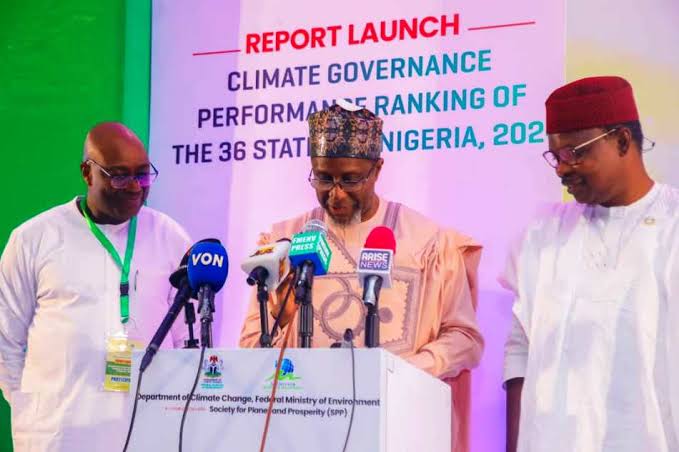
The Federal Government has reaffirmed its commitment to strengthening climate change governance and implementation across Nigeria through the third edition of the Subnational Climate Governance Performance Rating and Ranking Report.
The Minister of Environment, Malam Balarabe Lawal, stated this at the presentation of the report in Abuja on Thursday.
Lawal said climate change had become a development, economic, social and security imperative, with its effects increasingly evident through flooding, extreme heat, drought, food insecurity, pressure on water resources, infrastructure damage and disruption of livelihoods.
States Critical to Climate Action
The minister said Nigeria’s climate commitments could not be delivered by the Federal Government alone, stressing that effective implementation depended on stronger governance structures at state and community levels.
He urged governors to integrate climate priorities into development plans and budgets, mobilise climate finance, strengthen relevant institutions and develop bankable projects capable of delivering measurable adaptation and mitigation outcomes.
Lawal also encouraged states to use the ranking as a management and accountability tool while urging communities, women, young people, farmers, businesses and vulnerable groups to participate actively in building climate resilience.
Report Links National Policy to State Action
The Director-General of the National Council on Climate Change, Mrs Omotenioye Majekodunmi, said the rating report was designed to strengthen climate governance, accountability and coordinated action across different levels of government.
Majekodunmi said the report links national climate policies with implementation at state level, while identifying gaps and encouraging stronger institutions, financing arrangements and systems for delivering climate action.
She urged governors to mainstream climate change considerations into state development plans, projects and investments.
She also called on development partners and the private sector to support implementation efforts aimed at promoting inclusive low-carbon development.
Five States Record More Than 80 Per Cent
Prof. Chukwumerije Okereke, President of the Society for Planet and Prosperity, presented the rationale and methodology used for the ranking.
Okereke said the assessment measures governance, policies, implementation, resource mobilisation and visibility using verified evidence.
According to him, the exercise is intended to encourage states to improve climate action, learn from one another and strengthen their ability to attract climate-related funding.
He said the third edition recorded broad improvement, with five states scoring above 80 per cent.
“Climate implementation carries the highest weight, while timely submissions earn bonus points for breaking verified-score ties,” Okereke said.
He urged participants to provide feedback that could help improve future editions of the ranking and strengthen the learning process.
Katsina Moves to First Place
Prof. Mohammed Alamin, Katsina State Commissioner of Environment and Special Adviser on Climate Change, said the state had risen from 24th position to second and subsequently to first position in the ranking.
He attributed the improvement to a deliberate and gradual approach to climate governance, supported by programmes aligned with global climate agendas, national priorities and effective governance.
Alamin said climate-related challenges could contribute to wider socio-economic problems, including banditry and farmer-herder conflicts.
He argued that addressing climate change could therefore contribute to improved security, youth and women empowerment and broader development.
Commissioners Pledge Stronger Climate Action
Dr Nura Ibrahim, Chairman of the Environment Commissioners Forum, said state commissioners remained committed to climate action, environmental protection and ecosystem conservation.
He pledged stronger efforts to improve states’ performance in future editions of the subnational climate governance ranking.
Katsina Leads, Abia and Kano Follow
The third edition of the ranking placed Katsina State first, Abia second, Kano third, Lagos fourth and Kwara fifth.
The results highlight differences in the pace of climate governance and implementation among states, while also providing a framework for governments to identify areas requiring stronger policy, financing and institutional action.
For Nigeria, the central challenge now extends beyond producing climate policies to ensuring that those policies translate into funded projects, measurable outcomes and practical resilience for communities facing flooding, drought, heat, environmental degradation and livelihood disruption.
Atlantic Reports: Voices. People. Facts.
Written by
Atlantic Reports Admin
Comments
- Be the first to comment.