GenScan AI Founder Seeks Funding to Advance MRI Technology in Nigeria
By Atlantic Reports
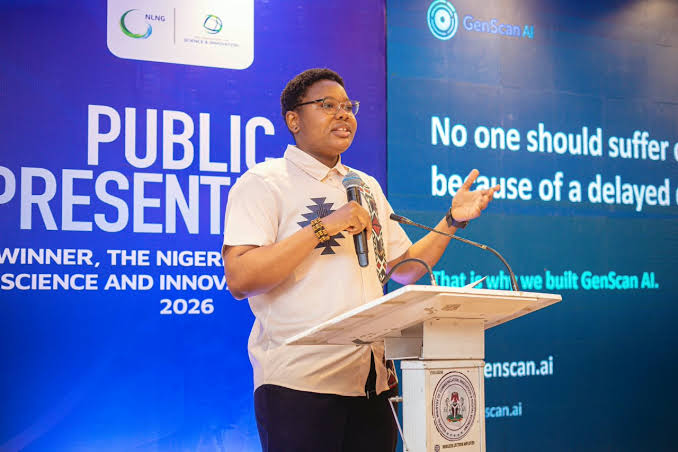
The founder of GenScan AI, Mary-Brenda Akoda, has called for increased funding and institutional support to bring her artificial intelligence-powered medical imaging technology into Nigerian hospitals.
Speaking at a news briefing in Lagos on Sunday, Akoda said insufficient support for clinical adoption could leave Nigerian patients waiting for access to an innovation developed locally.
The AI research scientist, who won the 2026 Nigeria Prize for Science and Innovation, carrying a $100,000 award sponsored by Nigeria Liquefied Natural Gas Ltd., said her immediate priority was moving GenMRI from research validation to clinical use.
That transition, she explained, requires investment in further studies, partnerships with healthcare institutions and regulatory compliance.
“We find ourselves constrained by having to first deploy elsewhere and then have our own home country, Nigeria, as an afterthought,” she said.
“There is the need for partners willing to support clinical adoption in Nigeria.”
Research Results Require Further Clinical Testing
Akoda said GenMRI could reduce Magnetic Resonance Imaging (MRI) scan times by up to 90 per cent, potentially allowing hospitals to examine more patients with their existing scanners.
According to her, the technology has been validated using more than 8,800 MRI images and achieved up to 99.7 per cent similarity to conventional images.
She also reported that an early blinded assessment by a consultant radiologist at Buckinghamshire Healthcare NHS Trust in the United Kingdom found the generated images diagnostically equivalent to conventional scans in all cases assessed.
These findings were presented by Akoda. The briefing did not specify the number of cases included in the radiologist’s assessment or provide detailed study results. Image similarity alone does not establish diagnostic performance across different conditions and clinical settings.
Akoda acknowledged that further clinical studies and regulatory approvals were necessary before GenMRI could be deployed for routine patient care.
She said she was working with clinical partners in Nigeria, the United Kingdom, the United States and Kenya to expand validation across different body regions and healthcare settings.
Funding and Hospital Partnerships Needed
The researcher identified the Gates Foundation, Development Innovation Ventures Fund and Global Innovation Fund as potential sources of support. She did not announce funding commitments from the organisations.
Akoda said the Ministry of Education had directed that clinical pilots be facilitated, while discussions with relevant healthcare stakeholders were ongoing.
She argued that shorter scans could help hospitals reduce waiting times and expand diagnostic capacity without immediately purchasing additional MRI equipment.
According to her, high-quality MRI scanners can cost between $1.5 million and $3.5 million or more, making equipment expansion difficult for healthcare providers.
Whether GenMRI delivers those anticipated benefits will depend on further clinical validation and its performance in hospital settings.
Personal Loss Behind the Research
Akoda said the death of an elderly loved one following a stroke prompted her interest in using AI to address delays in medical diagnosis.
The experience, she explained, led her to investigate how technology could help healthcare professionals improve diagnostic efficiency and overcome service constraints.
“I don’t believe that innovations should remain on paper. The whole idea of a healthcare innovation is that it eventually transforms the lives of the people who need it most,” she said.
She also called for closer collaboration between AI scientists and clinicians, stressing that medical technologies should respond to actual healthcare needs.
Akoda said she was targeting deployment in the second half of 2027, subject to funding, successful clinical validation and regulatory approval.
For Nigerian patients, access remains central to that ambition. She urged government institutions, healthcare providers and development partners to support the process, saying the technology’s ultimate value would depend on reaching the people who need it.
Atlantic Reports: Voices. People. Facts.
Written by
Atlantic Reports Admin
Comments
- Be the first to comment.