Katsina Health Workers Declare Seven-Day Warning Strike Over Pay
By Atlantic Reports
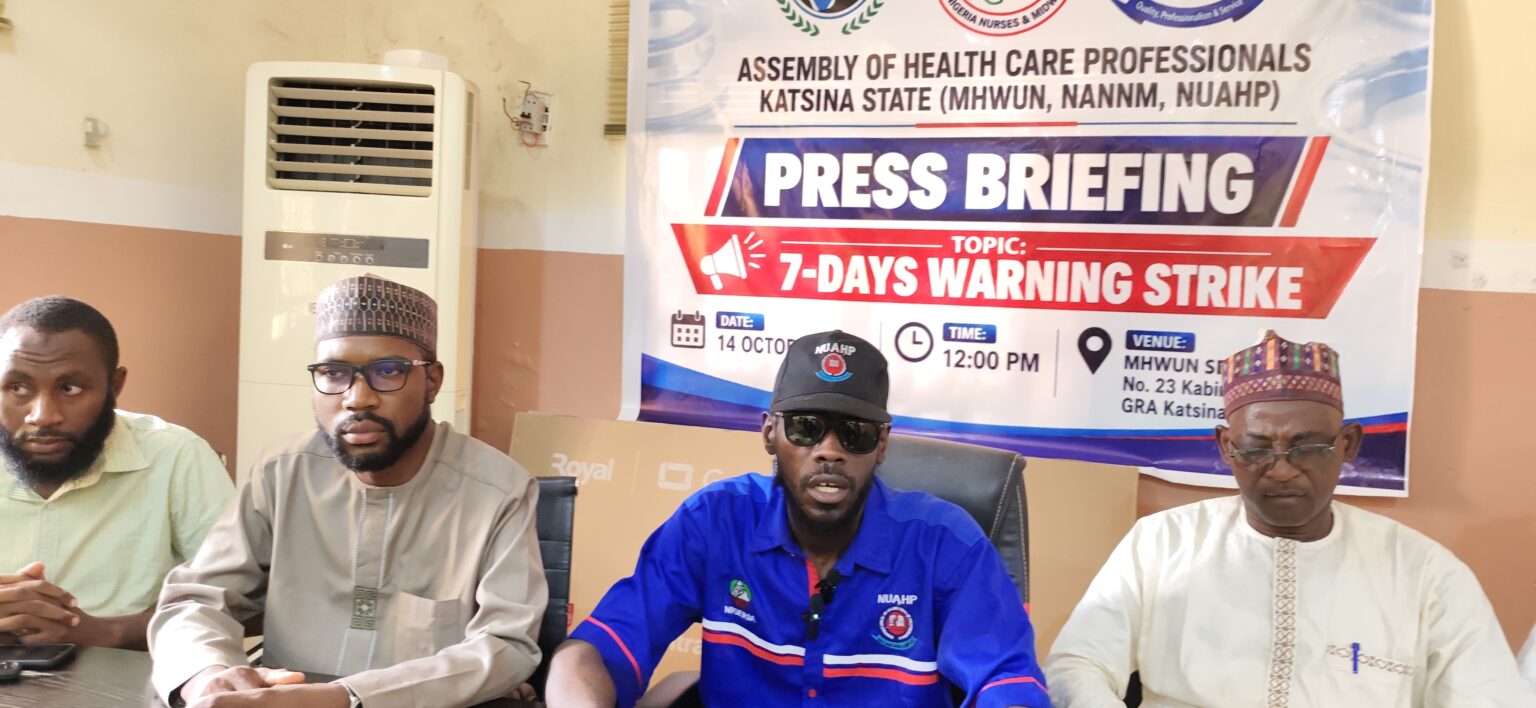
Healthcare workers in Katsina State have declared a seven-day warning strike over unresolved demands for improved allowances and salary adjustments, raising concerns about access to care in affected public facilities.
The Chairman of the Assembly of Healthcare Professionals, Ibrahim Balange, announced the decision on Wednesday, saying the strike would commence at midnight on October 14.
The assembly comprises the Medical and Health Workers Union of Nigeria (MHWUN), the National Association of Nigerian Nurses and Midwives (NANNM), and the National Union of Allied Health Professionals (NUAHP).
Balange said a seven-day strike notice issued to the state government on October 7 expired without a satisfactory resolution.
Dispute Over Salary Implementation
According to Balange, the dispute began in 2024 when the state government indicated plans to review healthcare workers’ allowances in line with those paid in federal institutions.
He alleged that workers were subsequently shortchanged during minimum wage implementation, saying their payments differed from the salary table approved for them.
A committee established to examine the complaints submitted recommendations in March 2025, he said, but those recommendations had yet to be implemented.
Balange said subsequent discussions with the Office of Public Service Reform produced an offer covering 10 per cent of the difference between state workers’ salaries and those of their federal counterparts.
The assembly rejected the offer and issued a three-week ultimatum, later extended by one week to allow further engagement.
He said plans to begin a strike on September 7 were suspended after stakeholders intervened and assurances were given that the concerns would be addressed.
Workers Seek Greater Adjustment
Balange said the assembly was later informed that the governor had approved a 15 per cent increment. He described this as only five percentage points above the earlier offer.
He also criticised the process, saying the assembly was not involved in preparing the adjustment table or determining the increase before it was communicated to members.
The precise basis of the reported 15 per cent adjustment was not explained in the account, leaving unclear how it would translate into individual workers’ pay.
Balange said the assembly wanted full implementation of the allowances and salary structure applicable in federal healthcare institutions, but had offered to accept 75 per cent implementation as a compromise.
“Some of our members have not even agreed to 75 per cent, but we have to look at the matter holistically and consider how to move forward,” he said.
Patient Access and Further Negotiations
Balange warned that remuneration disparities could weaken the state’s ability to retain healthcare professionals. He said Katsina had previously been regarded as offering relatively attractive employment conditions for health workers.
The assembly remained open to negotiations, he said, but wanted an improved offer that addressed its members’ concerns.
The announcement did not specify which facilities would be affected or whether emergency and other essential services would continue during the strike. Those details are important for patients who depend on public healthcare.
The account did not include the state government’s explanation of the salary adjustments or its position on the outstanding demands.
Balange said the assembly would reconvene after the warning strike to assess the outcome and decide its next steps. Failure to reach an agreement could lead to an ultimatum for an indefinite strike, he warned.
He apologised to the public for the inconvenience the action might cause, while maintaining that it was intended to protect workers’ welfare and professional interests.
Atlantic Reports: Voices. People. Facts.
Written by
Atlantic Reports Admin
Comments
- Be the first to comment.