NADDC Urges Local Manufacturing to Shape Nigeria’s Automotive Future
By Atlantic Reports
Nigeria’s automotive ambitions must extend beyond imported vehicles and assembly plants to the local production of components, technical skills and home-grown innovation, the National Automotive Design and Development Council (NADDC) has said.
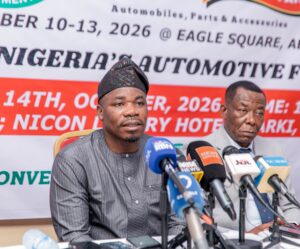
The council’s Director-General, Joseph Osanipin, outlined the priorities on Wednesday in Abuja at a joint news conference with BKG Exhibitions Ltd ahead of the 26th Abuja International Motor Fair.
The fair, themed “Driving Nigeria’s Automotive Future”, is scheduled for November 10 to 13 at Eagle Square, Abuja.
“The future of our automotive industry must not be defined solely by the vehicles we import, but increasingly by what we design, manufacture, assemble and develop,” Osanipin said.
He identified economic diversification, foreign exchange conservation, employment and stronger indigenous manufacturing as potential benefits of developing the sector.
Beyond Vehicle Assembly
Osanipin said a sustainable automotive industry would require local businesses producing components, spare parts and accessories alongside vehicle assemblers.
“A strong automotive industry cannot depend on vehicle assembly alone, hence, the need for local suppliers of components, spare parts and accessories,” he said.
He listed the council’s priorities as local content development, support for assembly and component manufacturing, research, technical training and investment in emerging automotive technologies.
For Nigerian enterprises, that agenda points to opportunities across the supply chain, including parts production, maintenance and after-sales services. However, the briefing did not specify new funding commitments, production targets or timelines for expanding local manufacturing.
New Technologies, Safety and Skills
Osanipin said NADDC was preparing Nigeria for electric mobility, alternative fuels and battery technology. He also described compressed natural gas (CNG) as an opportunity for affordable and efficient transport.
He stressed that CNG adoption must be supported by safety standards, technical training, quality assurance and public education.
The council’s position places skilled personnel and consumer confidence alongside investment as requirements for developing the industry.
Osanipin said young Nigerians should be equipped to participate as technicians, engineers, innovators, manufacturers and business leaders. He urged companies attending the fair to explore internships, partnerships and knowledge transfer.
He also called for reliable products, qualified personnel and responsible after-sales support to build public confidence in Nigerian-made and assembled vehicles.
A Marketplace for Investment
Osanipin urged manufacturers, assemblers, financial institutions and technology companies to consider investment in assembly, component production, automotive technology and after-sales services.
He said the fair was expected to connect local manufacturers with international brands, promote local content and create opportunities for small and medium-sized enterprises.
“Nigeria has the potential to become a stronger automotive manufacturing and mobility hub in Africa and this will require deliberate investment and sustained collaboration,” he said.
BKG Exhibitions Chairman Ifeanyichukwu Agwu described the automotive sector as a network of industries and services extending beyond vehicle production.
“When a nation builds a strong automobile industry, it does not build only vehicles. It builds industries around industries,” he said.
Agwu identified steel, rubber, batteries, finance, insurance, logistics and repairs as parts of that network.
He said the fair would serve as an automotive marketplace and a platform for policy engagement, bringing together manufacturers, assemblers, distributors, component producers, financial institutions, fleet owners, state governments and investors.
Both speakers called for closer cooperation between government and businesses. The practical test will be whether the fair produces commitments that translate into local production, training opportunities and dependable services for vehicle owners.
Atlantic Reports: Voices. People. Facts.
Written by
Atlantic Reports Admin
Comments
- Be the first to comment.