NCPWD: Persons with Disabilities Can Determine 2027 Outcome
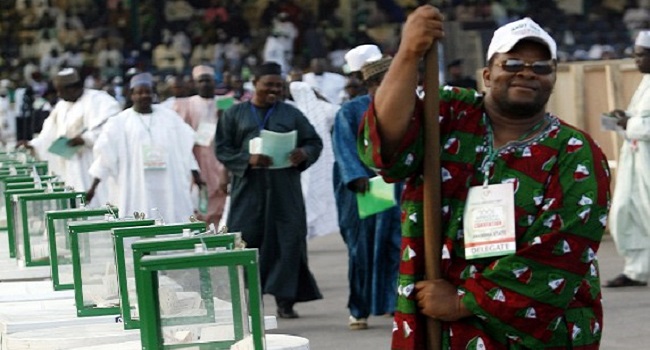
The Executive Secretary of the National Commission for Persons with Disabilities (NCPWD), Mr Ayuba Burki, says Persons with Disabilities (PWDs) possess the numerical strength to determine the outcome of elections in Nigeria.
Burki noted that PWDs, currently estimated at 35.5 million, could sway the results of any electoral contest if fully mobilised on election day.
He made the remarks during a National Strategy Engagement session with executive members of the Joint National Association of Persons with Disabilities (JONAPWD) and Organisations of Persons with Disabilities (OPDs) in Abuja on Wednesday.
Burki pointed out that while Nigeria's population stands at approximately 250 million, PWDs account for about 35 million of those figures. "This is a very commendable event, and it will be an opportunity for us to brainstorm and fashion our solutions that will enable more than 35.5 million Nigerians with disabilities to fully participate. If we are fully engaged, if we can mobilise 35 million people to an election, then we will determine where the votes will swing," he said.
Mobility Barriers Remain a Key Obstacle
However, Burki identified movement restrictions on election days and the lack of assistive devices as major barriers keeping PWDs away from the ballot box. He explained that while the Independent National Electoral Commission (INEC) records consistently low voter turnout among PWDs, the root causes extend well beyond the electoral body's direct control.
"Nine out of every 10 persons with disabilities require one form of assistive device or another to function. Millions of Nigerian children, youth, and adults badly affected by polio or surviving spinal cord injuries from high accident rates remain confined to their homes because they cannot afford wheelchairs or mobility aids. When elections come, transportation and movement are restricted. Vehicles cannot move. If you are limited by mobility and confined to a wheelchair at home, that means you have been completely etched out of the electoral process," he said.
"Any Election That Excludes PWDs Is Not a Democracy" — TAF Africa Founder
In his remarks, the Founder of TAF Africa, Mr Jake Epelle, warned that any election that excludes PWDs lacks democratic legitimacy. "Any election that fails to count the voices of persons with disability is not a democracy; it is simply an exercise in exclusion," he said.
Epelle commended INEC for achieving over 96 per cent implementation of priority voting for PWDs at polling units during recent off-cycle elections, but urged the commission to replicate that success in the areas of physical accessibility and the early deployment of assistive resources — such as Braille guides and magnifying glasses — at polling units.
"Preparing for 2027 requires that we start the groundwork today. Bridge policy to polling units, ensure that assistive resources such as Braille ballot guides, magnifying glasses, and accessible voting cubicles are not merely procured, but accurately deployed and utilised at every polling unit or station on election day," he said.
Epelle also called on the National Assembly to guarantee adequate budgetary allocation for INEC's disability inclusion programmes, to enable comprehensive voter data mining and grassroots mobilisation across all 36 states and the Federal Capital Territory (FCT).
JONAPWD Calls for More Frequent Engagements
Also speaking, the National President of JONAPWD, Mr Abdullahi Usman, commended INEC for maintaining a disability inclusion policy that was itself shaped by persons with disabilities. "In Nigeria, if we are talking about ministry, department and agencies, we always remember INEC and we commend INEC in terms of inclusivity. INEC is among, or I would say the only government agency I can remember, that has a policy on persons with disabilities which is owned by persons with disabilities. What I mean is that the policy of INEC that is for the participation of persons with disabilities in electoral process," he said.
However, Usman called for more frequent strategic engagements going forward, noting that a single national strategic engagement would not be sufficient to ensure full participation of persons with disabilities in the 2027 general election.
Written by
Atlantic Reports Admin
Comments
- Be the first to comment.