Nigeria @66: Kaduna Hails Tinubu's Impact on Key Sectors
The Kaduna State Government says interventions by the Tinubu administration in infrastructure, education, healthcare, agriculture, and security have significantly impacted the lives of residents across the state.
Maiyaki said these interventions have contributed to improved transportation, expanded access to education, strengthened healthcare delivery, and enhanced agricultural productivity across the state.
Infrastructure: Major Road and Rail Projects Progressing
On infrastructure, Maiyaki said the Abuja-Kaduna-Kano Federal Highway, originally initiated under former President Muhammadu Buhari, has recorded substantial progress, attributing the renewed momentum to the contract's re-award under President Tinubu and improved security along the Kaduna-Abuja corridor. He said work is also advancing on the 19-kilometre Western Bypass and the Eastern Kaduna-Zaria Highway projects.
According to him, the 102-kilometre Kaduna-Birnin Gwari road — dilapidated for nearly three decades — is also receiving attention, serving as an important link between Kaduna and Niger, Kwara, Ogun, and Lagos states, with contractors currently working to complete it within schedule.
Maiyaki said railway projects connecting Kaduna to Kano, Dala, and Niger Republic have reached about 80 per cent completion, with work ongoing and scheduled for completion by December. He also highlighted the Kaduna Light Rail project — a 50-kilometre network connecting major parts of the Kaduna metropolis — which he said would improve transportation and ease traffic congestion across Kaduna North, Kaduna South, and other metropolitan areas.
Education: New Universities Established
The commissioner said the state has also benefited from major Federal Government interventions in tertiary education, with three institutions established or upgraded into universities across Kaduna's three senatorial districts over the past three years. These include the Federal University of Applied Sciences in Kachia and the Federal University of Petroleum in Rigachikun, while the Federal College of Education, Zaria, has been converted into a Federal University of Education — institutions expected to expand access to higher education across the southern, central, and northern parts of the state.
Healthcare: Upgrades and Expanded Services
On healthcare, Maiyaki said the former Patrick Ibrahim Yakowa General Hospital in Kafanchan has been upgraded to a Federal Medical Centre, providing tertiary healthcare services to residents of Southern Kaduna and surrounding communities. He added that the Federal Government also supported the expansion of a 300-bed specialist hospital to strengthen cancer care services in the state.
Transportation: Free CNG Buses Benefit Millions
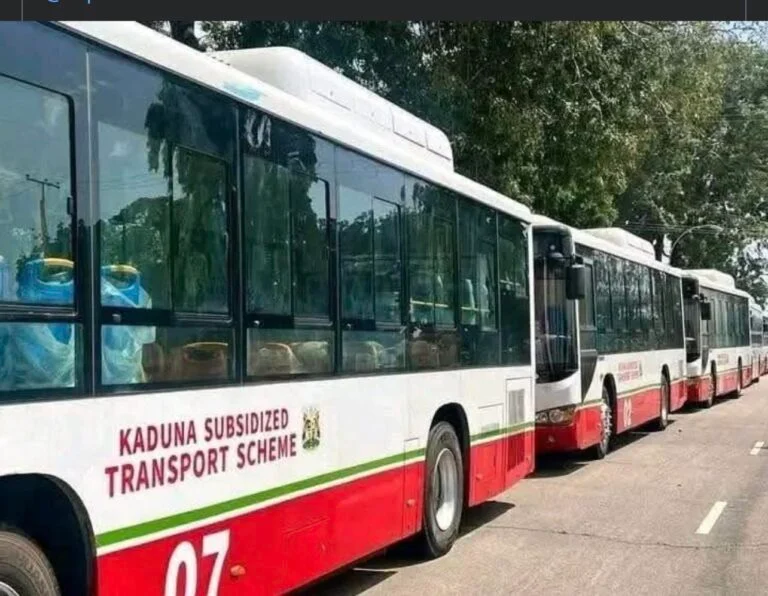
On transportation, Maiyaki said Federal Government support has strengthened Kaduna's Compressed Natural Gas (CNG) bus initiative, noting that Kaduna remains the only state offering free CNG-powered public transportation rather than a subsidised scheme. According to him, the programme transported more than five million passengers within 15 months, saving commuters over N5.2 billion. The state plans to introduce an additional 120 CNG buses following the Federal Government's new policy, expected to take effect from October.
Agriculture: Funding Surges Amid Improved Security
Maiyaki said agriculture has also received increased attention, with Kaduna's allocation rising from N1.4 billion in 2023 to over N100 billion in 2026 — a reflection, he said, of the sector's importance, given that agriculture contributes 43 per cent of the state's GDP, with about 60 per cent of residents depending on it for their livelihoods.
He disclosed that the state distributed 400 trucks of fertiliser to 100,000 farmers in 2024 and 500 trucks to the same category in 2025, with more than 600 trucks distributed to 150,000 smallholder farmers in 2026. Maiyaki added that tractors were also provided to promote mechanised agriculture and strengthen food security.
Security: Peace Model Yields Results
On security, Maiyaki said Federal Government support has strengthened the Kaduna Peace Model, particularly through intelligence gathering and increased security personnel, with President Tinubu approving 1,000 forest guards for the state to complement the military, police, and other security agencies.
According to him, improved security has enabled farmers to return to their farms and communities to regain access to essential services, with more than 500,000 hectares of farmland recovered, and over 200 schools and 150 health centres reopened. Kaduna's out-of-school children figure, he said, has also declined from a baseline of about 550,000 to approximately 187,000 — an improvement he attributed partly to enhanced security, social investment, and interventions supporting school enrolment and retention.
Maiyaki said Kaduna has not recorded an ethno-religious conflict in the past three years, crediting this to the state's early warning mechanism, which has received 75 early warning signals and responded to more than 70. He cautioned, however, that the state could not declare total victory, as disagreements could still arise among communities, though the peace architecture has contributed to improved communal relations and reduced farmer-herder tensions across the state.
Youth Development: Vocational Training Expands
On youth development, Maiyaki said Federal Government support has strengthened vocational training and skills development programmes in Kaduna, with the Federal Ministry of Education supporting curriculum development, regulation, and compliance with national standards through relevant agencies. According to him, Kaduna's vocational training curriculum has been adopted by the Federal Government as a model for skills development nationwide, with the state's vocational centres currently training youths in 14 different trades.
He added that Federal Government social investment programmes have also supported education, women's empowerment, and rural communities, with about 2.5 million people assisted in opening functional bank accounts under these interventions. School feeding programmes, he said, have encouraged parents to enrol their children and helped improve school retention.
Maiyaki also cited the partnership between the Small and Medium Enterprises Development Agency of Nigeria (SMEDAN) and Kaduna State, which provided N1 billion for empowerment initiatives, including support for 4,050 graduates of the state's vocational training programme. According to him, N810 million was provided to beneficiaries to help them establish businesses and become economically productive.
Written by
Atlantic Reports Admin
Comments
- Be the first to comment.