Africa’s Future Depends on Knowledge and Skilled Minds, Not Natural Resources, Says Ogundipe
By Atlantic Reports
Africa must place greater emphasis on education, research, innovation and leadership development rather than relying primarily on its natural resources to secure economic prosperity, Prof. Oluwatoyin Ogundipe has said.
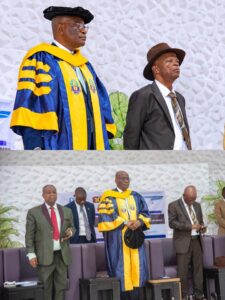
Ogundipe, Chairman of the Governing Board of the National Universities Commission (NUC) and immediate past Vice-Chancellor of the University of Lagos, made the call while delivering the 2026 convocation lecture at Anchor University, Ayobo, Lagos.
The lecture, titled “ANCHOR@10: University Education, Transformational Leadership and the Future of Africa”, examined the role of higher education and institutional leadership in shaping the continent’s development.
He argued that Africa’s future would depend less on resources such as crude oil, cobalt and cocoa than on its ability to produce knowledge, nurture innovation and develop leaders capable of responding to complex challenges.
“Our prosperity will not rest on crude oil, cobalt or cocoa. It will rest on our capacity to generate knowledge, nurture innovation and raise ethical, courageous leaders,” he said.
Universities urged to address Africa’s development challenges
Ogundipe said Africa continued to face poverty, unemployment, weak institutions, infrastructure deficits and uneven governance despite its considerable natural and human resources.
He observed that the continent remained a relatively small contributor to global manufacturing and knowledge production, while continuing to export raw materials and import finished products.
He also questioned the pattern in which African countries export skilled talent but often depend on external expertise to address development challenges.
According to him, these problems are closely connected to institutional weaknesses and leadership failures.
He maintained that universities must go beyond awarding degrees and transmitting existing knowledge. Instead, they should produce graduates equipped with critical thinking, practical skills, moral judgement and the capacity to create solutions.
He identified human capital development, knowledge generation and social and ethical formation as essential foundations for Africa’s progress.
The professor urged universities to deliberately promote moral reasoning, civic responsibility and public service among students, arguing that academic qualifications alone would not adequately prepare graduates for the demands of modern society.
Research and innovation must become university priorities
Ogundipe warned that institutions that fail to adapt to changing economic and technological realities risk becoming disconnected from the needs of society.
He called for universities to become centres of research, innovation, enterprise and technological development, where academic discoveries could be translated into practical solutions, products and employment opportunities.
He said institutions must prioritise original research rather than simply reproducing inherited knowledge.
He also stressed the importance of locally responsive education, urging universities to align their programmes with the needs, cultures and aspirations of their communities.
For Nigerian universities, this would require stronger links between academic research, industry and the wider economy.
Leadership must combine competence with integrity
Ogundipe described transformational leadership as central to institutional development, arguing that effective leaders must earn public trust through integrity and personal example.
He also highlighted the spiritual dimension of leadership, particularly the responsibility of leaders to recognise that their authority should be exercised in the service of the common good.
According to him, competence and courage must be guided by moral responsibility.
He urged Anchor University to build on its first decade by strengthening research excellence, digital transformation, industry partnerships and academic collaboration.
He also recommended structured pathways between classrooms and the workplace through internships, innovation incubators and curricula developed jointly with industry.
Partnerships with leading universities across Africa and beyond, he added, would help improve the institution’s academic visibility and research capacity.
Anchor University challenged to demonstrate community impact
Reflecting on the university’s 10-year journey, Ogundipe said the anniversary should provide an opportunity to assess what the institution had achieved, the quality of graduates it had produced and its priorities for the future.
He challenged the university to move from its founding ambitions towards becoming a recognised regional centre of excellence in teaching, research, innovation and leadership development.
He also urged the institution to ensure that its presence delivered measurable benefits to the Ayobo community, Lagos State and Nigeria.
“Anchor University need not wait a century to matter. It can matter now,” he said.
Addressing the graduating students, Ogundipe encouraged them to approach the next stage of their lives with faith, purpose and a commitment to making meaningful contributions to society.
He urged them not to see themselves merely as job-seekers but as potential agents of transformation, capable of creating value through their knowledge and abilities.
The challenge beyond the convocation lecture
Ogundipe’s address raises an important question about the practical role of Nigerian universities in national development.
While research, innovation and ethical leadership are widely recognised as priorities, achieving them requires sustained investment in academic infrastructure, reliable funding, qualified personnel, industry partnerships and an environment that supports intellectual inquiry.
For Anchor University and other institutions, the challenge will be to translate these ambitions into measurable improvements in research output, graduate employability, innovation and community development.
Africa’s natural resources remain economically important, but their long-term value will depend partly on the continent’s capacity to develop the knowledge, skills and institutions needed to process, manage and benefit from them.
Atlantic Reports: Voices. People. Facts.
Written by
Atlantic Reports Admin
Comments
- Be the first to comment.