AUST Selected to Host 5MW Solar Project Funded by African Development Bank
By Atlantic Reports
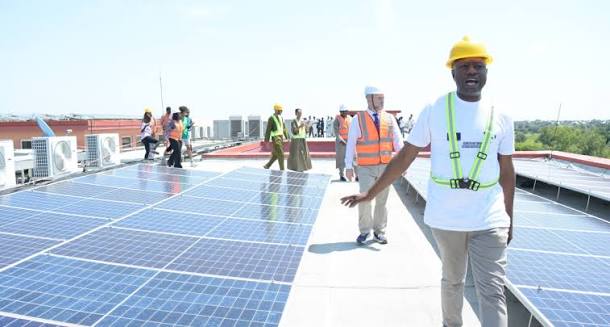
The African University of Science and Technology (AUST) in Abuja has been selected to host a proposed five-megawatt solar power project funded by the African Development Bank (AfDB) and implemented through the Rural Electrification Agency (REA).
The university’s Vice-Chancellor, Prof. Azikiwe Onwualu, announced this on Wednesday at the 43rd National Solar Energy Forum and induction of new fellows organised by the Solar Energy Society of Nigeria (SESN) in Abuja.
Onwualu said unreliable and expensive energy remained one of the biggest obstacles facing businesses and academic institutions in Nigeria, affecting productivity, campus services and learning.
He said AUST had already transitioned its student hostels to solar power and was working to expand its clean energy capacity.
“Today, all our hostels are fully on solar, and we are still moving to expand our capacity to improve campus services, security, and learning,” he said.
According to the vice-chancellor, the proposed five-megawatt project is expected to provide power to the entire campus and surrounding communities through a hybrid solar system.
However, details of the project’s implementation timeline, total cost, expected completion date and arrangements for supplying electricity to nearby communities were not provided in the statement.
Solar Power and Nigeria’s Energy Transition
The Director-General of the Energy Commission of Nigeria (ECN), Dr Mustafa Abdullahi, said solar energy would remain an important component of Nigeria’s pathway towards net-zero emissions by 2060.
Abdullahi, represented by the commission’s Director of Renewable Energy, Dr Babagana Tela, said the ECN was working to translate energy transition policies into practical action through planning, research, modelling and capacity building.
He cited the Nigeria Energy and Emission Calculator 2060 as one of the instruments supporting integrated energy planning.
According to him, expanding solar power should go beyond installing equipment to building a sustainable renewable energy sector capable of attracting investment, creating jobs and reducing dependence on fossil fuels.
He called for closer collaboration among government institutions, universities, professional bodies, private businesses, investors and development partners to advance Nigeria’s energy transition.
Experts Call for Implementation, Not More Plans
In her keynote address, Senator Uche Ekwunife said reliable, affordable and accessible energy was fundamental to national development, industrial expansion and job creation.
Ekwunife, represented by Prof. Joseph Dioha, Director of the Renewable Energy Project at Admiralty University of Nigeria, identified energy shortages as a major structural challenge facing the country.
She argued that Nigeria needed to prioritise the implementation of existing policies, given its natural energy resources and access to relevant technologies.
“Our energy demand is growing faster than generation, and today, only about 4,000 megawatts of green energy generation is available for more than 200 million people,” she said.
The figure was presented by Ekwunife’s representative and was not accompanied by a breakdown of the energy sources or the period covered.
Ekwunife also advocated decentralised electricity generation, particularly through mini-grids in rural communities. She said such systems could support small-scale industries, strengthen local economic activity and reduce the pressure on people to migrate to urban centres in search of opportunities.
The effectiveness of these interventions, however, will depend on affordability, reliable maintenance, suitable infrastructure and the ability of communities and businesses to access the electricity generated.
Solar Society Plans Free Technical Training for Youths
The President of the Solar Energy Society of Nigeria, Dr Sunny Akpoyibo, said the forum highlighted the importance of connecting academic research with investor confidence and practical renewable energy deployment.
He said hosting the event at a university underscored the role of science, innovation and locally developed research in expanding the use of Nigeria’s renewable energy resources.
Akpoyibo also announced plans by SESN to organise free post-conference training programmes nationwide to equip young people with technical skills in solar installation, maintenance and smart energy systems.
He urged stakeholders to use ongoing renewable energy interventions to strengthen local technical capacity and create employment opportunities in the growing green economy.
“The challenge before us is not the availability of resources, but how rapidly and effectively we can deploy those resources to transform lives and grow our economy,” he said.
The proposed training programmes could help address skills gaps in the renewable energy sector, although details of their schedule, locations, enrolment requirements and expected number of participants were not provided.
Project Delivery Will Determine Its Impact
The planned AUST solar project reflects wider efforts to expand renewable electricity beyond conventional power infrastructure and improve energy access for institutions and nearby communities.
Its eventual impact will depend on whether the proposed capacity is delivered, how the hybrid system is operated, and what arrangements are established for maintenance and community access.
For AUST, the project could build on its existing use of solar power in student hostels. For surrounding communities, the potential benefits will depend on the final distribution arrangements and the reliability and affordability of the electricity supplied.
The project’s implementation progress, funding details and delivery timetable will therefore be important indicators of whether the announcement translates into sustained improvements in electricity access.
Atlantic Reports: Voices. People. Facts.
Written by
Atlantic Reports Admin
Comments
- Be the first to comment.