CAN at 50: Okoh Urges Churches to Defend Justice, Democracy and Human Dignity
By Atlantic Reports
The Christian Association of Nigeria (CAN) has urged churches across the country to remain vigilant on issues of justice, human dignity, democracy, constitutionalism, peace and religious freedom, stressing that Christian faith must translate into practical service to society.
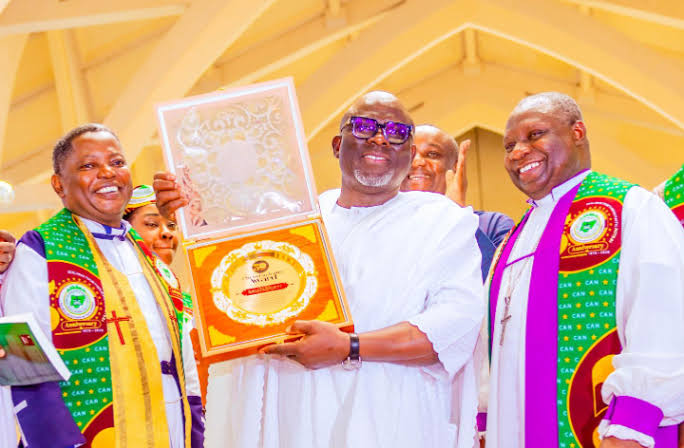
CAN President, Archbishop Daniel Okoh, made the call on Saturday in Abuja during the grand finale, thanksgiving and award ceremony marking the association’s 50th anniversary.
Speaking on the theme, “Walking Together in Faith,” Okoh said the Church had a responsibility to defend the vulnerable, scrutinise developments affecting the public interest and contribute constructively to national progress.
In his address, titled “CAN at 50: A Prophetic Voice of Hope,” he urged Christians to sustain the Church’s public voice through compassion, advocacy and practical service.
Drawing from the biblical account of the watchman in Ezekiel 33, Okoh compared the Church’s responsibility to that of a sentinel who remains alert to danger and warns the people when necessary.
He said the Church must be courageous in addressing national challenges while ensuring that its interventions are accurate, balanced, evidence-based and free from partisan interests.
Speaking for overlooked communities
Okoh said the Church had a particular responsibility to speak for people whose concerns were frequently overlooked in public discussions and policy decisions.
He identified internally displaced persons, children denied access to education, unemployed young people, rural farmers unable to reach their farmlands because of insecurity, women facing violence, communities affected by environmental degradation, victims of human trafficking and people without access to legal representation.
According to him, the living conditions of vulnerable citizens should remain central to the Church’s mission.
He argued that religious commitment could not be separated from practical responses to human suffering, calling on churches to combine prayer with service and advocacy.
The challenge, he said, was not simply to speak about national problems but to ensure that the Church’s interventions contributed meaningfully to addressing them.
Fifty years of Christian cooperation
Reflecting on CAN’s history, Okoh paid tribute to the association’s founding leaders, who established the organisation in August 1976 to provide Christians in Nigeria with a common platform.
He said successive generations of Christian leaders had worked to manage differences among religious traditions while advancing shared concerns, including religious freedom, justice, good governance, corruption, insecurity, humanitarian assistance and national development.
He also noted that past and present CAN leaders had engaged political leaders and government officials on issues affecting the common good.
Okoh described the Golden Jubilee theme as a reminder of the importance of unity and collective responsibility, urging Christians to preserve the relationships built over the past five decades.
He acknowledged that the association had faced suspicion, differences and marginalisation among some Christian traditions in its early years, but said continued engagement had helped strengthen cooperation.
The association comprises five major blocs: the Catholic Secretariat of Nigeria; the Christian Council of Nigeria; the Pentecostal Fellowship of Nigeria and the Christian Pentecostal Fellowship of Nigeria; the Organisation of African Instituted Churches; and the ECWA/TEKAN Fellowship.
Okoh described the coming together of diverse Christian traditions under one ecumenical platform as a significant achievement in the association’s history.
Church and state should engage critically
On relations between religious institutions and government, the CAN president advocated what he called critical collaboration, rather than hostility or unquestioning submission.
He said churches should cooperate with government where doing so advances the public interest, commend responsible governance and challenge authorities when justice demands it.
He also stressed that such engagement must not compromise the Church’s independence.
The position places accountability at the centre of church-state relations, with religious institutions expected to assess government actions on their merits rather than align themselves automatically with political interests.
Okoh urged political leaders to govern responsibly, respect the Constitution, account for public resources, protect citizens, listen to their concerns and strengthen national institutions.
He said the government’s obligations extended beyond political promises to the practical protection of citizens and the welfare of vulnerable communities.
Younger generation urged to preserve unity
Okoh called on younger Christians and future leaders to protect the unity of the association and resist divisive tendencies that had challenged the Church in the past.
He said the next 50 years should be characterised by a more informed, courageous, evidence-based and constructive public voice.
For CAN, that responsibility includes sustaining Christian unity while engaging national issues with integrity and a clear commitment to the common good.
The association’s future influence will depend not only on its ability to maintain cooperation among its member blocs but also on how effectively it translates its stated principles into sustained community service and credible public advocacy.
Hope must be matched with action
Concluding his address, Okoh expressed confidence in Nigeria’s future but warned that hope required responsibility and practical effort.
He said prayer should be accompanied by positive action, faith by integrity, leadership by accountability, and freedom by responsibility.
He urged the Church to pray for Nigeria and its leaders, speak out on national concerns, serve communities and contribute to healing divisions within society.
The Golden Jubilee ceremony also featured the presentation of awards to individuals recognised for their contributions to the Church and the nation.
As CAN marks five decades of existence, Okoh’s message placed renewed emphasis on the relationship between Christian unity, public accountability and the everyday realities facing Nigerians.
Atlantic Reports: Voices. People. Facts.
Written by
Atlantic Reports Admin
Comments
- Be the first to comment.