COP31: Climate Advocacy Group Demands Local Control of Climate Finance and Decisions
By Atlantic Reports
A Nigerian youth-led climate advocacy organisation, Connected Advocacy, has called on governments, international financial institutions and development partners to give frontline communities greater control over climate funding and decision-making.
The organisation warned that global climate commitments could fail to deliver meaningful results if communities directly affected by environmental challenges remain excluded from planning and implementation.
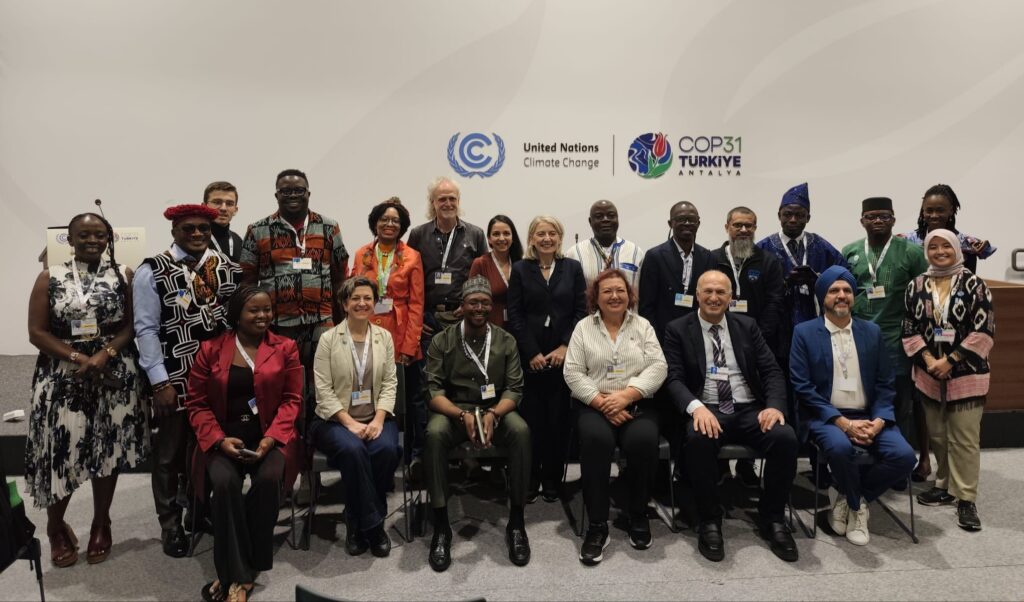
The call was made during a high-level side event organised through its Global Localisation Forum at the 31st United Nations Climate Change Conference (COP31) in Antalya, Türkiye.
The forum, themed “The Global Localisation Forum: Fixing Gaps in the Implementation of Climate Disaster Response and Energy Democracy”, brought together community leaders, civil society organisations, researchers and climate advocates.
Communities demand a stronger role
Connected Advocacy argued that communities bearing the consequences of climate change often have limited influence over decisions concerning funding and environmental interventions, despite contributing relatively little to the causes of the crisis.
It identified coastal erosion, rising sea levels, flooding, ocean pollution, biodiversity loss, displacement and energy poverty as growing threats to vulnerable populations.
The organisation called for climate policies to move beyond international declarations and provide local communities with the financial resources and authority needed to implement solutions.
“Localisation must move beyond policy language. It must become a practical framework that transfers resources, authority and accountability to the people and institutions closest to the challenges,” the statement said.
Climate finance must reach grassroots organisations
Five sessions at the forum examined barriers to locally led climate action, including access to climate finance, disaster response, community protection, energy democracy and the implementation of international environmental agreements.
At a session on climate finance, Prof. Giuliana Battisti of Warwick Business School and the Circular Economy Powered Renewable Energy Centre discussed obstacles preventing local organisations and community actors from accessing funding.
Gloria Majiga of Tax Justice Network Africa examined climate tax justice, innovative financing and the need to address illicit financial flows.
Participants argued that climate finance should be accessible, flexible, predictable and sufficiently long-term to allow communities to develop and expand locally designed solutions.
The discussions also highlighted the importance of directing funding to grassroots organisations rather than relying exclusively on centralised funding structures.
Traditional knowledge and community resilience
His Royal Majesty Fon Ngum IV, Paramount Ruler of the Oku Kingdom in Cameroon, emphasised the value of Indigenous, traditional and community knowledge in environmental protection and climate governance.
Experiences from frontline communities were also presented by Sema Genel Karaosmanoğlu, founder of Support to Life in Türkiye, and Qarnar Igbal of Climate Alliance Pakistan and the Charter for Change Advocacy Working Group.
They highlighted the role of local communities as first responders to climate-related emergencies, despite often having limited access to financial resources and formal decision-making platforms.
For coastal communities, the discussions are particularly relevant to livelihoods threatened by erosion, flooding, marine pollution and changes affecting fisheries and other ocean-based economic activities.
Energy transition must include communities
Another session examined clean-energy access, community-led renewable energy and public participation in energy-transition planning.
Speakers included Yomar Elmawi of the Africa Movement of Movements, Seruni Salsabila of the United Nations Industrial Development Organisation's Energy and Climate Action Youth Advisory Group, and Gunter Hermeyer, Senior Campaign Manager for Nuclear Power Is Not the Answer.
Drawing on experiences from Africa, Indonesia and Germany, they discussed the importance of involving communities in decisions about energy systems and the transition to cleaner sources.
The forum argued that energy policies should be developed with communities rather than imposed on them, particularly where decisions affect household energy costs, livelihoods and access to electricity.
Five calls to action
Presenting the forum's five calls to action, Prince Israel Orekha, a RISE UP Fellow, urged the international community to ensure that climate finance reached grassroots organisations and community-led initiatives.
The demands included:
-
Directing climate finance to local organisations and community-led projects.
-
Accelerating emissions reductions and supporting an equitable transition away from fossil fuels.
-
Strengthening protection for oceans, coastal environments and livelihoods.
-
Giving greater recognition to gender justice in climate policies.
-
Translating international environmental agreements into measurable national and subnational actions that reflect community priorities.
The organisation also advocated a co-creation approach in which communities participate in identifying problems, designing policies, developing budgets and sharing decision-making responsibilities.
Building a platform for local climate action
Connected Advocacy said the Global Localisation Forum was intended to establish a coordinated platform linking frontline communities, civil society organisations, governments, development partners, researchers, youth movements and international institutions.
The proposed platform would support collective learning, cooperation and advocacy for locally led climate solutions.
Its central message was that communities should not merely be consulted after decisions have been made. They should have meaningful influence over the priorities, funding and implementation of projects affecting their lives.
From international commitments to local results
The forum's demands raise an important question for governments and climate finance institutions: how much funding actually reaches the communities expected to implement climate solutions?
Greater local participation will require more than consultations. It will depend on transparent funding arrangements, clear accountability systems, institutional support and the capacity of community organisations to manage projects.
For vulnerable coastal and rural populations, the impact of climate commitments will ultimately be judged by whether they translate into practical protection, resilient livelihoods, reliable energy access and stronger local economies.
Connected Advocacy for Empowerment and Youth Development Initiative works on inclusive democratic leadership, climate and energy justice, environmental protection, community resilience and sustainable development, with a focus on the participation of young people, women and underserved groups.
Atlantic Reports: Voices. People. Facts.
Written by
Atlantic Reports Admin
Comments
- Be the first to comment.