COP31: Environmental Groups Demand Community Control and Corporate Accountability in Energy Transit
By Atlantic Reports
The Health of Mother Earth Foundation (HOMEF) and Oilwatch Africa have called for stronger corporate accountability and meaningful community participation in the global transition to cleaner energy.
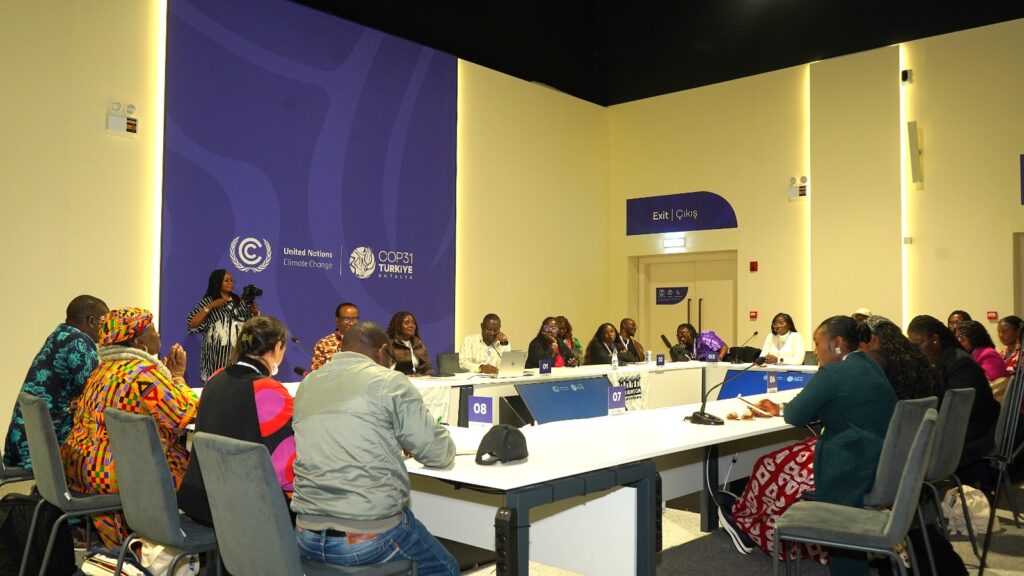
The organisations made the call during an engagement on accountability in the just transition process at the 31st United Nations Climate Change Conference (COP31) in Antalya, Türkiye.
The discussion examined the responsibilities of governments, corporations, civil society organisations and other stakeholders in ensuring that the shift away from fossil fuels protects affected communities, workers and their livelihoods.
Participants questioned whether the transition could genuinely be considered just if communities lost control of their natural resources while corporations gained new commercial opportunities.
Concerns over corporate influence
The organisations warned that corporations and industries responsible for pollution were increasingly shaping the just transition agenda in ways that could protect commercial interests rather than address the concerns of affected communities.
Participants called for a people-centred approach that recognises the connections between communities, their environment, cultural identity, livelihoods and natural resources.
They argued that communities affected by environmental degradation and extractive activities must have a meaningful role in deciding how their territories and resources are managed.
The forum also raised concerns about the exclusion of informal sector workers from transition planning, particularly in discussions about alternative livelihoods, compensation and social protection.
Governments and companies face accountability demands
Participants identified governments and parliaments as key institutions responsible for protecting citizens, managing natural resources in the public interest and ensuring that corporations are held accountable for environmental and social damage.
Civil society organisations were encouraged to strengthen advocacy and monitoring, while trade unions were urged to defend workers' rights and build stronger alliances with affected communities.
The forum also called for transparency, access to information and meaningful public participation in decisions affecting local communities.
It stressed that companies responsible for environmental damage should provide remediation, compensation and livelihood restoration rather than abandon communities after extracting resources or withdrawing from projects.
Fishing communities highlight the cost of transition
Nigerian environmentalist and climate justice advocate Patricia Achakpa drew attention to the experiences of fishing communities in Sanriku, Japan, to illustrate how environmental and economic restrictions can disrupt traditional livelihoods.
She argued that communities affected by such changes should receive appropriate compensation and support.
Achakpa also emphasised the importance of including women, young people and children in transition planning.
She called for policies that reflect the experiences of women, persons with disabilities and older people, adding that women's participation should extend beyond consultation to include real influence over decisions and access to resources.
Lessons from Ecuador's anti-oil campaign
Ecuadorian environmentalist and climate justice activist Yvonne Yanez highlighted the Yasuní Initiative and the broader Yasunize campaign as examples of alternatives emerging from the experiences and demands of communities affected by oil extraction.
She said the campaign was rooted in community experiences rather than imposed by external organisations.
The discussion also questioned climate frameworks that allow continued fossil fuel extraction and carbon trading while presenting themselves as solutions to the climate crisis.
Participants argued that climate action must address the underlying systems responsible for environmental destruction rather than simply create new commercial opportunities.
HOMEF advocates a different development model
Dr Nnimmo Bassey, Executive Director of HOMEF, introduced the concept of the "Good Life" as an alternative vision of development built around ecological balance, human dignity, cultural values and community wellbeing.
He argued that a genuine transition should prioritise sustainable living and harmony with nature instead of placing economic growth, consumption and financial accumulation at the centre of development.
Bassey called for an end to destructive extraction, restoration of damaged ecosystems and a fundamental shift away from development models that depend on intensive exploitation of natural resources.
Communities must shape the transition
The engagement concluded with calls for stronger community education, enforceable corporate accountability mechanisms, workers' rights protection and increased support for locally driven solutions.
Participants urged governments to reconsider continued fossil fuel expansion and promote development policies that prioritise community control of natural resources and ecological restoration.
The central message was that a just transition must involve more than replacing one energy source with another. It must also address the economic, political and social inequalities that leave some communities exposed to environmental damage while others benefit from resource extraction.
For communities across Africa, particularly those whose livelihoods depend on land, rivers, forests and coastal ecosystems, the debate has direct implications for employment, food security, cultural identity and access to natural resources.
Whether these demands influence climate policies and investment decisions will be an important measure of the global transition's commitment to social and environmental justice.
Atlantic Reports: Voices. People. Facts.
Written by
Atlantic Reports Admin
Comments
- Be the first to comment.