Drivers Prefer CNG to Petrol Despite Long Queues, Cite 60% Cost Savings
By Atlantic Reports
Some commercial drivers operating along Niger State and Federal Capital Territory routes have expressed preference for Compressed Natural Gas (CNG) over petrol, citing lower operating costs and improved profitability.
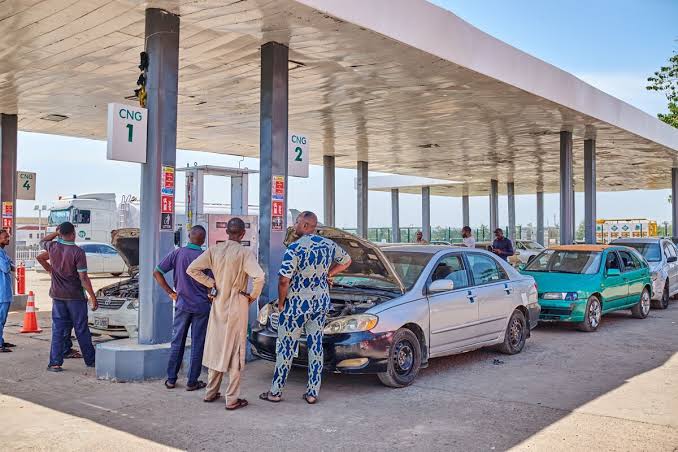
The drivers, who spoke in separate interviews with the News Agency of Nigeria (NAN) on Thursday in Madalla, Niger State, said the financial benefits of using CNG outweighed the inconvenience of spending hours in queues at refuelling stations.
One of the drivers, Mr Musa Bello, said he remained committed to CNG despite the challenges associated with accessing the product.
He claimed that using CNG reduced his daily fuel expenses by between 50 and 60 per cent per kilometre compared with petrol.
Bello said the savings had made CNG a more attractive option for his transportation business.
Another driver, Mr Michael Attah, said CNG burns cleaner than petrol and helps reduce vehicle maintenance costs.
He acknowledged complaints about long queues at CNG stations but maintained that he had no intention of returning to Premium Motor Spirit (PMS).
Conversion Costs Delay Transport Fare Reductions
Despite the reported savings on fuel, commuters are yet to see corresponding reductions in transportation costs.
A driver, Suleiman Abubakar, attributed the situation partly to the expenses involved in converting vehicles from petrol to CNG.
According to him, some drivers are maintaining existing transport fares to recover the money invested in converting their vehicles.
He expressed optimism that the financial benefits of the conversion would eventually reflect in transportation costs.
His explanation highlights an important economic consideration in the adoption of alternative vehicle fuels: savings on daily operations do not necessarily translate into immediate reductions in passenger fares, particularly when operators are still recovering their initial investments.
CNG Adoption Gains Momentum After Subsidy Removal
CNG has increasingly been promoted in Nigeria as a cheaper alternative to petrol and diesel for vehicle operations.
Its adoption gained momentum following the removal of petrol subsidies in May 2023, with the Federal Government introducing the Presidential Initiative on Compressed Natural Gas and Electric Vehicles (Pi-CNG and EV) to accelerate the transition.
The initiative seeks to leverage Nigeria's natural gas resources while encouraging the use of alternative energy sources in transportation and other sectors.
Motorists and commercial fleet operators generally use dual-fuel conversion systems that allow vehicles to operate on either CNG or petrol.
Beyond transportation, natural gas also has applications in industrial operations and power generation.
However, the expansion of CNG-powered transportation depends partly on the availability of refuelling infrastructure, affordability of vehicle conversion and public confidence in safety standards.
Technician Urges Compliance with Safety Standards
Addressing concerns about the flammable nature of CNG, a technician, Mr Sunday Christopher, said the gas had different combustion characteristics from petrol.
He maintained that proper maintenance and compliance with safety regulations were essential to preventing accidents involving CNG-powered vehicles.
Christopher explained that CNG ignites within a concentration range of approximately five to 15 per cent in air and requires a relatively high ignition temperature.
He contrasted this with petrol, which he said has a wider flammability range and can ignite more easily under certain conditions.
His comments underscore the importance of professionally installed conversion systems, regular inspections, properly maintained cylinders and adherence to prescribed safety procedures.
As more Nigerian motorists consider switching to CNG, the challenge for policymakers and operators will be to ensure that the promised savings are matched by accessible refuelling facilities, affordable conversions and reliable safety oversight.
For commuters, the ultimate measure of success will be whether lower operating costs eventually translate into more affordable and dependable transportation.
Atlantic Reports: Voices. People. Facts.
Written by
Atlantic Reports Admin
Comments
- Be the first to comment.