ECOWAS Parliament Seeks Stronger Institutional Cooperation to Advance West African Integration
By Atlantic Reports
The ECOWAS Parliament has called for stronger collaboration among regional institutions and more effective legislative oversight to address West Africa’s security, economic and governance challenges.
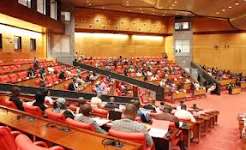
Speaker of the Parliament, Hajia Memounatu Ibrahima, made the appeal on Friday, 27 November 2026, at the opening of the institution’s 2026 Second Ordinary Session in Abuja.
Ibrahima said the growing complexity of regional challenges made it difficult for any single institution or member state to respond effectively without cooperation.
She argued that the Parliament must move beyond monitoring regional developments and strengthen its role as a political voice for citizens through greater legislative influence and oversight.
Parliament urged to strengthen accountability
The Speaker highlighted the Lungi Declaration, which reaffirmed the commitment of ECOWAS leaders to strengthening the Parliament’s legislative and oversight responsibilities.
She said sustainable integration depended on credible institutions, public trust, democratic governance, justice and respect for the rule of law.
A major item on the session’s agenda is consideration of the proposed 2027 ECOWAS Community Budget.
Ibrahima urged lawmakers to ensure that allocations reflected clear regional priorities, measurable outcomes and tangible benefits for citizens, particularly amid growing financial pressures and development demands.
She also called on national parliaments to press their governments to collect and remit the ECOWAS Community Levy systematically.
According to her, the resources contributed to the regional body represent both the financial commitment and expectations of West African citizens.
Security and trade barriers remain regional concerns
President of the ECOWAS Commission, retired Gen. Birame Diop, called for renewed regional solidarity and stronger parliamentary diplomacy to address security threats, geopolitical tensions and economic uncertainty.
He identified terrorism and insecurity in the Sahel, including their implications for coastal West African countries, as major concerns requiring coordinated regional responses.
Diop also advocated renewed engagement with international partners, particularly the United States, to strengthen security cooperation and border safety while supporting the free movement of people.
On the economic front, he said West Africa’s population of more than 400 million and its natural and entrepreneurial resources offered significant opportunities for development.
However, he maintained that the region could not fully benefit from these advantages without interconnected markets and fewer barriers to trade.
He said ECOWAS was prioritising trade liberalisation, the removal of tariff and non-tariff barriers, improved customs procedures, digitalisation and industrialisation.
The Commission is also seeking to develop regional value chains to increase production, competitiveness and economic cooperation among member states.
Diop stressed that integration must deliver practical benefits for traders, farmers, entrepreneurs, young people and ordinary citizens.
ECOWAS Court seeks stronger enforcement of judgments
President of the ECOWAS Court of Justice, Justice Charlyne Brumskine, called for closer cooperation between the Court and Parliament to improve compliance with judicial decisions across member states.
She described the two institutions as complementary, with Parliament providing political representation and the Court offering legal protection and remedies for rights violations.
Brumskine said the Court’s credibility depended substantially on whether member states complied with its judgments.
She urged lawmakers to encourage governments to enforce the Court’s decisions and domesticate ECOWAS legal instruments to improve access to justice.
She also presented the Court’s Justice 2030 strategic roadmap, which is intended to bring the institution closer to citizens, particularly women.
The Court president identified predictable funding, qualified personnel and modern infrastructure as necessary for improving judicial operations.
Among her proposals were regular institutional dialogue, periodic briefings on judicial activities and jurisprudence, and stronger parliamentary support for enforcing judgments.
Two-week session to consider regional priorities
The Second Ordinary Session will run for two weeks and include the presentation of the ECOWAS Commission president’s strategic plan and report on the state of the Community.
Lawmakers are also expected to consider country reports, parliamentary oversight reports and the proposed 2027 Community Budget.
Other scheduled issues include regional trade facilitation, the ECOWAS Mission in The Gambia and agricultural development projects. Strengthening the regional electricity market will also feature in the deliberations.
Turning regional commitments into results
The discussions reflect a continuing challenge for ECOWAS: translating regional agreements and institutional commitments into outcomes that citizens can experience.
Stronger parliamentary oversight, as proposed by the Speaker, will depend on the Parliament’s ability to scrutinise regional spending, assess implementation and hold institutions accountable.
Similarly, the effectiveness of the Court will depend not only on the quality of its judgments but also on compliance by member states. Trade integration will require practical improvements in border procedures, infrastructure and the removal of barriers that affect businesses and ordinary travellers.
The proposed 2027 budget and the issues scheduled for consideration will provide an important measure of whether regional institutions can turn their commitments into coordinated action.
Atlantic Reports: Voices. People. Facts.
Written by
Atlantic Reports Admin
Comments
- Be the first to comment.