EU, Nigeria Deepen Cooperation on Migration and Security as Brunner Meets Ministers
By Atlantic Reports
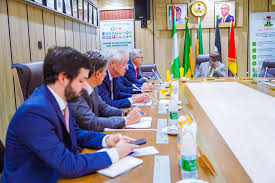
The European Union and Nigeria have taken further steps to strengthen their bilateral relationship, with European Commissioner for Internal Affairs and Migration, Mr Magnus Brunner, meeting key Nigerian ministers in Abuja to advance cooperation on migration, security and other shared priorities.
Brunner met the Minister of Foreign Affairs, Amb. Bianca Odumegwu-Ojukwu; the Attorney-General of the Federation and Minister of Justice, Mr Lateef Fagbemi; the Minister of Interior, Dr Olubunmi Tunji-Ojo; and the Minister of Humanitarian Affairs and Poverty Reduction, Dr Bernard Doro.
The meetings were disclosed in a statement issued on Wednesday by the Press and Information Officer of the EU Delegation to Nigeria and ECOWAS, Mr Modestus Chukwulaka.
Brunner's visit comes amid renewed efforts by both sides to expand their longstanding partnership, particularly following the signing of the EU-Nigeria Readmission Agreement (EURA) on Tuesday.
Readmission agreement establishes reciprocal procedures
According to the EU Delegation, the readmission agreement provides reciprocal procedures for returning individuals who do not have the legal right to remain in the territories of the parties.
Under the arrangement, EU member states can return Nigerian citizens who no longer have the legal right to remain in Europe, while Nigeria is similarly expected to facilitate the return of European nationals who meet the agreement's conditions.
The agreement applies strictly to irregular migrants and does not affect Nigerians legally living, studying or working in Europe with valid visas or residence permits.
The EU statement put the number of Nigerians legally resident in its member states at an estimated 260,000.
The distinction is important as the agreement concerns individuals without the legal right to remain, rather than Nigerians who have complied with immigration requirements.
The EU said its cooperation with Nigeria on migration management had already produced improvements through bilateral engagement and collaboration with European agencies, including Europol, Eurojust and Frontex.
It also disclosed that €66 million had recently been allocated to support new migration-related projects.
EU commits additional funding to security cooperation
Beyond migration, security cooperation featured prominently in the discussions.
The EU said it had allocated €26 million to security-related actions, including efforts to tackle the proliferation of small arms and drug trafficking.
The bloc also announced the adoption of its first bilateral assistance measure to Nigeria under the European Peace Facility.
The €20 million measure is intended to support Nigeria's counterterrorism efforts.
These funding commitments reflect the EU's growing security engagement with Nigeria, particularly as both sides seek to address threats with implications for national and regional stability.
However, the allocations represent funding commitments. The statement did not provide details of disbursement schedules, specific project beneficiaries or implementation timelines.
Global Gateway projects expand areas of cooperation
The EU Delegation said the partnership also extended beyond migration and security through the Global Gateway initiative, the bloc's framework for supporting sustainable infrastructure and investment in partner countries.
Team Europe, comprising the European Union and its member states, is implementing projects across several sectors in Nigeria under the initiative.
The delegation said bilateral relations had gained momentum following the eighth EU-Nigeria Ministerial Meeting held in Abuja in March, which was attended by the EU High Representative for Foreign Affairs and Security Policy and Vice-President of the European Commission, Kaja Kallas.
It described Nigeria's strategic position in West Africa and the wider region as an important factor in the relationship, particularly in regional economic cooperation, security, migration and trade.
The EU also highlighted its commitment to multilateralism and a rules-based international order as areas of shared interest with Nigeria.
Brunner says partnership must deliver mutual benefits
Speaking during the meetings, Brunner described Nigeria as an important European partner and said cooperation between both sides was increasingly translating into practical action.
“Nigeria is a key partner for Europe, and our ties are steadily growing stronger. Together we are turning dialogue into action.
“More security, better migration management, joining forces to bring results. We are turning the huge potential of our partnership into mutual benefit,” he said.
The commissioner said the visit provided an opportunity to review progress, advance cooperation on existing priorities and prepare for engagement in additional areas beyond migration and security.
Implementation and accountability remain important
The expanding relationship presents opportunities for Nigeria to strengthen migration management, improve security cooperation and attract support for sustainable development projects.
However, the practical impact of the agreements and funding commitments will depend on implementation, transparency and measurable outcomes.
For the readmission agreement, important considerations include ensuring that return procedures respect applicable legal protections and that individuals are properly assessed before removal.
Similarly, the effectiveness of the security funding will depend on how resources are deployed, the capacity of implementing institutions and the results achieved in tackling terrorism, arms proliferation and drug trafficking.
With an estimated 260,000 Nigerians legally resident in the EU, the distinction between regular migration and irregular migration will also remain important in public understanding of the agreement.
The latest engagements signal a broader effort by Nigeria and the European Union to turn diplomatic relations into practical cooperation across migration, security, trade and development.
Atlantic Reports: Voices. People. Facts.
Written by
Atlantic Reports Admin
Comments
- Be the first to comment.