Experts Demand Increased Funding, Accountability to Expand Family Planning Services in Nigeria
By Atlantic Reports
Health experts have called on the Federal Government and state authorities to increase funding, strengthen accountability mechanisms and improve access to family planning services across Nigeria.
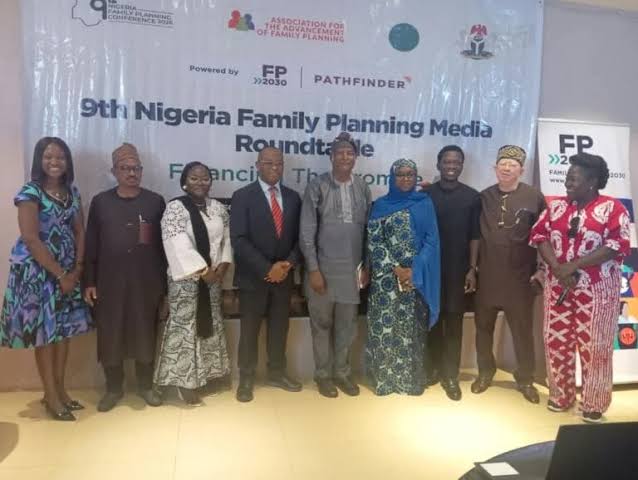
The experts made the call at a pre-conference media roundtable organised by the Association for the Advancement of Family Planning (AAFP), with support from Pathfinder International, in Abuja.
The meeting, held ahead of the ninth Nigeria Family Planning Conference, focused on sustainable financing, domestic resource mobilisation and accountability for government commitments under the theme, “Financing the Promise”.
The conference is scheduled to hold from November 30 to December 4, 2026, in Abuja, under the theme, “Securing the Future of Nigeria’s Family Planning Agenda for Sustainable Health and Development.”
Nigeria Targets 27% Modern Contraceptive Prevalence by 2030
The Chairman of the Conference Management Committee and Local Organising Committee, Dr Ejike Oji, said Nigeria needed stronger domestic financing, effective partnerships and reliable contraceptive supply chains to sustain progress in family planning.
He explained that the country's commitments under the FP2030 initiative included expanding access and choice, strengthening supply chains, improving financing and reinforcing accountability mechanisms.
According to Oji, Nigeria is targeting at least 27 per cent modern contraceptive prevalence by 2030, a goal that would require sustained political commitment and adequate financial resources.
He said family planning remained essential to informed reproductive decisions, improved health outcomes and the ability of individuals to participate fully in social and economic development.
Oji noted that the forthcoming conference would shift discussions beyond policy commitments towards practical implementation.
Key areas would include domestic resource mobilisation, innovative financing, public-private partnerships and local manufacturing of contraceptive commodities.
He added that equitable access to services, stronger data systems and accountability would feature prominently in technical sessions, policy discussions and high-level meetings.
The conference committee chairman disclosed that 546 abstracts had been reviewed, with 109 oral presentations and 200 poster presentations selected for the event.
Experts Challenge Media to Track Government Spending
Oji urged journalists to distinguish between government announcements, financial pledges, confirmed commitments, actual fund releases and measurable results when reporting family planning interventions.
He also called on media organisations to give greater attention to the experiences of women, young people, persons with disabilities, healthcare workers and underserved communities.
Similarly, the President of the Association for Reproductive Health and Family Planning (ARHF), Prof. Oladipo Oladapo, said the media had an important role in advancing Nigeria's family planning agenda.
Oladapo, a former chairman of AAFP, challenged journalists to investigate government commitments, programme implementation and funding gaps rather than relying solely on official announcements.
He warned that Nigeria's development prospects could remain constrained without deliberate efforts to address rapid population growth through improved access to reproductive health and family planning services.
He urged journalists to scrutinise domestic financing proposals and establish whether government commitments were translating into functional programmes and accessible services.
According to him, accurate reporting, sustained advocacy and constructive engagement with policymakers could improve public understanding and encourage informed decisions.
Pathfinder Calls for Reduced Donor Dependence
The Regional Portfolio Director of Pathfinder International, Dr Amina Dorayi, said Nigeria needed to reduce its dependence on external development assistance and make domestic resource mobilisation central to financing family planning programmes.
She observed that changing global development financing conditions presented an opportunity for African countries to strengthen ownership of essential health programmes through predictable domestic funding.
Dorayi stressed that domestic financing involved more than making budgetary allocations, noting that timely releases, efficient expenditure and measurable outcomes were equally important.
She called for accountability mechanisms capable of tracking family planning allocations, releases and expenditure at federal and state levels.
She also emphasised the need to establish whether contraceptive commodities purchased with public funds actually reached healthcare facilities.
Dorayi urged journalists to investigate financing commitments, document the experiences of women and healthcare workers, and sustain public attention on family planning beyond the forthcoming conference.
She described family planning as an investment in human capital, women's economic empowerment, education, household resilience and national development.
She added that development partners should support governments through research, innovation and stronger health systems, while domestic leadership remained central to sustaining reproductive health programmes.
FP2030 Advocates Dedicated Budget Lines
The Managing Director of FP2030 for West and Central Africa, Dr Alain Damiba, called for diversified funding sources and improved efficiency in the management of available resources.
He urged Nigeria to move beyond donor-dependent financing by strengthening contributions from federal and state governments, health insurance schemes, private sector organisations and domestic institutions.
Damiba specifically recommended dedicated family planning budget lines, increased funding for contraceptive procurement and stronger last-mile distribution through primary healthcare facilities.
He also identified timely budget releases, transparent procurement procedures, improved supply chain management and regular expenditure tracking as necessary measures for reducing contraceptive stock-outs.
According to him, journalists should monitor budget allocations, actual releases and expenditure, while assessing whether the funds improve contraceptive availability and access to voluntary family planning services.
He particularly highlighted the need to reach women and girls in underserved communities, where limited healthcare infrastructure and supply challenges can restrict access to reproductive health services.
Funding Commitments Must Translate into Services
The experts' concerns highlight a major accountability question in Nigeria's family planning agenda: whether financial commitments are translating into contraceptives being available and affordable at healthcare facilities.
A budget allocation alone does not guarantee implementation. Funds must be released, procurement completed and commodities distributed to facilities where women and girls can access services.
The distinction is particularly important as Nigeria pursues its 2030 contraceptive prevalence target.
The ninth Nigeria Family Planning Conference, scheduled for November 30 to December 4 in Abuja, is expected to provide an opportunity for government officials, development partners, healthcare professionals, researchers and civil society organisations to examine financing gaps and identify practical solutions.
Ultimately, progress will depend not only on the commitments announced at conferences but also on transparent spending, reliable supplies, trained healthcare workers and voluntary access to quality family planning services across the country.
Atlantic Reports: Voices. People. Facts.
Written by
Atlantic Reports Admin
Comments
- Be the first to comment.