FCT Traditional Rulers’ Wives Validate Charter to Protect Women and Girls in Abaji, Kwali
By Atlantic Reports
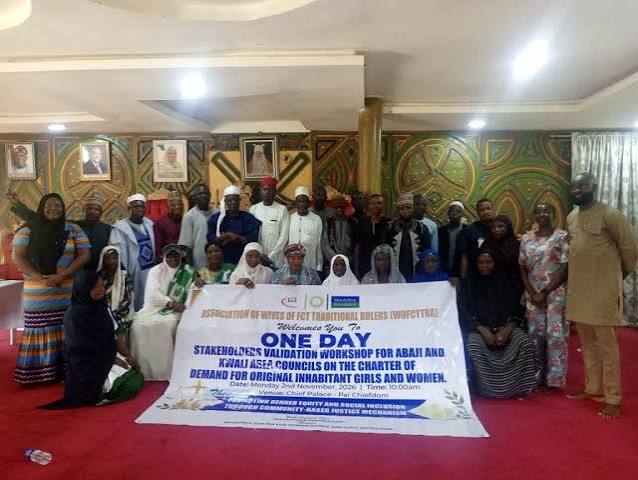
The Association of Wives of FCT Traditional Rulers (WOFCTTRA) has continued consultations with stakeholders in Abaji and Kwali Area Councils to validate a Charter of Demands aimed at strengthening the rights and protection of women and girls among the Federal Capital Territory’s Original Inhabitants.
The one-day stakeholders’ meeting was held in Abuja on Tuesday under the theme “Promoting Gender Equity and Social Inclusion through Community-Based Justice Mechanisms.”
The exercise was designed to ensure that the experiences, concerns and expectations of women and girls in the two area councils were reflected in the proposed charter.
Charter addresses violence and discrimination
The President of WOFCTTRA and Queen of Abaji Chiefdom, Hajiya Hauwa Adamu, said the charter was intended to bring together the concerns of women and girls and clearly outline their expectations from traditional institutions, government and other stakeholders.
Adamu, represented by the Queen of PAI Chiefdom, Hajiya Aisha Haruna, said consultations across communities in the FCT had identified concerns including gender-based violence, forced marriage, discrimination, economic difficulties and limited access to justice.
She urged participants to contribute actively to the validation process, stressing that the exercise should go beyond producing a document to ensure that the voices of women, girls and vulnerable groups influenced community decisions.
She identified improved protection against gender-based violence, an end to early and forced marriage, access to education for girls and greater participation of women in community affairs as key priorities.
She also called for the inclusion of persons with disabilities in efforts to promote social equity.
Traditional institution highlights education and response to abuse
The Chief of PAI, Alhaji Abubakar Sani, said education remained an important tool for protecting girls against discrimination and harmful practices.
Represented by Mr Isa Iya, known as the Iyan Pai, he said the community supported girls' education through school renovations and assistance with school fees and uniforms for children, including those from neighbouring communities.
Sani also said the traditional institution did not tolerate domestic violence, adding that complaints involving wife battering reported to the palace were referred to the police for appropriate action.
“When you beat a woman, we send you to the police station and call the police to take you to court,” he said.
He explained that complaints were expected to follow the community's traditional leadership structure, beginning with the village head before moving through the relevant traditional authorities.
WOFCTTRA seeks stronger traditional justice systems
The Programme Manager and Project and Partnership Lead of WOFCTTRA, Ms Sarah Evbotokhai, described the participation of women, girls and male community leaders in the validation exercise as an important part of the project.
She said the association had taken the consultation process to different chiefdoms despite limited resources, with the aim of ensuring that the charter reflected the experiences of Original Inhabitants' women and girls across the FCT.
Evbotokhai urged traditional rulers to use the charter to strengthen community justice mechanisms, follow up reported cases and ensure victims received appropriate support and justice.
She expressed concern that some cases had previously been suppressed within communities rather than properly addressed.
She also said traditional institutions could consider reparative justice in appropriate minor cases, while serious criminal offences should be referred to statutory authorities.
Community protection requires accountability
The validation exercise forms part of a project focused on strengthening traditional justice delivery systems to address sexual and gender-based violence, early child marriage and gender discrimination.
The project is supported by the MacArthur Foundation through the Resource Centre for Human Rights and Civic Education (CHRICED), with WOFCTTRA engaging community stakeholders across the FCT.
The proposed charter seeks to give traditional institutions a clearer framework for responding to complaints and promoting the rights of women and girls.
However, its impact will depend on whether community leaders consistently act on reported cases, protect victims from intimidation and ensure that serious offences are referred to the appropriate authorities.
For women and girls in the participating communities, the central test will be whether the commitments agreed during the consultations translate into safer environments, fairer access to justice and greater opportunities for education and participation.
Atlantic Reports: Voices. People. Facts.
Written by
Atlantic Reports Admin
Comments
- Be the first to comment.