FG Announces ₦30bn Youth and Women Fund, 10,330 Electric Vehicles for North-East
By Atlantic Reports
The Federal Government has unveiled a new package of economic and infrastructure interventions for the North-East, including a ₦30 billion Youth and Women Empowerment Fund and plans to deploy 10,330 electric vehicles across the region.
Vice-President Kashim Shettima announced the initiatives on Tuesday, November 24, 2026, in Maiduguri, reaffirming the administration's commitment to rebuilding communities affected by years of insecurity and economic hardship.
He said the empowerment fund would be implemented in partnership with the Bank of Industry (BoI), with financing targeted at micro, small and medium-sized enterprises across the region.
According to Shettima, the interventions are intended to expand economic opportunities and support the participation of women and young people in the region's recovery.
He said the North-East had endured years of insecurity without losing its determination to rebuild.
“The right to tomorrow cannot be confiscated by the violence of today or yesterday,” he said, describing the government's reconstruction programme as an effort to translate President Bola Tinubu's commitment into practical development initiatives.
Electric mobility and renewable energy expansion
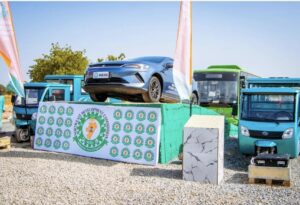
Shettima said the deployment of 10,330 electric vehicles would promote cleaner energy, reduce transportation costs and improve mobility across the six states of the North-East.
He added that the North-East Development Commission (NEDC) planned to deploy 50 megawatts of solar-powered mini-grids to improve electricity supply for businesses, healthcare facilities and communities.
The electric mobility initiative is also expected to create economic opportunities, although details of the vehicles' distribution, ownership arrangements, charging infrastructure, maintenance and deployment timetable were not provided.
Borno Governor Babagana Zulum described the programme as an opportunity to reduce transport costs, create jobs and improve livelihoods.
He said residents should become active participants in the renewable energy transition rather than merely consumers of its benefits.
Roads, bridges and public infrastructure
Providing an account of the commission's interventions, Shettima said the NEDC had constructed and rehabilitated 51 roads and 35 bridges, with additional projects ongoing.
He also reported that more than 100,000 solar streetlights had been installed under the Light Up the North-East Initiative to improve public lighting and support economic activities.
The Vice-President said reliable transport infrastructure was essential for residents to move between communities, take agricultural produce to markets and access opportunities beyond their immediate locations.
However, the scale of the reported road and bridge interventions makes project-level information important, including locations, completion status, expenditure and maintenance arrangements.
Education and healthcare investments
In education, Shettima said the commission had constructed 18 mega schools, 232 classrooms and 22 hostels, alongside interventions in 49 tertiary institutions.
He added that scholarships and bursaries had been provided to students, including orphans and vulnerable children in secondary schools.
The NEDC Managing Director, Mohammed Alkali, separately disclosed that the commission had introduced a ₦25 billion scholarship scheme for students from disadvantaged families.
The relationship between the scholarship scheme and the newly announced ₦30 billion empowerment fund was not clarified.
In healthcare, Shettima reported that the commission had undertaken 92 projects involving hospitals and specialist facilities.
He said the interventions included eight MRI and CT scan units, medical equipment and medicines supplied to tertiary healthcare institutions.
The effectiveness of these investments will also depend on the availability of trained personnel, maintenance, medical supplies and reliable electricity to keep facilities operational.
Housing, water and agricultural support
The Vice-President said more than 3,500 houses had been constructed under the commission's mass housing programme to support displaced people and vulnerable households.
He also reported the provision of more than 100 water, sanitation and hygiene facilities, alongside 1,100 solar-powered boreholes and community water supply schemes.
In agriculture, Shettima said farmers had received more than 2,000 units of machinery and equipment, while more than 38,000 bags of fertiliser had been distributed to support food production.
These interventions are particularly relevant to communities seeking to restore livelihoods after years of displacement and disruption.
Their lasting impact, however, will depend on transparent beneficiary selection, access to farming inputs, equipment maintenance and continued support for agricultural production.
Governors welcome recovery initiatives
Gombe State Governor and Chairman of the Northern Governors' Forum, Inuwa Yahaya, reaffirmed the commitment of governments at all levels to improving citizens' welfare.
He commended the Federal Government and the NEDC for their interventions, particularly the electric mobility initiative.
Zulum also described the programme as an important part of the region's reconstruction following years of insurgency.
Alkali said the commission's activities were critical to economic recovery, adding that the electric mobility programme would provide affordable transport, reduce dependence on conventional fuels and stimulate economic activity.
He assured stakeholders that public funds allocated to the commission's interventions would be accounted for.
Accountability will determine the success of the initiatives
The announcements represent a broad range of proposed and reported interventions covering transport, energy, education, healthcare, housing, water and agriculture.
However, the figures announced at the event do not, by themselves, establish how many projects have been completed, how much funding has been released or the number of people who have directly benefited.
For the ₦30 billion empowerment fund, important details include eligibility requirements, application procedures, financing conditions, beneficiary selection and disbursement timelines.
For the electric vehicle programme, the public will need information on procurement costs, distribution across the six states, charging facilities, operating arrangements and long-term maintenance.
The NEDC's assurance of financial accountability will be particularly important as the commission continues to manage a wide range of reconstruction projects.
For communities recovering from insecurity, the measure of success will ultimately be whether these investments translate into functioning infrastructure, sustainable livelihoods, better public services and improved living conditions.
Atlantic Reports: Voices. People. Facts.
Written by
Atlantic Reports Admin
Comments
- Be the first to comment.