FG Commends Zulum’s Education Investment, Describes Borno Schools as Model for Nigeria
By Atlantic Reports
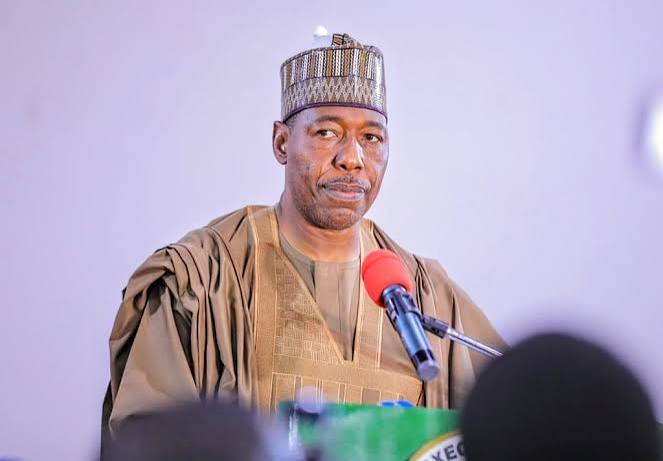
The Federal Government has commended Borno State Governor, Prof. Babagana Zulum, for sustained investment in education, describing the reconstruction and modernisation of public schools across the state as an example for other states to emulate.
The Minister of State for Education, Prof. Suwaiba Ahmad, gave the commendation on Thursday during the closing ceremony of the 70th National Council on Education (NCE) Summit in Maiduguri.
Ahmad said Borno's investment in rebuilding schools after years of insurgency represented more than infrastructure development, noting that it had helped restore dignity, hope and educational opportunities for children affected by the conflict.
She said modern classrooms demonstrated that the future of children in communities devastated by insecurity remained a priority.
“Your investment in modern schools has made Borno a model of what public education can and should be in Nigeria.
“For a child who wants a chance to learn, walking into a new classroom is more than a return to school. It is the assurance that their future has not been forgotten,” she said.
Federal Government highlights education reforms
The minister commended the Borno Government and residents for hosting the national summit, describing it as an important platform for education policymakers and stakeholders to assess existing reforms, identify challenges and develop strategies for improving learning outcomes.
She said the Federal Ministry of Education, under the leadership of Prof. Maruf Tunji Alausa, was implementing reforms anchored on evidence, accountability and measurable results under the Renewed Hope Agenda.
Ahmad stressed that the success of education policies should not be measured by the number of programmes introduced but by their actual impact on learners, teachers and communities.
She identified teachers as central to sustainable education reforms, urging governments to prioritise their welfare, professional development, motivation and capacity building.
“Without a good teacher, there is no real learning,” she said.
Borno reports 1.8 million learners
Earlier, the Borno State Commissioner for Education, Science and Technology, Prof. Lawan Wakilbe, disclosed that the state had recorded more than 1.8 million learners across formal, informal and secondary education.
Wakilbe said the state government had constructed 5,792 classrooms as part of its efforts to rebuild and expand educational infrastructure.
He also disclosed that the number of functional senior secondary schools had increased from 84 in 2019 to 129 in 2026.
According to him, Borno's education recovery strategy is driven by investments in school infrastructure, teacher recruitment and professional capacity development.
These figures highlight the scale of the state's efforts to restore educational services following years of insurgency that disrupted schooling and damaged public infrastructure.
Infrastructure and teacher motivation remain priorities
The 70th National Council on Education Summit was held under the theme, “Infrastructural Development and Teacher Motivation for Improved Learning Outcomes”.
The discussions underscored the need to combine adequate school facilities with competent, motivated and professionally supported teachers.
While the reported expansion of classrooms and senior secondary schools represents progress, the broader test of Borno's education recovery will be whether children can access these facilities, attend school consistently and achieve improved learning outcomes.
The reported enrolment figure also raises important questions about classroom capacity, teacher availability, learning materials and the distribution of educational opportunities across communities affected by insecurity.
For Borno and other states confronting educational challenges, sustainable progress will depend on ensuring that investments in infrastructure translate into better teaching, stronger learning outcomes and improved access for vulnerable children.
Atlantic Reports: Voices. People. Facts.
Written by
Atlantic Reports Admin
Comments
- Be the first to comment.