FG Defends Borrowing, Says Loans Are Funding Major Infrastructure Projects
By Atlantic Reports
The Federal Government has defended its borrowing for infrastructure development, saying funds obtained through loans are being invested in major road projects and other infrastructure intended to improve connectivity and stimulate economic activity.
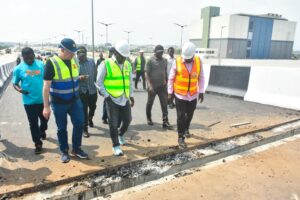
The Minister of Works, Sen. Dave Umahi, gave the explanation on Sunday during an inspection of the Lagos-Calabar Coastal Highway project in Lagos.
Responding to concerns about the purpose of government borrowing, Umahi insisted that the funds were being directed towards infrastructure investment.
“They are being used for investment in infrastructure,” he said.
He described the coastal highway as a major infrastructure project, expressing satisfaction with the construction work around Maiyegun and Jakande estates in Lagos.
“I am very proud of my country, Nigeria. I am very proud of President Bola Ahmed Tinubu. I am very proud of this legacy project,” he said.
FG highlights progress on major highway projects
Umahi also provided updates on other federal highway projects, including the 1,068-kilometre Sokoto-Badagry Superhighway, which he said was approximately 30 per cent completed technically.
He put progress on the 465-kilometre Trans-Sahara Road at about 20 per cent.
The minister added that construction was progressing on the Akwanga-Jos-Bauchi-Gombe-Biu-Maiduguri Road.
However, the figures were presented as government-reported progress estimates. The minister did not provide project-by-project expenditure figures, loan amounts or independent assessments of the reported completion levels.
These details will be important in determining how borrowed funds are being allocated and whether construction milestones are being achieved within approved budgets and timelines.
Coastal highway tolling and proposed facilities
Umahi disclosed that some bidders had expressed interest in refunding the full amount spent on the Lagos-Calabar Coastal Highway in exchange for the opportunity to operate the road as a toll facility.
He said the government was still considering the arrangements and wanted to complete additional facilities before finalising the plans.
These include closed-circuit television (CCTV) surveillance, rest areas and land for tourism facilities, factories and other commercial activities along the corridor.
The minister did not disclose the identities of the interested bidders, the proposed concession terms, the projected toll charges or the mechanism for selecting an operator.
Such details will be significant in assessing how the government intends to recover infrastructure investment while ensuring that tolling arrangements remain transparent and affordable to road users.
Government projects carbon credits and wider economic benefits
Umahi said the Federal Government expected some infrastructure projects to generate additional economic value through environmental initiatives.
He explained that the use of concrete in road construction and solar energy instead of conventional electricity could support carbon credit claims.
He also said the Sokoto-Badagry Superhighway would feature more than 67 dams intended to support electricity generation and agricultural irrigation.
According to him, the corridor would also provide opportunities for agricultural production across large areas of land, alongside proposed wind energy installations.
However, the minister did not provide details of the carbon credit assessment, expected revenue, project financing arrangements or the timelines for delivering the proposed energy and irrigation facilities.
The proposed benefits will depend on actual implementation, technical feasibility and the availability of supporting infrastructure.
Connectivity and economic development
The Senior Special Assistant to the President on Community Engagements, South-West, Mrs Moremi Ojudu, commended Umahi for inspecting bridges and highway projects.
She said the bridge under inspection would improve the movement of people and goods across parts of Lagos State.
Ojudu also urged Nigerians to support Tinubu's re-election, arguing that the administration's infrastructure programme could expand further if given another term.
Her remarks reflected the administration's political support for its infrastructure agenda.
Borrowing requires transparent accounting
The Federal Government's argument that borrowing is being invested in infrastructure raises an important public accountability question: whether the economic and social returns from these projects will justify their financing costs.
Road construction can improve transportation, reduce travel time, support trade and open up communities to investment. However, the benefits depend on timely completion, quality construction, maintenance and effective management of public resources.
For Nigerians, assessing the value of infrastructure borrowing requires clear information on the amounts borrowed, interest obligations, project expenditure, contractors, completion timelines and measurable economic outcomes.
The government has outlined its infrastructure ambitions, but transparent financial reporting and independent project monitoring will be essential to demonstrate how the borrowed funds are being used and what benefits citizens are receiving.
Atlantic Reports: Voices. People. Facts.
Written by
Atlantic Reports Admin
Comments
- Be the first to comment.