FG Enrols Additional 150,000 Trainees in TVET Programme After 87,701 Complete First Cohort
By Atlantic Reports
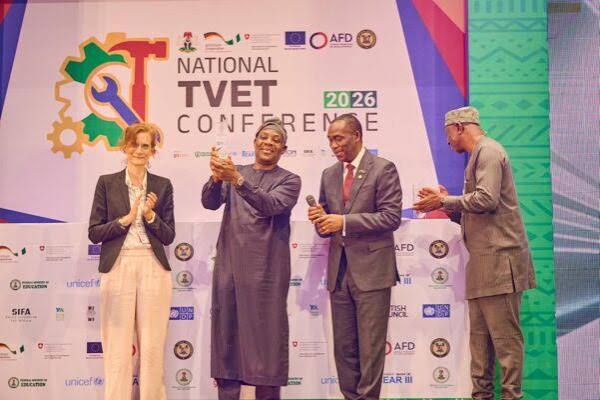
The Minister of Education, Dr Tunji Alausa, announced the development on Wednesday, November 18, 2026, during the graduation ceremony of the first cohort and the presentation of starter kits to beneficiaries in Abuja.
Alausa said the newly admitted trainees were selected from nearly 1.5 million applications received for the programme's second cohort.
According to him, the beneficiaries will undergo vocational training at 82 accredited centres across the country.
He explained that the initiative reflects President Bola Tinubu's commitment to strengthening technical education, improving youth employability and creating opportunities for self-reliance through practical skills acquisition.
The minister said the programme was designed to bridge the gap between vocational training and economic opportunities by equipping participants with relevant competencies, tools and resources to establish businesses or secure employment.
"Through the Renewed Hope Agenda, Mr President has placed aspirations of young Nigerians at the heart of our national developmental efforts.
"His support for this initiative is an investment in their capacity to earn a dignified living and help build a strong Nigeria economy," he said.
Alausa stressed that Nigeria's development depended on building a skilled workforce capable of meeting the demands of industries and society.
He noted that the country required qualified technicians, electricians, artisans and entrepreneurs to support industrial growth and economic productivity.
87,701 beneficiaries complete first phase
The minister disclosed that 87,701 beneficiaries had completed training under the first cohort, covering several vocational fields.
The areas of training included welding and fabrication, electrical installation, automobile mechanics, solar photovoltaic installation and fashion designing, among others.
He said competency-based assessments and certification processes were ongoing to ensure that graduates obtained nationally recognised skills qualifications.
According to him, the certification process would help establish the professional competence of beneficiaries and improve their opportunities in the labour market.
Starter kits to support business development
Alausa described the distribution of starter kits as a critical component of the programme, explaining that access to appropriate equipment would enable graduates to put their newly acquired skills into productive use.
He said the kits were intended to help beneficiaries establish businesses, become self-employed and contribute to economic activities within their communities.
The minister added that participants trained in areas without designated starter kits, including livestock, agricultural technology and animal husbandry, would receive equivalent financial support.
He emphasised that the success of the initiative would not be determined solely by the number of people trained but by the economic opportunities created after graduation.
"The lasting value of this initiative will be measured by what happens after training; graduates securing work, establishing businesses, improving their earnings and creating opportunities for others," he said.
He urged the graduates to use their starter kits responsibly, maintain professional standards, observe safety regulations and uphold integrity in their businesses.
Minister of State highlights programme achievements
Earlier, the Minister of State for Education, Prof. Suwaiba Ahmad, described the graduation as an important milestone in the Federal Government's efforts to reposition technical and vocational education in Nigeria.
Ahmad said the programme had demonstrated the government's capacity to provide practical training, stipends and starter kits to young Nigerians.
She recalled that when the initiative was introduced, some Nigerians had questioned its feasibility, particularly the government's ability to pay trainees' stipends, remunerate training service providers and distribute starter kits.
However, she said the programme had moved from an ambitious proposal to an operational initiative.
According to her, its structure was designed to align vocational training with industry requirements through accredited training centres and relevant curricula.
She urged the graduates to apply their acquired skills responsibly, explore employment opportunities, establish businesses and transfer their knowledge by training others.
Lawmaker urges beneficiaries to maximise opportunity
Also speaking, the Chairman of the House of Representatives Committee on Basic Education, Hon. Mark Useni, described technical and vocational education as fundamental to Nigeria's technological advancement.
Useni commended the Ministry of Education for aligning its reforms with the development agenda of the Tinubu administration.
He encouraged the beneficiaries to maximise the opportunity provided by the programme to improve their livelihoods and contribute meaningfully to national development.
Beneficiary welcomes starter kits
One of the beneficiaries, Rashidat Isah, expressed appreciation to President Tinubu for the initiative.
She said the starter kits would help improve her livelihood and provide similar opportunities for other graduates.
Questions remain over post-training outcomes
The expansion of the TVET programme represents a significant increase in the number of young Nigerians targeted for vocational training. However, its broader impact will depend on whether beneficiaries can translate their newly acquired skills into sustainable employment and businesses.
The availability of equipment, access to business financing, reliable electricity, market opportunities and continued technical support will be important to determining how much graduates benefit from the intervention.
The government will also need to demonstrate how the programme's outcomes are being monitored, particularly in relation to employment, business survival and income improvements after graduation.
With another 150,000 trainees admitted into the second cohort, attention will increasingly turn to the quality of training, the effectiveness of the starter-kit distribution and the programme's capacity to create lasting economic opportunities for young Nigerians.
Atlantic Reports: Voices. People. Facts.
Written by
Atlantic Reports Admin
Comments
- Be the first to comment.