FG Moves to Finalise Bidding for Lagos-Calabar Coastal Highway Service Lanes
By Atlantic Reports
The Federal Government is preparing to finalise the bidding process for the construction of service lanes along the Lagos-Calabar Coastal Highway, according to the Minister of Works, Sen. Dave Umahi.
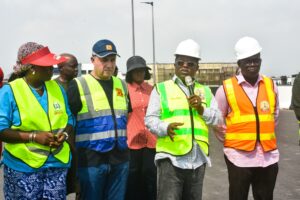
Umahi disclosed this on Sunday during an inspection of the highway project in Lagos, explaining that contractors would be invited to participate in a selective bidding process.
He said the inspection was part of efforts to complete preparations for the procurement process.
“It is going to be on selective bidding. Contractors are going to be invited to bid,” the minister said.
He added that the proposed service-lane project would include a deep drainage channel designed to convey water into the lagoon.
Umahi described the drainage infrastructure as critical to the project, saying he was in Lagos to assess the requirements before opening the bidding process.
Drainage infrastructure forms part of the plan
The proposed drainage channel is intended to address water management along the highway corridor.
However, the ministry has not provided details of the estimated contract cost, the length of the service lanes, the contractors eligible to participate or the expected construction timeline.
The selective bidding process will also require clarification on the criteria for selecting contractors and how the procurement will be conducted.
These details will be important in assessing the project's cost, transparency and implementation schedule.
Federal Government begins emergency road repairs
During the inspection, Umahi also provided updates on emergency repairs to sections of the Lagos-Benin Expressway and Benin-Asaba Road affected by flooding.
He said several roads and bridges across the country had suffered damage from climate-related events and years of inadequate maintenance.
According to him, the Federal Ministry of Works had deployed senior directors to affected locations to assess the damage and coordinate temporary repairs.
The minister said the government had appealed to the Minister of Finance for the release of emergency funds to support the interventions.
He explained that the immediate repairs were intended to restore accessibility while permanent rehabilitation works were being planned.
Benin-Asaba Road receives temporary intervention
Umahi said Hitech Construction Company Ltd. had been deployed to sections of the deteriorated Benin-Asaba Road.
He acknowledged that no payment had been made to the company at the time of the announcement, although the government had promised to pay for the work.
The minister said the contractor was laying asphalt on about 40 kilometres of the Benin axis.
He stressed that the intervention was palliative and would be followed by permanent rehabilitation.
The absence of payment at the time of the announcement raises questions about the contractual arrangements, funding commitments and payment schedule for the emergency work.
East-West Road receives additional attention
Umahi also disclosed that work was ongoing on approximately seven kilometres of the East-West Road in the Niger Delta.
He said the government was also undertaking work on the dualised Delta section of the road, describing it as a separate commitment from the Lagos-Calabar Coastal Highway project.
The minister attributed the additional intervention to President Bola Tinubu's commitment to infrastructure development in the Niger Delta.
Funding and delivery remain key issues
The planned service-lane contract, emergency road repairs and ongoing rehabilitation projects highlight the scale of infrastructure demands facing the Federal Government.
However, the distinction between temporary repairs, contracts awaiting procurement and projects undergoing permanent construction remains important.
For the Lagos-Calabar Coastal Highway service lanes, the next significant steps will be the conclusion of bidding, disclosure of the selected contractor, contract value, funding arrangements and construction timetable.
On the flood-damaged roads, the government will also need to demonstrate that emergency interventions lead to durable repairs rather than repeated temporary fixes.
Atlantic Reports: Voices. People. Facts.
Written by
Atlantic Reports Admin
Comments
- Be the first to comment.