FG Strengthens Rehabilitation Efforts Against Violent Extremism with New Clinic in Zamfara
By Atlantic Reports
The Federal Government has restated its commitment to ending terrorism and violent extremism through a combination of military operations and non-kinetic interventions focused on rehabilitation, reintegration and community recovery.
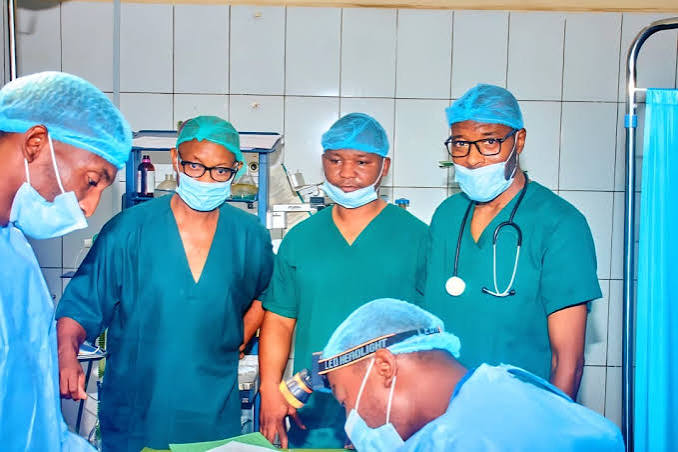
The Director at the National Counter Terrorism Centre (NCTC), Office of the National Security Adviser (ONSA), Amb. Abimbola Wonosikou, gave the assurance on Thursday during the unveiling of a newly equipped clinic at the Operation Safe Corridor (OPSC) camp in Tsafe, Zamfara State.
The clinic was equipped with modern medical facilities through the support of the Centre for Democracy and Development (CDD) West Africa.
It is intended to provide healthcare services for individuals undergoing the Federal Government’s Disarmament, Demobilisation and Reintegration (DDR) programme, which seeks to address terrorism, kidnapping and other forms of violent extremism across the North-West.
FG emphasises rehabilitation and reintegration
Wonosikou reaffirmed the NCTC’s commitment to working with the Zamfara State Government, the DDR Peace and Security Committee, Operation Safe Corridor and development partners to strengthen rehabilitation and reintegration efforts.
She described the clinic as an important addition to the country's DDR framework, particularly in improving the rehabilitation, recovery and reintegration components of the programme.
“The NCTC remains committed to working closely with the Zamfara State Government, the DDR, Peace and Security Committee, Operation Safe Corridor and relevant partners to strengthen the state’s DDR architecture and ensure effective coordination of ongoing and future interventions,” she said.
Wonosikou expressed appreciation to CDD West Africa for supporting the provision of medical equipment, describing the intervention as an example of how development partners and civil society organisations could complement government efforts to address insecurity.
She explained that rehabilitation required more than ideological reorientation and behavioural transformation, stressing that the physical and psychological wellbeing of participants must also receive adequate attention.
According to her, access to quality healthcare is essential to a comprehensive and humane rehabilitation process.
Operation Safe Corridor and national DDR framework
The NCTC director described Operation Safe Corridor as a critical component of the Federal Government’s non-kinetic strategy against terrorism and violent extremism.
She said the programme's success depended not only on rehabilitating individuals but also on providing professional support, institutional capacity and adequate facilities to help participants return to society.
Wonosikou also highlighted the recent presidential assent to the National Policy Framework and Strategy for DDR, describing it as an important step towards improving coordination of rehabilitation and reintegration interventions nationwide.
She said the framework provided renewed direction for collaboration among government institutions and other stakeholders at national and sub-national levels.
However, she stressed that the responsibility now rested on relevant institutions to translate the policy into practical programmes and measurable outcomes.
Clinic to serve camp beneficiaries and host communities
Wonosikou urged the management of the Tsafe camp to ensure proper maintenance and effective use of the facility.
She said the clinic should remain accessible to programme beneficiaries and, where appropriate, serve as a platform for improving relations between the camp and surrounding communities.
According to her, access to healthcare could strengthen public confidence, trust and acceptance of the rehabilitation process.
She also encouraged other development partners and institutions to support rehabilitation centres with facilities that address their practical needs.
Wonosikou maintained that the success of DDR should not be measured only by the number of individuals rehabilitated but also by their successful reintegration, restored community relationships and prevention of future violence.
OPSC coordinator welcomes healthcare investment
Earlier, the National Coordinator of Operation Safe Corridor, Brig.-Gen. Yusuf Ali, described the clinic as an important development for primary healthcare delivery at the Tsafe camp and in the surrounding communities.
He credited the achievement to the support of CDD West Africa and the commitment of the Chief of Defence Staff to the welfare and motivation of personnel and beneficiaries.
Ali also commended the Chief of Army Staff for creating an enabling environment for the programme and Zamfara State Governor Dauda Lawal for making the facility available to Operation Safe Corridor North-West.
Solar power, CCTV and water facilities provided
The Commandant of the OPSC camp, Col. James Anthony, disclosed that the company responsible for executing the project provided additional infrastructure to support the clinic's operations.
He said an extra closed-circuit television (CCTV) camera was installed and connected to the camp's control room to strengthen security monitoring.
The company also provided an alternative power supply comprising a 2.5KVA inverter system and six solar panels to support continuous electricity at the facility.
Anthony added that a water reticulation network had been connected to the clinic, supported by a 10,000-litre storage tank within the camp to ensure reliable water supply.
The event also featured a free medical outreach for residents of host communities.
Healthcare support and the challenge of sustainable reintegration
The new facility provides additional healthcare capacity for individuals undergoing rehabilitation and offers an opportunity to strengthen relations between the camp and surrounding communities.
However, the long-term effectiveness of the intervention will depend on consistent medical staffing, availability of medicines, maintenance of equipment and reliable funding.
Beyond facilities, the broader DDR process will require careful assessment of rehabilitation outcomes, community acceptance, post-reintegration support and safeguards against renewed involvement in violence.
For communities affected by insecurity in the North-West, the ultimate measure of success will be whether rehabilitation programmes contribute to lasting peace, safer communities and reduced violence.
Atlantic Reports: Voices. People. Facts.
Written by
Atlantic Reports Admin
Comments
- Be the first to comment.