Fire Destroys 30 Shops in Gwagwalada Market, Traders Face Heavy Losses
By Atlantic Reports
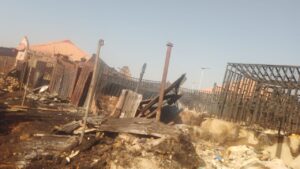
At least 30 shops have been affected by a fire outbreak at Gwagwalada United Traders International Market in the Federal Capital Territory (FCT), leaving traders counting their losses and appealing for government assistance.
The fire occurred at about 8 p.m. on Saturday, November 14, 2026, according to the Chairman of the Gwagwalada United Traders International Market Association, Aminu Bakinruwa.
He said preliminary investigations were ongoing to establish the cause, although an electrical fault was suspected.
Electrical fault suspected
Bakinruwa explained that electricity supply had initially been interrupted before power was restored shortly before the fire started.
He said the flames reportedly broke out less than 10 minutes after electricity returned, raising suspicions that an electrical spark may have triggered the incident.
The affected section housed traders selling palm oil and groundnut oil. According to the market chairman, the presence of the products helped the fire spread.
He credited the prompt intervention of firefighters with bringing the situation under control.
However, the suspected electrical cause has not been officially established, as investigations involving traders, security agencies and the Gwagwalada Area Council are continuing.
Traders count losses and fear loan repayments
Bakinruwa said affected traders had been asked to submit written statements to help determine the extent of their losses and the value of destroyed goods.
He added that the association planned to approach the Chairman of Gwagwalada Area Council, Kasim Mohammed, and the Minister of the Federal Capital Territory, Nyesom Wike, for financial assistance after the assessment.
He expressed concern that many affected business owners operated with borrowed funds and were already making instalment repayments.
One of the victims, Sulaiman Isah, estimated that goods worth more than ₦4 million were in his shop when the fire occurred. He said the stock included items customers had paid for but were yet to collect.
Isah appealed for government intervention, explaining that the losses had left him uncertain about how to restart his business.
He also said he had stocked goods in preparation for increased demand during the festive season.
Area council chairman promises investigation
The Chairman of Gwagwalada Area Council, Kasim Mohammed, sympathised with the affected traders and confirmed that no lives were lost.
He said the council, security agencies and market representatives were working to determine the actual cause and assess the damage.
The council chairman also pledged that measures would be taken to prevent a recurrence.
Recovery and fire prevention challenges
The incident has exposed the financial vulnerability of small traders who depend on loans and daily business turnover to sustain their livelihoods.
Beyond immediate relief, affected traders will need support to replace inventory, settle outstanding obligations and restore their businesses.
The investigation must also establish whether faulty electrical infrastructure, poor wiring or another factor contributed to the outbreak.
For the affected traders, the immediate concern is recovery. For market authorities, preventing another fire will require effective electrical inspections, accessible firefighting equipment and clear emergency response arrangements.
Atlantic Reports: Voices. People. Facts.
Written by
Atlantic Reports Admin
Comments
- Be the first to comment.