Guterres Hails Navi Pillay's 2026 Nobel Peace Prize, Calls for Stronger International Justice
By Atlantic Reports
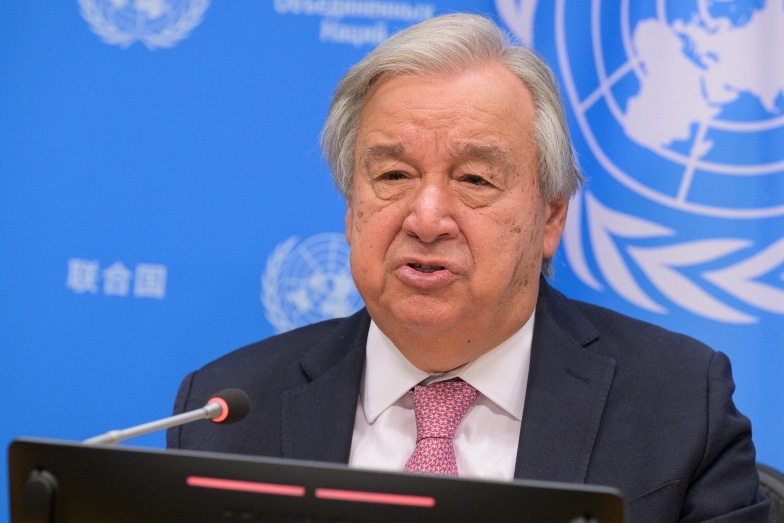
United Nations Secretary-General António Guterres has congratulated South African jurist and former UN human rights chief Navanethem “Navi” Pillay on winning the 2026 Nobel Peace Prize, describing her as a courageous and independent defender of justice whose career has helped strengthen international law.
The Norwegian Nobel Committee announced Pillay as the 2026 laureate on Friday, October 9, recognising her contributions to peace, international legal principles and efforts to hold perpetrators of serious international crimes accountable.
Nobel Peace Prize
+1
In a congratulatory statement issued through his spokesperson, Stéphane Dujarric, at UN Headquarters in New York, Guterres said Pillay's decades of service demonstrated the importance of protecting human rights and ensuring that legal principles prevail over arbitrary power.
“I warmly congratulate Navanethem ‘Navi’ Pillay on being awarded the 2026 Nobel Peace Prize,” he said.
The Secretary-General described her as a steadfast advocate of justice whose work has influenced international legal proceedings involving some of the gravest violations of human rights.
From Apartheid South Africa to International Justice
Pillay's career began under South Africa's apartheid system, when racial discrimination was institutionalised through laws restricting the rights and opportunities of non-white citizens.
Born in Durban in 1941, she entered the legal profession at a time when women of colour faced substantial barriers to professional advancement.
She established her own law practice in 1967 and became involved in defending anti-apartheid activists, including Nelson Mandela.
Nobel Peace Prize
Her legal work challenged discriminatory practices and contributed to efforts to protect people whose rights were restricted under apartheid.
Guterres recalled this period as an important foundation for her later contributions to international justice.
“For decades, she has been a champion of international law and human rights, and a steadfast, independent voice of justice,” he said.
Pillay subsequently moved into judicial service, becoming a judge of South Africa's High Court before assuming responsibilities in international criminal justice institutions.
Her progression from practising law under apartheid to serving in international courts illustrates the relationship between domestic struggles for equality and the development of international human rights protections.
Role in Prosecuting Crimes from Rwanda's Genocide
One of Pillay's most significant international appointments was to the International Criminal Tribunal for Rwanda (ICTR).
The tribunal was established by the United Nations Security Council to prosecute individuals responsible for genocide and other serious violations of international humanitarian law committed in Rwanda in 1994.
Pillay served as a judge and later as President of the tribunal.
Her judicial work contributed to important developments in the treatment of sexual violence under international criminal law.
The Nobel Committee specifically recognised her role in advancing legal accountability for rape and other forms of sexual violence committed during atrocities.
Nobel Peace Prize
These legal developments helped strengthen recognition that sexual violence can constitute an international crime, including genocide, when the applicable legal requirements are established.
For survivors of conflict-related sexual violence, such principles are important because they recognise harms that have historically been neglected or inadequately addressed by justice systems.
Guterres commended Pillay's contribution to international judicial proceedings arising from the Rwandan genocide.
Her work at the tribunal was followed by service at the International Criminal Court, further extending her involvement in the development of international criminal justice.
Six Years as UN Human Rights Chief
Pillay served as United Nations High Commissioner for Human Rights from 2008 to 2014.
During that period, she addressed human rights concerns involving armed conflicts, discrimination, political repression and threats to fundamental freedoms.
The position placed her at the centre of international efforts to encourage governments to respect their obligations under human rights law.
Her responsibilities included drawing attention to violations, advocating accountability and promoting stronger protections for vulnerable populations.
Guterres said her tenure reflected a consistent commitment to justice and the rule of law.
He praised her conviction that “the force of law must prevail over the law of force”.
The statement reflects a central principle of international justice: governments and individuals should be subject to established legal standards rather than relying solely on political influence or military power.
Leadership of UN Inquiry on Israel and Palestinian Territory
The Secretary-General also acknowledged Pillay's leadership of the UN Independent International Commission of Inquiry on the Occupied Palestinian Territory, including East Jerusalem, and Israel.
Pillay chaired the commission from 2021 to 2025, overseeing investigations and assessments concerning alleged violations of international human rights and humanitarian law.
United Nations
The commission's work has attracted international attention and political controversy, particularly over its findings concerning the conflict in Gaza.
In 2025, the commission concluded that Israel was responsible for genocide in Gaza, an assessment rejected by the Israeli government.
Israel has disputed the commission's conclusions and criticised Pillay's work, while the commission has maintained that its findings were based on its investigations and assessment of the evidence.
Al Jazeera
+1
These findings represent the commission's conclusions and should be distinguished from a final judgment by an international court.
Pillay's recognition has therefore come at a time when international accountability mechanisms face intense political scrutiny.
Nobel Committee Recognises Defence of International Law
The Norwegian Nobel Committee awarded Pillay the prize for her efforts to promote peace and international law.
Its announcement highlighted her contributions to strengthening international legal institutions and supporting accountability for genocide, war crimes and crimes against humanity.
The committee also expressed concern about increasing pressure on international legal institutions amid armed conflicts and disputes over the application of international law.
Nobel Peace Prize
Guterres welcomed the recognition, saying it reinforced the importance of enduring legal principles in building sustainable peace.
“In its citation, the Nobel Committee reminded the world that peace must be built on lasting principles, not the will of the powerful,” he said.
The Secretary-General argued that protecting human rights remained essential to preventing injustice, conflict and abuses of power.
Recognition Extends Beyond One Individual
Guterres said the Nobel Peace Prize recognised not only Pillay's personal achievements but also the broader efforts of individuals and institutions defending human rights and international justice.
“Today’s prize is a tribute to all those working to uphold and defend international law, the rule of law and human rights,” he stated.
His remarks drew attention to lawyers, judges, human rights advocates, investigators and civil society organisations working to protect vulnerable communities and secure accountability.
Such efforts often take place in difficult circumstances, including armed conflicts and environments where powerful individuals or institutions resist scrutiny.
The Secretary-General maintained that sustainable peace requires justice, accountability and respect for fundamental freedoms.
His message was that international law should serve as a safeguard against the arbitrary exercise of power, regardless of the political or military influence of those involved.
A Prize Amid Growing Pressure on International Courts
Pillay's Nobel recognition comes during a period of renewed debate about the authority and independence of international judicial institutions.
The International Criminal Court, in particular, has faced pressure from governments disputing its jurisdiction and investigations.
The United States announced additional sanctions targeting the ICC on the same day Pillay's award was announced, intensifying concerns about political interference with international criminal justice.
Reuters
Although the Nobel award does not resolve these disputes, it places renewed attention on the institutions and legal principles intended to hold perpetrators of serious crimes accountable.
For victims of atrocities, the effectiveness of international justice depends not only on legal decisions but also on cooperation from governments, protection for witnesses and the ability of institutions to carry out their mandates.
Pillay's career reflects decades of engagement with these challenges, from confronting racial discrimination in South Africa to participating in international proceedings involving genocide and other grave crimes.
Justice as a Foundation for Lasting Peace
The 2026 Nobel Peace Prize recognises a legal career spanning national and international institutions, with a consistent emphasis on human rights and accountability.
For Guterres, Pillay's recognition carries a message extending beyond the achievements of one jurist.
It reinforces the argument that peace cannot be sustained through political agreements or military power alone without respect for law, human dignity and fundamental rights.
The award also highlights the importance of independent institutions capable of examining allegations of serious violations, even when their work attracts political opposition.
As governments continue to debate the reach of international courts and the responsibilities of states, Pillay's recognition brings renewed attention to the principle that justice must remain accessible to victims and that accountability should not depend on the influence of those accused.
For the United Nations Secretary-General, her career offers a reminder that lasting peace requires institutions and individuals willing to defend the rule of law, particularly when doing so is difficult.
Atlantic Reports: Voices. People. Facts.
Written by
Atlantic Reports Admin
Comments
- Be the first to comment.