Iva Valley Massacre: Activists Protest at British High Commission, Demand Compliance With ₦? Court
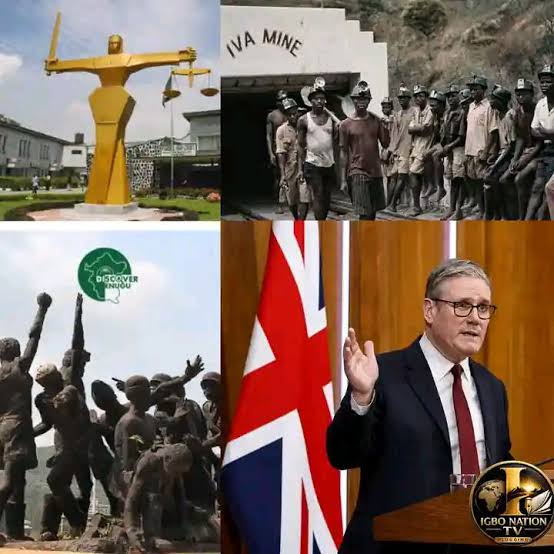
By Atlantic Reports
The Juritrust Centre for Socio-Legal Research and Documentation has led a protest to the British High Commission in Nigeria, demanding compliance with an Enugu State High Court judgment concerning the killing of 21 unarmed miners at Iva Valley in Enugu in 1949.
The protest took place on Wednesday, November 18, exactly 77 years after colonial security forces opened fire on miners who were participating in a protest at the coal mine.
The Executive Director of the centre and counsel in the case, Prof Yemi Akinseyi-George, SAN, said the demonstration was intended to renew calls for accountability and redress for the victims and their families.
He said the centre was demanding that the British Government respect the court's decision, which was delivered on February 5, 2026, by Justice Anthony Onovo in suit No. E/909/2024.
Court declares killings unlawful
According to the account of the judgment provided by the centre and reported by the News Agency of Nigeria, Justice Onovo held that the killings at the Iva Valley Coal Mine were unlawful and amounted to an extrajudicial violation of the miners' right to life.
The court reportedly ruled that the right to life remained enforceable under Nigeria's Constitution despite the fact that the incident occurred during colonial rule.
It ordered the British Government to pay £20 million to each of the 21 affected families, bringing the total compensation award to £420 million.
The judgment also directed the British Government to issue unreserved written apologies to the victims' families. The apologies are to be published in major Nigerian newspapers, including Daily Sun, Daily Independent and The Punch, as well as three leading newspapers in the United Kingdom.
The court further ordered payment within 90 days, with post-judgment interest of 10 per cent annually until the compensation is fully paid.
These are the reported terms of the High Court judgment. The final outcome of the case remains subject to the ongoing appellate process.
Federal Government appeals judgment
Akinseyi-George said the Federal Government of Nigeria had exercised its constitutional right to appeal the judgment, adding that the centre was awaiting the decision of the appellate court.
He maintained that the appeal did not diminish the need to address the alleged violation of the miners' right to life and provide appropriate remedies for their dependants.
He also argued that the British Government had neither appealed nor challenged the judgment, urging it to comply with the court's orders.
“Since no response as stated above came from them, we urge the British Government to respect the rule of law and judicial integrity by complying with the judgment in suit No: E/909/2024 of Enugu High Court, delivered by Justice A.O. Onovo on Feb. 5, 2026,” he said.
The centre maintained that the victims' families should not continue to bear the consequences of a tragedy that occurred under colonial administration.
However, the legal position and enforceability of the judgment, particularly in view of the Federal Government's appeal, remain important considerations in determining the next steps.
Protesters demand recognition of victims
Demonstrators gathered around the British High Commission with placards calling for recognition of the victims and compliance with the court's decision.
Some of the messages read: “Iva Valley Massacre, Remember the 21 Miners”, “Britain Honour the Court Judgment and Names of the Victims” and “Iva Valley Massacre, Remembering the Past”.
The protest was organised to keep public attention on the historical killings and the continuing demands for justice by the victims' families.
The 1949 massacre and its continuing significance
The Iva Valley massacre remains a significant episode in Nigeria's colonial history and the struggle for workers' rights.
On November 18, 1949, 21 coal miners were killed during a protest at the Iva Valley coal mine in Enugu. The incident became a defining moment in the history of labour resistance and opposition to colonial rule in Nigeria.
The renewed campaign for redress raises broader questions about historical accountability, the rights of victims' families and the responsibilities of governments over violations committed under colonial administrations.
For the families, the issue extends beyond financial compensation. Recognition of the victims, an official apology and acknowledgement of the historical circumstances surrounding their deaths remain central to the demand for justice.
The next major development will depend on the appellate proceedings and the legal steps available to enforce the Enugu High Court's orders.
Atlantic Reports: Voices. People. Facts.
Written by
Atlantic Reports Admin
Comments
- Be the first to comment.