Lagos Government Seeks Practical Solutions to Out-of-School Children Crisis
By Atlantic Reports
The Lagos State Government has called for practical and measurable interventions to address the growing challenge of out-of-school children, improve access to quality education and strengthen essential healthcare services for young people.
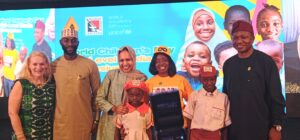
The call was made by the wife of the Lagos State Governor, Mrs Ibijoke Sanwo-Olu, during the 2026 World Children’s Day Media Symposium held in Ikeja on Thursday.
The symposium, organised by the United Nations Children’s Fund (UNICEF) in partnership with the Nigerian Guild of Editors and the Diamond Awards for Media Excellence, was themed “Every Child Matters: Alive, Learning and Thriving, Our Shared Responsibility”.
Delivering the keynote address, Sanwo-Olu said every child excluded from the education system represented a challenge requiring collective attention, a proper understanding of the underlying circumstances and practical solutions.
“Behind every such child is a story, a circumstance or a barrier that must be understood and addressed,” she said.
Poverty, insecurity among barriers to education
Sanwo-Olu identified poverty, inadequate family support, social pressures and insecurity as major factors preventing children from accessing education.
She stressed that providing schools alone was insufficient to guarantee educational access, noting that children must also be enrolled, attend classes regularly, remain in school and complete their education.
She urged government institutions, parents, community leaders, development partners, civil society organisations and the media to work together to identify out-of-school children and understand the circumstances responsible for their exclusion.
According to her, interventions must be designed around the specific challenges affecting children and their families to ensure that those excluded from education can return to the classroom.
She reaffirmed the Lagos State Government's commitment, under Governor Babajide Sanwo-Olu, to expanding educational opportunities, strengthening healthcare delivery, protecting vulnerable children and promoting social inclusion.
Lagos Boy Child Initiative targets youth development
The governor's wife also highlighted the Lagos Boy Child Initiative, established by her office in 2021 to provide boys with mentorship, educational exposure, emotional support and positive role models.
She said boys, like girls, deserved quality education and opportunities to develop their abilities, adding that they also faced emotional difficulties, peer pressure and other social challenges requiring attention.
“Our responsibility is not simply to raise boys. It is to prepare them for responsible adulthood,” she said.
Sanwo-Olu urged media organisations to give children greater visibility, amplify their voices and expose violations of their rights.
She challenged participants at the symposium to translate discussions into practical actions that would improve children's access to safety, education and quality healthcare.
Lagos identifies up to 130,000 zero-dose children
Beyond education, the symposium highlighted concerns about childhood immunisation and early development.
The Permanent Secretary of the Lagos State Primary Health Care Board, Dr Mustapha Ibrahim, identified the first 1,000 days of life, from conception to a child's second birthday, as a critical period for physical growth, brain development and long-term wellbeing.
Ibrahim disclosed that Lagos State had an estimated 120,000 to 130,000 zero-dose children, referring to children who had not received routine vaccinations.
He said interventions implemented in collaboration with development partners had reached more than 100,000 previously unvaccinated children.
However, he called for intensified efforts, particularly in informal settlements and hard-to-reach communities where access to healthcare services remains challenging.
According to him, inadequate nutrition and healthcare during the first 1,000 days can have lasting consequences for children's health, learning abilities and development.
Call for stronger primary healthcare investment
Ibrahim urged sustained investment in primary healthcare facilities, frontline health workers, routine immunisation and nutrition programmes to improve access to essential services.
He stressed that a child's location should not determine whether they receive routine vaccinations.
He also called on government institutions, development partners and community stakeholders to strengthen efforts towards eliminating zero-dose children across Lagos.
Turning commitments into measurable outcomes
The discussions at the symposium underscored the interconnected nature of education, healthcare and child protection.
Children excluded from school may also face poverty, inadequate healthcare, insecurity and limited social support. Addressing these challenges requires interventions that go beyond public declarations and involve sustained engagement with affected families and communities.
For Lagos State, the disclosed immunisation figures and renewed calls to address school exclusion highlight the scale of the task ahead.
The effectiveness of the commitments will ultimately depend on the reach of interventions, the number of children enrolled and retained in school, improved vaccination coverage and the protection of vulnerable children.
Both speakers called for stronger collaboration among government, families, development partners, communities and the media to ensure that every child is protected, healthy and able to fulfil their potential.
Atlantic Reports: Voices. People. Facts.
Written by
Atlantic Reports Admin
Comments
- Be the first to comment.