Macaulay Family Appeals to Tinubu to Return Lagos Post Office Property for Nationalist Memorial
By Atlantic Reports
Descendants of Nigeria’s nationalist pioneer, Herbert Macaulay, have appealed to President Bola Tinubu to return the property housing the General Post Office in Lagos to the family for the establishment of a permanent memorial in his honour.
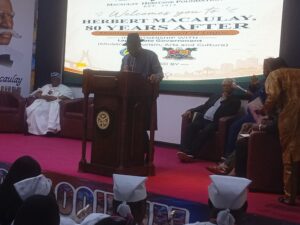
The appeal was made by Chief Olabode George, former Deputy National Chairman of the Peoples Democratic Party (PDP) and Macaulay’s great-grandnephew, at a memorial colloquium held on Saturday, November 14, 2026, at the Nigerian Institute of International Affairs (NIIA), Victoria Island, Lagos.
The event marked the 162nd anniversary of Macaulay’s birth and was chaired by former President Goodluck Jonathan.
Family proposes permanent memorial
George explained that the property currently occupied by the General Post Office was the site of the house where Macaulay lived before his death in 1946.
He said the family home was demolished after his death, with the General Post Office subsequently constructed on the site.
The descendants are asking the Federal Government to return the property to the family, which they say is prepared to develop it into a permanent memorial hall.
“If you look at the back of the programme pamphlet, you will see the house in which he lived. The British colonial authorities were so apprehensive of his activities and influence.
“Following Papa’s death in 1946, the house was demolished, and the General Post Office was subsequently built on the site. That building remains the General Post Office today.
“We therefore wish to appeal to the President to consider returning that property to the family. We are prepared to build a permanent memorial hall in honour of Herbert Macaulay,” George said.
He described Macaulay as a courageous and resourceful nationalist whose political philosophy remained relevant to contemporary leadership.
According to him, Macaulay demonstrated that political participation and public office should be driven by service to the people rather than personal interests.
George said the family initiated the colloquium to preserve the nationalist’s legacy and encourage younger generations and contemporary political leaders to understand the values that shaped his public life.
Another descendant, Mr Gladstone Macaulay, said the nationalist would continue to be remembered for his contributions to Lagos and Nigeria.
Jonathan celebrates Macaulay's nationalist legacy
In his address, Jonathan described Macaulay as a man of exceptional intellect, courage and conviction who played an important role in Nigeria’s nationalist movement.
He noted that Macaulay distinguished himself as an engineer, surveyor, journalist, political activist and public intellectual.
According to the former President, Macaulay was among the early Nigerian voices that challenged colonial injustice and demanded greater political participation and self-determination.
Jonathan said his advocacy helped strengthen the belief that Nigerians had both the right and the capacity to participate in governing their own affairs.
He urged Nigerians to move beyond commemorating the nationalist's achievements and examine the aspirations that informed the struggle for independence.
Nigeria yet to fulfil some independence aspirations
Jonathan argued that the vision of Nigeria’s founding nationalists went beyond replacing colonial administrators with indigenous political leaders.
He said they envisaged a sovereign country capable of controlling its resources, determining its future and using its wealth to improve the welfare of citizens.
Their aspirations, he explained, included economic emancipation, industrialisation, quality education, accessible healthcare, employment opportunities and social justice.
However, Jonathan questioned how much progress Nigeria had made towards achieving those objectives 66 years after independence in 1960.
“Winning independence was a historic achievement. Building a prosperous and united nation remains an ongoing responsibility for us and future generations,” he said.
He identified leadership failures, institutional weaknesses, corruption, policy inconsistency, inadequate infrastructure, insecurity and excessive dependence on raw-material exports as major obstacles to national development.
Comparing Nigeria's development experience with countries such as South Korea, India and Singapore, Jonathan said the countries had recorded significant advances in industrialisation, technology, education, healthcare and human development.
He challenged Nigeria to translate its human and natural resources into sustainable economic growth.
2060 centenary should become a development target
Jonathan urged the country to begin preparing for the centenary of independence in 2060, arguing that the milestone should provide an opportunity to measure national progress rather than simply celebrate another anniversary.
He observed that a child born in 2026 would be about 34 years old when Nigeria marks 100 years of independence.
The former President said the country should avoid passing unresolved development challenges to another generation.
He called for a national development agenda with clear objectives, measurable targets, timelines and identifiable responsibilities.
According to him, political leaders must provide direction, public institutions must deliver efficiently, businesses must invest in productive capacity, and educational institutions must prepare Nigerians for future challenges.
Calls for democratic and educational reforms
Jonathan identified democratic reform, improved political recruitment and functional education as important priorities for Nigeria's long-term development.
On democracy, he called for stronger popular participation, respect for the rule of law, separation of powers, protection of human rights, judicial independence and accountability.
He also expressed concern that political leadership selection was often influenced by religious and ethnic considerations rather than competence, character and capacity.
Jonathan urged Nigerians to support a political system that prioritises the ability of candidates to serve effectively.
On education, he stressed the importance of strengthening universities and other institutions to support technological advancement, innovation and knowledge creation.
Although he acknowledged the presence of capable academics and good universities in Nigeria, he said the country needed to improve the quality and effectiveness of its educational system.
“We have excellent universities and capable academics, but we must do better than we are doing at present.
“Education is critical. We cannot make meaningful progress with weak educational institutions,” he said.
Jonathan added that he obtained all his academic degrees in Nigeria, stressing that his call for educational improvement was not a rejection of the country's universities.
Preserving the legacy of Nigeria's nationalists
The former President urged younger Nigerians to advance the ideals of freedom through innovation, enterprise, civic participation and accountability.
He also warned against allowing the country to lose its historical identity, arguing that preserving the memory of those who fought for independence was essential to understanding Nigeria's national journey.
He cited Herbert Macaulay, Nnamdi Azikiwe, Obafemi Awolowo and Ahmadu Bello among the nationalists whose sacrifices should inspire present and future generations.
Jonathan said the greatest tribute to the founding nationalists would be to build a country that reflected the principles for which they struggled.
Who was Herbert Macaulay?
Born on November 14, 1864, Herbert Macaulay was one of the pioneers of Nigerian nationalism. He died in 1946, fourteen years before Nigeria gained independence.
He co-founded the Nigerian National Democratic Party (NNDP) in 1923 and became an influential figure in the political mobilisation against colonial rule.
His descendants' appeal for a permanent memorial at the site of his former residence raises questions about the preservation of Nigeria's historical heritage and the role of public institutions in protecting sites associated with the country's nationalist struggle.
The proposed memorial, if realised, could provide an enduring space for historical education and public engagement with the ideas and contributions of one of Nigeria's early political leaders.
However, the request for the return of the General Post Office property remains an appeal to the President. No decision by the Federal Government on the proposal was announced at the colloquium.
Atlantic Reports: Voices. People. Facts.
Written by
Atlantic Reports Admin
Comments
- Be the first to comment.