Motorists in Abuja Yet to Feel Relief from Dangote Refinery’s ₦35 Petrol Price Cut
By Atlantic Reports
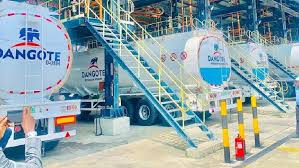
Dangote Refinery recently reduced its petrol gantry price from ₦1,250 to ₦1,215 per litre, following a decline in international crude oil prices.
The reduction raised expectations that motorists and businesses would experience some relief from rising fuel costs.
However, checks across several filling stations in Abuja on Monday showed that petrol prices remained between ₦1,325 and ₦1,420 per litre.
The observed prices included ₦1,410 at Salbas and Rainoil, while Empire Energies sold at ₦1,420 per litre.
MRS sold at ₦1,385, NNPC at ₦1,325, AY Shafa at ₦1,399 and NIPCO at ₦1,380 per litre.
The development has raised questions about how quickly changes in refinery and depot prices are transmitted to consumers.
Experts Question Slow Adjustment of Pump Prices
A former Secretary-General of the Organisation of African Trade Union Unity (OATUU), Mr Owei Lakemfa, said reductions in petrol prices rarely translated into corresponding decreases in transportation fares and other consumer costs.
He argued that transport operators and service providers were often slow to adjust their charges even when fuel prices declined.
Lakemfa called on the government to protect consumers against unpredictable pricing practices by oil companies and major industry players.
He also advocated proper economic planning and the availability of strategic petroleum reserves to cushion the effects of supply disruptions.
According to him, weak long-term economic planning and poor implementation of development policies have contributed to Nigeria's recurring economic challenges.
He said the government should prioritise citizens' welfare over the interests of oil companies and other market players.
Lakemfa further identified the absence of an efficient mass transit system as a major contributor to the country's transportation difficulties.
He pointed to reliable public transportation networks, including underground trains and railway systems in developed economies, as examples of investments that could reduce the financial burden on citizens.
He maintained that businesses could not plan effectively in an environment characterised by uncertainty and inconsistent policies.
Analyst Calls for Marketers' Accountability
Public affairs analyst, Mr Jide Ojo, urged Nigerians to hold independent petroleum marketers accountable for failing to reflect reductions in supply costs in their retail prices.
Ojo expressed concern that increases in petroleum prices were often passed on to consumers immediately, while reductions took longer to reach filling stations.
He said the practice could allow some marketers to maximise profits at the expense of consumers.
Although he acknowledged the influence of government policies and international market conditions on petrol prices, he argued that some local business practices also contributed to the hardship.
Ojo expressed hope that diplomatic efforts would ease tensions involving the United States and Iran, particularly concerns surrounding the Strait of Hormuz, a major international crude oil transportation route.
He said resolving the tensions could help stabilise global crude oil prices.
He appealed to independent marketers to reflect reductions announced by Dangote Refinery in their pump prices.
Ojo also called on regulatory authorities to strengthen monitoring and enforcement to ensure that pricing practices were fair to consumers.
Economist Proposes Production-Based Fuel Subsidy
An economist and public affairs analyst, Dr Aliyu Ilias, urged the Federal Government to introduce measures to stabilise petrol prices, including consideration of a production-based fuel subsidy.
Ilias said unpredictable fuel costs were creating uncertainty for businesses and households, making economic planning increasingly difficult.
He described energy security as fundamental to economic development, arguing that reliable and predictable energy supplies were necessary for sustainable business operations.
According to him, frequent petrol price adjustments make it difficult for companies to forecast operating costs and plan investments.
He therefore urged the government to consider a subsidy arrangement tied to domestic production as a possible mechanism for promoting price stability and restoring confidence among consumers and businesses.
Ilias also called for stronger regulatory oversight by the Nigerian Midstream and Downstream Petroleum Regulatory Authority (NMDPRA), particularly in monitoring filling station pricing practices.
He alleged that some filling stations increased pump prices immediately when replacement supplies became more expensive but were slower to reduce prices when supply costs declined.
He urged regulators to ensure that changes in procurement costs were fairly and promptly reflected in retail prices.
Motorists Demand Lower Pump Prices
Motorists across different parts of Abuja expressed hope that the reduction in Dangote Refinery's gantry price would eventually translate into cheaper petrol.
Mr Ishiaku Baba, a motorist residing in Jikwoyi, said the reduction should result in a significant decrease in pump prices.
He expressed concern about the impact of high petrol costs on transportation, household expenses and business operations.
Similarly, Mrs Benita Akwu, a motorist in Bwari, called on marketers to reduce pump prices to ease the burden of transportation and other essential expenses.
Another motorist, Mr Thompson Abraham, who resides in Dutse, urged filling stations to reflect the latest reduction, saying lower petrol prices would provide relief to road users and commercial transport operators.
Mr Julius Uzor, a motorist in Gwarinpa, also called on marketers to ensure that reductions in procurement and operating costs were passed on to consumers.
IPMAN Explains Why Price Adjustment May Take Time
The National Publicity Secretary of the Independent Petroleum Marketers Association of Nigeria (IPMAN), Mr Chinedu Ukadike, said the timing of price adjustments would depend partly on when marketers received new supplies at the revised rates.
Ukadike explained that refineries and petroleum marketers would need to review their pricing arrangements and financial settlements in response to the new supply costs.
His explanation highlights one of the factors that may influence how quickly changes in refinery prices reach retail outlets.
The Wider Cost-of-Living Question
The continued difference between the refinery's announced gantry price and prevailing pump prices has renewed concerns about transparency and competition in Nigeria's downstream petroleum market.
While marketers' existing stock and replacement costs may influence the timing of price adjustments, consumers are increasingly demanding greater transparency in how retail prices are determined.
The key question for regulators is whether reductions in supply costs are being passed on to consumers within a reasonable period, just as increases are reflected at filling stations.
For millions of Nigerians who depend on petrol for transportation, electricity generation and business operations, meaningful relief will ultimately be measured not by refinery announcements but by the prices they pay at the pump.
Atlantic Reports: Voices. People. Facts.
Written by
Atlantic Reports Admin
Comments
- Be the first to comment.