NADF Supports 4,000 Flood-Affected Rice and Maize Farmers in Ogun
By Atlantic Reports
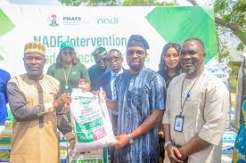
The National Agricultural Development Fund (NADF) has launched an emergency agricultural support programme for 4,000 smallholder rice and maize farmers whose farmlands were affected by flooding in Ogun State.
The intervention is designed to help farmers recover from flood-related losses, restore agricultural activities and reduce the risk of disruption to subsequent planting seasons.
NADF Executive Secretary, Mohammed Ibrahim, disclosed the initiative in a statement on Monday, November 23, 2026.
Represented by Olakunle Dabiri, Head of the fund's Mechanisation Unit, Ibrahim said the beneficiaries comprised 2,800 maize farmers and 1,200 rice farmers.
The farmers are expected to receive fertilisers, herbicides and pesticides under the fund's Agricultural Emergency Intervention in Enterprise Recovery for Flood-Affected Smallholder Farmers.
Emergency support targets farm recovery
Ibrahim said the floods destroyed farmlands, damaged agricultural assets and threatened the incomes of smallholder farmers, making urgent intervention necessary.
He said the programme was intended to strengthen agricultural resilience, protect livelihoods and support national food security objectives.
“Without timely intervention, a disaster measured in days can easily become a crisis that lasts for seasons,” he said.
The intervention has three main components: needs assessment and data verification, emergency distribution of farm inputs, and climate-smart recovery measures.
According to Ibrahim, the assessment was conducted in collaboration with state governments to identify affected farmers, determine the extent of damage and ensure that assistance reaches verified beneficiaries.
The fund also plans to promote agricultural extension services, early-warning systems and capacity-building programmes to improve farmers' preparedness for future climate-related emergencies.
Seven-week implementation timeline
NADF said the intervention is expected to be completed within seven weeks, stressing that timely delivery of farm inputs is necessary to prevent beneficiaries from missing critical production periods.
The fund will use its digital monitoring and evaluation framework to track input distribution, verify beneficiaries and assess agricultural recovery.
Ibrahim said the programme's success should be measured by the restoration of farms and livelihoods rather than the quantity of inputs distributed.
“The true measure of success will not be the quantity of inputs delivered, but the fields restored to cultivation, livelihoods rebuilt, harvests secured and resilience strengthened across our farming communities,” he said.
He urged beneficiaries to use the inputs responsibly and adopt climate-smart farming practices to improve productivity and reduce vulnerability to future environmental shocks.
Ogun government highlights existing agricultural support
The Ogun State Commissioner for Agriculture, Bolu Omotowo, commended NADF for supporting farmers affected by the floods.
He said the intervention complemented the agricultural development initiatives of Governor Dapo Abiodun's administration, particularly efforts to improve access to farm inputs, equipment and mechanisation services.
Omotowo said NADF had distributed more than 20,000 bags of fertiliser to farmers in the state four months earlier during the planting season.
He also disclosed that the state government had supplied eight tractors to its eight farm settlements, alongside tipping trailers, ploughs, harrows, maize planters and cassava planters.
According to him, the equipment is intended to promote mechanised farming, reduce dependence on traditional cultivation methods and increase agricultural production.
The commissioner, however, called for agricultural support to extend beyond rice, maize and cassava to other commodities cultivated in Ogun State.
He specifically requested assistance for cotton farmers, describing cotton as an important part of the state's agricultural production.
Omotowo assured that the state government would ensure transparency in distributing the emergency inputs and urged beneficiaries to use the support to rebuild their farming businesses.
Accountability and recovery remain key tests
The intervention provides immediate support to farmers facing the consequences of flooding, but its wider impact will depend on whether the inputs reach verified beneficiaries on time and enable affected farms to return to production.
The seven-week implementation period also makes timely distribution and effective monitoring important, particularly where delays could cause farmers to miss planting opportunities.
Beyond emergency assistance, sustained investment in drainage, flood-risk mapping, early-warning systems, resilient agricultural practices and extension services will be important in reducing future losses.
For the 4,000 beneficiaries, the ultimate measure of the programme will be whether damaged farms return to cultivation, household incomes recover and subsequent harvests are protected.
Atlantic Reports: Voices. People. Facts.
Written by
Atlantic Reports Admin
Comments
- Be the first to comment.