NEDC Expands Multi-Sectoral Interventions to Support North-East Households
By Atlantic Reports
The North-East Development Commission (NEDC) is expanding its interventions across Nigeria's six North-Eastern states, with new projects and social support programmes targeting households affected by prolonged insurgency, displacement and economic hardship.
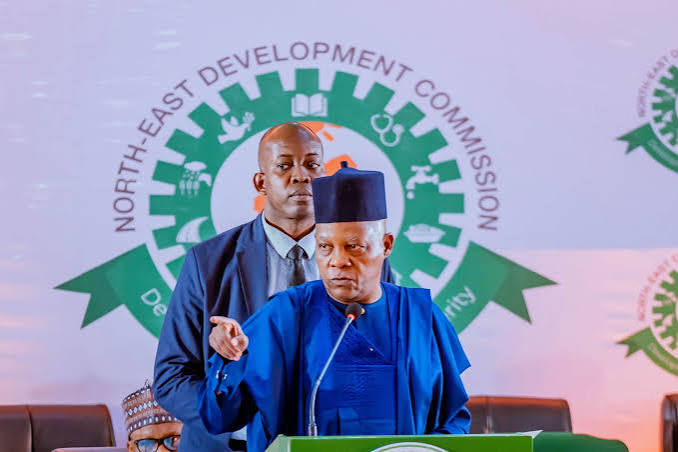
The initiatives, unveiled by Vice-President Kashim Shettima on November 24, 2026, are designed to improve access to essential services, strengthen local economies and reduce financial pressure on vulnerable households.
According to the News Agency of Nigeria (NAN), the interventions cover road and bridge construction, housing, schools, hospitals, renewable energy, electric transportation, agriculture and humanitarian assistance.
Among the major announcements are the deployment of 10,330 electric vehicles across the region and the approval of ₦30 billion for a regional Youth and Women Empowerment Fund.
Electric Mobility Targets Transportation and Livelihoods
The NEDC Managing Director, Dr Mohammed Alkali, said the electric mobility initiative comprises 10,000 electric tricycles, 300 electric taxis and 30 electric buses for distribution across the six states.
He explained that the electric tricycles would primarily serve vulnerable households in rural communities, while the taxis and buses would operate in metropolitan areas to support transportation and commercial activities.
Alkali said some of the vehicles could cover distances of up to 300 kilometres on a full charge, while electric tricycles could have a lifespan of up to 10 years with proper maintenance.
He described the intervention as part of efforts to stimulate economic recovery in a region that has endured more than a decade of insurgency.
Minister of Regional Development, Mr Abubakar Momoh, said the initiative would provide additional transportation opportunities for workers, traders, students and other residents.
He added that electric mobility could create opportunities for young people to acquire technical skills and participate in the emerging electric transportation industry.
However, the long-term impact will depend on the availability of charging infrastructure, maintenance facilities, spare parts and affordable access for intended beneficiaries.
₦30 Billion Empowerment Fund and Business Support
The commission is also prioritising economic empowerment, particularly for women, young people and small business owners.
Alkali said the NEDC had supported Micro, Small and Medium Enterprises (MSMEs) through collaboration with the Bank of Industry.
He disclosed that approximately ₦3 billion was disbursed in 2025 to support displaced businesses and other small enterprises.
The newly approved ₦30 billion Youth and Women Empowerment Fund is expected to provide further support for economic participation and livelihood development.
The commission's interventions also include a ₦25 billion scholarship scheme targeting students from disadvantaged families.
These programmes are intended to address economic exclusion and improve opportunities for households affected by displacement and prolonged insecurity.
Roads, Bridges and Housing Reconstruction
Infrastructure development remains a major component of the NEDC's reconstruction programme.
Shettima said the commission had undertaken the construction and rehabilitation of 51 roads and 35 bridges to improve movement between communities and commercial centres.
He noted that better road connectivity would help farmers transport agricultural produce to markets and enable residents to access economic opportunities beyond their immediate communities.
The Vice-President also highlighted the construction of more than 3,500 houses under the commission's mass housing programme.
The housing intervention is intended to support displaced families and vulnerable households that have lost homes during years of insecurity.
Other projects include the Akwanga-Gombe-Biu-Maiduguri road, the Bama-Banki road and other road interventions expected to improve transportation and trade across the region.
Education and Digital Development
In the education sector, Shettima disclosed that the NEDC had constructed 18 mega schools, 232 classrooms and 22 hostels.
He also highlighted interventions across 49 tertiary institutions, alongside scholarship and bursary programmes for deserving students, including orphans and vulnerable children.
Alkali said the commission had established information and communication technology centres across the six states and selected tertiary institutions.
The centres are intended to promote digital skills, artificial intelligence applications, research, commerce and innovation.
These investments are particularly relevant to young people seeking opportunities in an increasingly technology-driven economy.
Nevertheless, the benefits will depend on reliable electricity, internet connectivity, equipment maintenance and access to practical training.
Healthcare, Water and Sanitation
The health sector has also received attention under the commission's multi-sectoral programme.
Shettima said the NEDC had undertaken 92 projects across hospitals and specialist healthcare facilities.
He added that the commission had provided eight magnetic resonance imaging (MRI) and computed tomography (CT) scan units, alongside other medical equipment and medicines to tertiary healthcare institutions.
The interventions also include more than 100 water, sanitation and hygiene facilities and 1,100 solar-powered boreholes and community water supply schemes.
These projects are intended to improve access to healthcare, safe water and sanitation, particularly in communities facing longstanding infrastructure challenges.
However, the availability of trained medical personnel, equipment maintenance, essential medicines and reliable water management will remain important to sustaining the investments.
Renewable Energy and Agricultural Support
The commission has also installed more than 100,000 solar streetlights across communities under its Light Up the North-East initiative.
The programme is designed to improve public lighting and support economic activities, particularly in communities where electricity access remains limited.
In agriculture, Shettima said farmers had received more than 2,000 units of agricultural machinery and equipment, as well as 38,000 bags of fertiliser to support food production.
The interventions are expected to strengthen agricultural productivity and support livelihoods in a region where farming remains an important economic activity.
Borno State Governor and Chairman of the North-East Governors' Forum, Prof. Babagana Zulum, said the region was increasingly participating in renewable energy development rather than remaining only a consumer of energy solutions.
He also emphasised the importance of vocational and technical training to equip young people with practical skills.
Government Highlights Regional Recovery Efforts
The Vice-President commended residents of the North-East for their resilience despite years of insecurity, displacement and economic disruption.
He said reconstruction must provide displaced families with secure housing, improve access to public services and restore opportunities for economic participation.
Senior Special Assistant to the President on Media and Public Enlightenment, Mr Abdulaziz Abdulaziz, said ongoing federal projects were expected to improve the lives of residents.
Gombe State Governor, Muhammadu Inuwa Yahaya, also acknowledged the Federal Government's stated commitment to improving the welfare of people in the region.
Implementation and Accountability Remain Critical
Despite the scale of the announced interventions, the NEDC acknowledges that the consequences of prolonged insurgency, displacement and infrastructure destruction cannot be addressed overnight.
The commission says it is prioritising the completion of ongoing projects, consolidation of previous achievements and stronger monitoring of implementation.
However, the success of the programmes will ultimately depend on transparent procurement, timely delivery, proper maintenance and fair distribution of benefits across all six states.
Questions also remain about the detailed allocation of the ₦30 billion empowerment fund, the selection of beneficiaries for the electric vehicles, the operational arrangements for charging facilities and the long-term maintenance costs of the projects.
Security remains another critical consideration. Without sustained improvements in safety, communities may struggle to benefit fully from new infrastructure, agricultural investments and economic opportunities.
For households recovering from years of conflict, the real measure of progress will be whether these interventions translate into secure homes, accessible healthcare, quality education, reliable transportation and sustainable livelihoods.
The reconstruction effort must therefore move beyond project announcements to demonstrable improvements in everyday living conditions across the North-East.
Atlantic Reports: Voices. People. Facts.
Written by
Atlantic Reports Admin
Comments
- Be the first to comment.