Nigeria Records Marginal Increase in Food Production, Decline in Some Prices, Says Minister
By Atlantic Reports
The Federal Government has reported an increase in the production of major food crops and a decline in the prices of some commodities in Nigeria during the 2026 wet season.
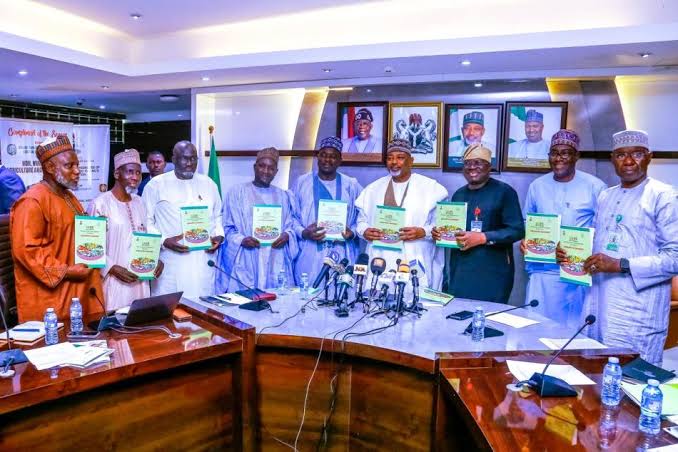
The Minister of Agriculture and Food Security, Senator Abubakar Kyari, disclosed this on Wednesday in Abuja during the presentation of the 2026 Agricultural Performance Survey (APS) Report.
The survey was conducted by the National Agricultural Extension and Research Liaison Services (NAERLS), Ahmadu Bello University, Zaria, in collaboration with relevant government agencies and development partners.
Kyari said the findings indicated a marginal increase in agricultural output compared with the 2025 survey, particularly in the production of maize, rice, millet, yam, sorghum, cowpea and cassava.
He attributed the reported improvement to government interventions and support programmes targeting farmers across the country.
“We have seen the increase in productivity, and the results we are seeing today are for the 2026 wet season,” he said.
The minister added that increased production had been recorded across states, although the survey's findings would need to be assessed alongside challenges affecting farmers and the wider agricultural value chain.
Government reports decline in prices of some food commodities
Kyari also said the prices of selected food commodities, including garri and millet, had declined between 2025 and 2026.
“When you compare 2025 and 2026, we have seen prices dropping, garri, millet and others have come down,” he said.
He expressed optimism that additional harvests expected within the following month would improve food availability and support further price reductions.
However, the reported decline applies to some commodities and does not establish that food prices have fallen across all markets or that household food affordability has generally improved.
The minister said the 2025 agricultural output had exceeded production levels recorded in each of the preceding three years, while the 2026 survey indicated a further marginal increase.
Government plans second phase of mechanisation programme
On agricultural mechanisation, Kyari disclosed that the second phase of the Federal Government's mechanisation programme was expected to be delivered within the next two to three months.
He said mechanisation remained important to improving productivity and supporting farmers' operations.
The minister commended NAERLS for conducting the agricultural assessment and urged the institute to begin preparations for the dry-season survey.
The next assessment is expected to provide further information on agricultural production trends beyond the wet-season findings.
Niger leads rice production, report says
Presenting the survey, NAERLS Executive Director, Prof. Yusuf Sani, identified Niger State as Nigeria's leading rice-producing state.
The report also examined regional contributions to the production of cereals, legumes, roots and tubers, as well as vegetables.
According to Sani, the North-Central region recorded the largest contribution to cereal, legume, root and tuber production.
The North-West accounted for the highest share of vegetable production, representing approximately 31 per cent of the national output in that category.
Production gains face wider food security test
The reported increase in agricultural production offers an indication of progress in Nigeria's food supply, but sustaining the gains will require attention to challenges beyond farm output.
Farmers' access to affordable inputs, financing, irrigation, mechanisation, storage facilities and reliable transportation remains important to ensuring that increased harvests translate into food availability and more affordable prices.
The relationship between production and market prices also requires careful monitoring, as transportation costs, storage losses, distribution challenges and regional supply differences can affect what consumers eventually pay.
While the 2026 survey provides encouraging indications in selected crop categories, further details on actual production volumes, state-by-state performance and commodity price movements would help establish the scale and distribution of the reported gains.
For Nigerian households facing food affordability pressures, the key measure of progress will be whether increased agricultural output leads to sustained reductions in food costs and improved access to nutritious food.
Atlantic Reports: Voices. People. Facts.
Written by
Atlantic Reports Admin
Comments
- Be the first to comment.