Nigeria’s Foreign Affairs Minister Appointed Commonwealth Action Group Vice-Chair
By Atlantic Reports
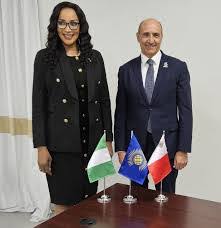
Nigeria’s Minister of Foreign Affairs, Bianca Odumegwu-Ojukwu, has been appointed Vice-Chair of the Commonwealth Ministerial Action Group (CMAG), following a meeting held during the 28th Commonwealth Heads of Government Meeting (CHOGM 2026) in St John’s, Antigua and Barbuda.
The appointment was announced by the Ministry of Foreign Affairs and made during the group’s meeting on the sidelines of the summit, which brought together leaders and representatives of the Commonwealth’s 56 member countries.
Nigeria Takes Up Role in Commonwealth Governance
The appointment places Nigeria in a leadership position within one of the Commonwealth’s key ministerial bodies, which is responsible for upholding the organisation’s fundamental political values.
These include democracy, human rights, good governance and the rule of law.
The Ministry of Foreign Affairs said Odumegwu-Ojukwu’s emergence would strengthen Nigeria’s participation in discussions and collective responses concerning democratic governance, institutional accountability and the protection of fundamental freedoms across member states.
The group is chaired by Malta’s Foreign Affairs Minister, Chris Fearne, who was elected to continue in the position for another two years during the Commonwealth meetings in Antigua and Barbuda.
Understanding the Commonwealth Ministerial Action Group
Established in 1995 under the Millbrook Commonwealth Action Plan, CMAG serves as a mechanism for addressing serious or persistent breaches of the Commonwealth’s shared political principles.
Its responsibilities include assessing developments in member countries and recommending collective action where necessary.
The group provides a platform for member states to address concerns relating to democratic institutions, constitutional governance, human rights and the rule of law.
Implications for Nigeria’s Diplomatic Engagement
Odumegwu-Ojukwu’s appointment offers Nigeria an opportunity to participate more directly in Commonwealth discussions on governance and institutional accountability.
The significance of the position will depend on how Nigeria uses its role to contribute to the group's deliberations, promote dialogue among member states and support the principles underpinning the Commonwealth Charter.
The development also places attention on the responsibilities associated with representing a country within an organisation whose stated values include democratic accountability and the protection of fundamental rights.
Atlantic Reports: Voices. People. Facts.
Written by
Atlantic Reports Admin
Comments
- Be the first to comment.