Nigeria's STEM Gap Narrows as Girls Learn AI, Coding Skills
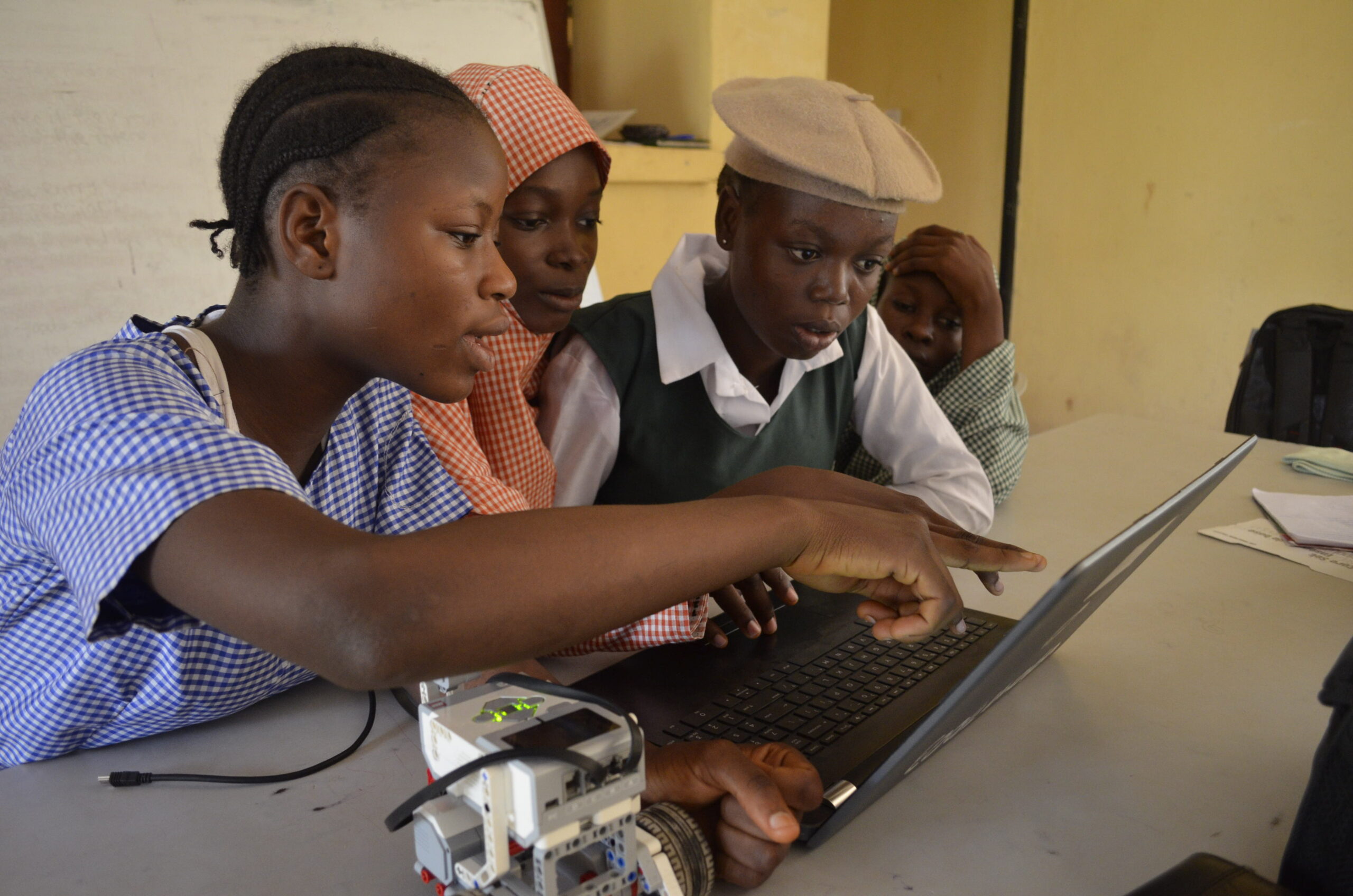
For Esther Olabiyi, an SS3 student at Ibadan Grammar School, having access to computers, laptops, and smartphones did not necessarily translate into knowing what she could actually do with them. That changed when she took part in the AI/Data Science for Her 2026 programme, organised by Tech Girls Club.
Within just five days, Olabiyi was introduced to programming, Python, and Microsoft Excel — giving her an entirely new understanding of technology and its possibilities. "Before the training, I had access to computers, laptops and phones but my knowledge of what I could do with them was limited," she said.
Her experience captures one of the central challenges facing efforts to increase girls' participation in Science, Technology, Engineering, and Mathematics (STEM) in Nigeria: having access to technology does not necessarily mean having the knowledge, skills, or opportunity to use it meaningfully.
A Global Gap, A Local Challenge
This challenge is not unique to Nigeria. Globally, women now outnumber men in higher education, with 114 women enrolled for every 100 men. Yet, according to the United Nations Educational, Scientific and Cultural Organisation (UNESCO), women account for only 35 per cent of STEM graduates worldwide — a gap between women's broader participation in higher education and their representation specifically in STEM fields.
In Nigeria, the disparity is even more pronounced. Data from the National Bureau of Statistics (NBS) shows that women account for only about 22 per cent of STEM graduates in the country. For many girls, the barrier is not a lack of interest or ability, but rather limited exposure, inadequate infrastructure, teaching methods centred on theory and memorisation, and few opportunities to apply knowledge practically.
A Programme Spanning Nigeria's Six Geopolitical Zones
Against this backdrop, the AI/Data Science for Her programme was rolled out across Nigeria's six geopolitical zones, with editions held in Ilorin, Yola, Port Harcourt, Zaria, Nsukka, and Ibadan. The initiative was supported by a 2026 Bridging the Future grant from the NeurIPS Foundation, which said the programme would train 300 Nigerian high-school girls in the fundamentals of artificial intelligence and data science. Through the programme, participants received practical training in AI, data science, programming, and broader digital skills.
According to Wonderful Osalor, Project Manager of the programme, participants arrived with widely varying levels of prior exposure to technology. "Some had regular access to computers, while others came from schools without adequate computer facilities. For some participants, the programme provided their first opportunity to use a computer extensively," she said.
Osalor noted that these differences became far less significant once the girls were given similar tools, knowledge, and opportunities. "Once you give them the right knowledge, tools, exposure and experience, any girl can excel in technology and science," she said.
From Basic Keyboard Skills to Writing Python Code
For some participants, the learning process began with the most basic computer operations. Osalor recalled that some initially struggled with typing and locating special characters on a keyboard — some did not even know where to find the "@" symbol. Within five days, however, they were writing Python code.
For Osalor, this transformation underscored the importance of teaching methods that meet learners where they are, rather than making them feel incapable because they had not previously encountered certain concepts. "Learning should begin from the basics and progress according to the learners' pace," she added.
What Happens After the Training Ends?
Yet the training raised a more difficult question: what happens once it ends? Dr Wilson Sakpere, Lead Facilitator and board member of Tech Girls Club, said the programme surfaced real concerns about what some participants would return to. Many girls, he noted, would go back to schools without the computers or facilities needed to continue practising. Indeed, some participants were already asking how they might continue learning programming through mobile applications, anticipating they might not have access to computers after the programme ended.
Sakpere called for greater investment in facilities within public schools, warning that exposure without continuity could limit the development of lasting skills. "A girl who learns Python, data analysis or AI during a short programme needs opportunities to practise afterwards if the skills are to develop into competence," he said.
Rethinking How Children Are Taught
Infrastructure, however, is only part of the challenge. Dr Aderonke Sakpere, Principal Investigator of AI/Data Science for Her, argued that the way children are taught must also change, calling for greater emphasis on practical learning and everyday experiences rather than excessive memorisation. "Education should move away from excessive emphasis on memorisation and connect theoretical concepts with everyday experiences," she said.
She cited digital platforms such as YouTube, where children frequently interact with AI-generated recommendations without realising that artificial intelligence is behind what they see — an example, she said, of how teachers could use familiar experiences to introduce students to concepts that might otherwise seem abstract. "At one centre students told facilitators that they had never been taught in that manner in school," she said.
Beyond teaching methods, Sakpere advocated exposing children to STEM at an earlier age. Although the 2026 programme focused mainly on senior secondary students, she made exceptions for two younger girls at one centre — and their strong performance reinforced her belief that concepts traditionally reserved for senior secondary level could be broken down for younger learners. She advocated extending such programmes to junior secondary and, eventually, primary school pupils.
Turning Knowledge Into Real-World Ambitions
For Grace Sakpere, a Junior Secondary School One student who took part in the programme, the exposure opened up possibilities she had never previously considered. She said she hopes to develop an application capable of detecting fraudulent messages and calls. "This is because there are two types of hackers: black hackers and white hackers. With the knowledge I have from this programme, I can create an app that can detect fraud," she said, explaining that such an application could help people identify suspicious texts or calls and potentially trace fraudulent activity.
Similarly, the programme helped other participants connect technology with careers they already aspired to pursue. Oluwatonilola Oladosu, an SS1 student at Oritamefa Baptist Model School, Ibadan, said she had developed an interest in architecture and architectural engineering. "This programme introduced me to the possibility of applying AI to architecture," she said.
For the organisers, such connections matter because STEM learning becomes far more meaningful when students can see how it relates to their own interests and future careers.
Bridging the Public-Private School Divide
The programme also brought differences in technological exposure between public and private school students into sharp focus. Osalor observed that some private-school students appeared more confident at the outset, while public-school participants often faced greater initial challenges — though she noted these differences became less pronounced as training progressed.
Olajide Oluwole, Curriculum and Content Developer for Tech Girls Club and AI/Data Science for Her, recalled that at the Ibadan centre, only about six participants were initially coding confidently. By the lunch break of the third day, however, all 49 participants were making visible progress. For Oluwole, this demonstrated why girls should not be judged by what they know before being given the opportunity to learn.
A Call for Curriculum Reform
Oluwole also believes Nigeria's curriculum urgently needs modernisation to reflect the realities of today's learners. "You can't be working with 1986 syllabus in 2026," he said, adding that curriculum reform should not simply mean adding more subjects or increasing content volume. "Instead, students should spend less time listening to lengthy theoretical explanations and more time applying what they have learnt," he said.
In his view, teachers could explain concepts briefly before allowing students more time to work practically with them, with the curriculum ultimately answering one fundamental question: what can the learner actually do with this knowledge? Oluwole also advocated introducing AI concepts earlier, given the technology's growing application across sectors including health, agriculture, law, and accounting.
Everyday Devices as Learning Tools
One public-school participant's experience illustrated how existing technology could become a powerful learning tool once students are shown how to use it. Dr Aderonke Sakpere recalled a girl who owned a smartphone and had seen Microsoft Excel on it but had never actually used the application. After the training, the girl returned home, opened Excel, and began entering data. "That simple experience changed her understanding of what a mobile device could do," Sakpere said. "Instead of seeing the phone merely as a communication or entertainment device, she began to see it as a tool for learning and computation."
Similarly, another participant's teacher reportedly requested information about a mobile version of Python so students could continue practising after returning to school. Sakpere said such experiences show that while governments work to address infrastructure deficits, schools can also encourage responsible use of available mobile technology for learning in the meantime.
From Consumers to Problem-Solvers
Importantly, the programme did not stop at teaching girls how to use technology — participants were also challenged to think about how technology could solve problems in their own communities. Grouped across public and private schools, they were asked to identify local problems that could be addressed using AI and data science.
Their ideas included solutions for waste management, including an AI-enabled smart waste detector, as well as automated traffic-control systems designed to capture licence plates and identify reckless driving. Other projects focused on crop-poisoning prevention, cyberbullying detection, and measures to mitigate transformer vandalism — demonstrating how young learners can move from being passive consumers of technology to active problem-solvers, when given the opportunity.
Sustaining Momentum Beyond the Training Room
Even so, Sakpere warned that promising ideas could remain stuck at the prototype stage without continued mentorship, funding, and access to incubation opportunities — a concern that points to a broader challenge: sustaining momentum after short-term interventions end.
For the organisers, the end of the five-day training should not mark the end of the learning process. Osalor said participants are expected to return to their schools and share what they've learnt with other students. "We hope that schools will establish AI clubs, supported by ICT teachers, where participants can continue practising," she said.
Sakpere similarly suggested collaboration with incubation centres to help develop promising student projects, and noted that national STEM-related events could provide platforms for showcasing students' innovations. She urged the girls to take ownership of the opportunity by continuing to practise, teaching others, and developing their ideas further.
A Broader Vision for Girls in STEM
Ultimately, the experiences from the programme suggest that increasing girls' participation in STEM requires far more than simply encouraging an interest in science. "It requires functional infrastructure, age-appropriate curricula, practical teaching, trained teachers, early exposure, sustained mentorship and opportunities for girls to apply knowledge to real-world problems," Sakpere said.
For students such as Olabiyi, Grace, and Oladosu, the five-day experience has already begun reshaping how they see technology and what they believe they can do with it. For Olabiyi, the transformation began with something deceptively simple: she already had access to a computer. What she lacked was the opportunity to understand what was truly possible.
Stakeholders insist that Nigeria must ensure more girls gain access to such opportunities — and that their learning is sustained well beyond the training room.
Written by
Atlantic Reports Admin
Comments
- Be the first to comment.