Nigerian Army Urges Commanders to Prioritise Troops’ Welfare and Mental Health
By Atlantic Reports
The Nigerian Army has urged commanders across its formations to place greater emphasis on troops’ welfare, strengthen operational feedback systems and apply lessons from previous engagements to improve military effectiveness.
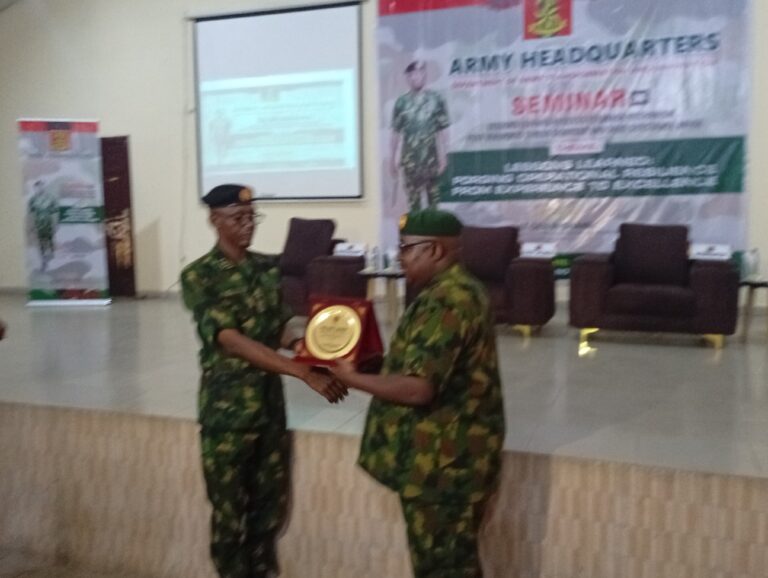
The Chief of Army Staff (COAS), Lt.-Gen. Waidi Shaibu, made the call on Thursday, November 19, at a sensitisation seminar organised by the Department of Transformation and Innovation, Army Headquarters, at Sobi Cantonment, Ilorin.
Shaibu was represented at the event by Maj.-Gen. Yakubu Yahaya, General Officer Commanding (GOC), 9 Division, Nigerian Army, and Commander of the Joint Task Force North Central, Operation Savannah Shield.
The seminar, themed “Lessons Learned: Forging Operational Resilience from Experience to Excellence”, focused on turning operational experiences into practical improvements in military training, planning, leadership and personnel management.
Army seeks stronger operational feedback
Shaibu said an effective lessons-learnt process would help the Army identify operational challenges, investigate their causes and introduce measures to prevent recurring shortcomings.
He urged commanders to promote timely reporting, objective assessments and the implementation of validated lessons across their formations.
According to him, the process should inform improvements in military training, doctrine, operational planning and force protection.
The COAS stressed that operational experiences would have limited value if the lessons were not properly documented, assessed and translated into changes in military practice.
Mental health and substance abuse concerns
The Army chief also highlighted the need to address post-traumatic stress disorder (PTSD) and drug and substance abuse among military personnel.
He noted that prolonged operational pressure and exposure to traumatic experiences could affect personnel’s psychological well-being, judgement and performance.
Shaibu urged commanders to recognise early signs of psychological distress and ensure that affected personnel receive appropriate medical attention.
He said effective management of these challenges would strengthen individual resilience, unit cohesion and the Army’s ability to carry out assigned missions.
The emphasis on mental health points to an important dimension of military readiness: personnel must be physically equipped and operationally trained, but their psychological well-being also requires sustained attention.
Welfare identified as essential to operational readiness
Shaibu reaffirmed the Nigerian Army’s commitment to becoming a more professional, adaptable, combat-ready and resilient force capable of fulfilling its constitutional responsibilities within joint and multi-agency operations.
He urged participants to ensure that the seminar produced practical improvements in personnel welfare and operational performance.
In his welcome address, the Chief of Transformation and Innovation, Army Headquarters, Maj.-Gen. Peter Okoye, said the seminar was designed to strengthen the leadership and operational capacity of junior and middle-cadre officers and soldiers.
Okoye was represented by Brig.-Gen. Haruna Dasuki, Deputy Chief of Transformation and Innovation, Research and Development.
He said the programme would equip participants with knowledge and strategies to address operational challenges, including PTSD and substance abuse.
Army highlights human element of military operations
Okoye said the initiative aligned with the COAS’s leadership philosophy, which prioritised professional excellence, effective administration, operational readiness, strategic cooperation and exemplary leadership.
He emphasised that personnel welfare remained central to military success, arguing that the mental and physical well-being of troops was as important as the equipment available to them.
The seminar was scheduled to feature three lectures, with participants encouraged to contribute actively and apply the knowledge gained within their respective formations and units.
Okoye commended the Army chief for placing emphasis on the human element of military operations and reaffirmed the department’s commitment to programmes that promote combat effectiveness and mental resilience.
The challenge for the Army will be to translate the seminar's recommendations into consistent practices, including accessible mental health support, early intervention for personnel facing psychological difficulties and effective systems for learning from operational experiences.
Atlantic Reports: Voices. People. Facts.
Written by
Atlantic Reports Admin
Comments
- Be the first to comment.