Nollywood: RMD Urges Regulators to Balance Industry Standards with Creative Freedom
By Atlantic Reports
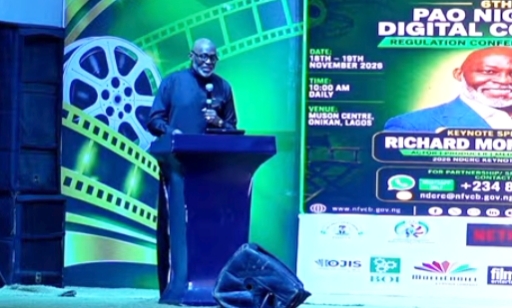
Veteran Nigerian actor and filmmaker Richard Mofe-Damijo, popularly known as RMD, has urged regulators to strike a balance between enforcing industry standards and protecting creative freedom as digital technology continues to reshape Nollywood.
Mofe-Damijo made the call on Wednesday while delivering the keynote address at the 6th Peace Anyiam-Osigwe Nigerian Digital Content Regulatory Conference 2026 in Lagos.
The two-day conference, organised by the National Film and Video Censors Board (NFVCB), was themed “Film and Content Production in the Digital Era: Balancing Regulation and Innovation.”
The actor said the rapid growth of digital technology had fundamentally changed how films and other creative content were produced, distributed and consumed.
He noted that filmmakers could now reach international audiences through digital platforms without relying exclusively on traditional cinemas and broadcasting channels.
However, he warned that the opportunities created by digital distribution had also introduced challenges, including misinformation, piracy, intellectual property violations and the unauthorised use of people's images and voices.
According to him, regulatory frameworks must evolve alongside technological developments without discouraging innovation or unnecessarily restricting the ability of filmmakers to tell stories.
“There is a difference between regulating an industry and restricting its capacity to grow.
“There is also a difference between protecting society and unnecessarily limiting creative expression,” he said.
Regulation must not suppress creative expression
Mofe-Damijo described film as more than a source of entertainment, noting that it also served as a platform for cultural expression, historical documentation and social commentary.
He argued that filmmakers should have sufficient freedom to explore difficult subjects and address social realities without facing unnecessary restrictions.
“Responsible storytelling must not become an excuse for controlling storytelling,” he said.
The actor maintained that effective regulation did not have to conflict with artistic independence.
He identified film classification, clear content guidelines, age-appropriate access and transparent regulatory procedures as practical measures for protecting audiences while respecting the creative rights of industry practitioners.
His position raises an important question for Nigeria's film regulatory system: how can authorities protect children and other vulnerable audiences while ensuring that legitimate artistic expression is not unnecessarily restricted?
For Nollywood, the distinction is significant as filmmakers increasingly distribute content through streaming services, social media and other digital platforms operating across different regulatory environments.
Global recognition must translate into economic benefits
Mofe-Damijo also expressed concern that Nollywood's growing international visibility was not necessarily translating into sustainable financial returns for content creators.
He identified intellectual property ownership, distribution rights, royalties and licensing agreements as major issues requiring greater attention.
“Visibility is not the same as value,” he said.
He urged filmmakers to develop a better understanding of contracts, commercial rights and intellectual property arrangements to protect their creative works and secure the economic benefits generated by their productions.
The actor's comments highlight the importance of strengthening the business side of Nigeria's film industry.
While international distribution can increase the reach of Nigerian films, creators also need clear contractual arrangements that establish who owns their work, how distribution rights are allocated and how revenue is shared.
Without adequate protection, filmmakers and other creative professionals risk losing control over their productions or receiving limited financial returns despite the commercial success of their work.
Piracy continues to threaten the industry
Mofe-Damijo described piracy as another major obstacle to the growth and financial sustainability of Nollywood.
He explained that the unauthorised reproduction and distribution of films weakened their commercial value, discouraged investment and threatened the livelihoods of people working in the creative sector.
He called for stronger collaboration among regulatory authorities, law enforcement agencies, digital platforms, rights holders and industry associations to address the problem.
Such cooperation, he said, would be necessary to improve the protection of creative works in an environment where digital content can be copied and distributed rapidly.
The challenge extends beyond filmmakers to producers, actors, writers, cinematographers, distributors and other professionals whose earnings depend on the commercial use of creative content.
Effective enforcement would therefore need to address both traditional forms of piracy and unauthorised digital distribution.
AI raises questions about consent and ownership
Addressing the growing influence of artificial intelligence, Mofe-Damijo acknowledged that the technology offered opportunities to improve production processes, generate visual concepts and reduce costs.
He said these capabilities could be particularly useful to emerging filmmakers who often face financial and technical limitations.
However, he warned that the use of AI in the creative industry also raised concerns about authorship, consent, ownership and the replication of actors' faces and voices without their permission.
“Technology should expand the possibilities of human creativity, not diminish the value of human beings,” he said.
The actor called for clearer regulatory guidelines to protect creative professionals as AI tools become increasingly integrated into film production and digital content creation.
His concerns reflect a growing debate across the global entertainment industry over the use of digital replicas, synthetic performances and AI-generated material.
For Nigerian actors and filmmakers, clear rules on consent, compensation and ownership could become increasingly important as production companies explore new technologies.
Call for investment in production and distribution
Beyond regulation and intellectual property protection, Mofe-Damijo urged increased investment in production infrastructure, training institutions, financing mechanisms and distribution networks.
He said these areas were essential to building a stronger creative ecosystem capable of supporting filmmakers and improving the industry's competitiveness.
He also called on the NFVCB to deepen engagement with practitioners and other stakeholders as digital platforms and emerging technologies continue to transform the production and distribution of content.
According to him, policies should respond to technological developments while reflecting the practical realities of filmmakers and other creative professionals.
“The future is not a choice between regulation and innovation.
“The future belongs to those who understand how to make both work together,” he said.
The challenge facing Nigeria's film regulators
The issues raised at the conference point to a broader challenge for Nollywood as its audience and distribution networks expand.
Regulators are expected to protect the public, enforce appropriate content standards and address harmful material. At the same time, they must ensure that their decisions are transparent, proportionate and consistent with the protection of legitimate creative expression.
The industry also faces the task of improving intellectual property enforcement, strengthening contractual protections and ensuring that technological innovation benefits creators rather than exposing them to exploitation.
For the NFVCB, the effectiveness of its regulatory approach will depend not only on the rules it establishes but also on how those rules are implemented and how consistently industry stakeholders are consulted.
The conference provided a platform for discussing these competing interests, but the next important step will be translating the discussions into practical policies that protect audiences, respect creative rights and support the long-term economic development of Nigeria's film industry.
Atlantic Reports: Voices. People. Facts.
Written by
Atlantic Reports Admin
Comments
- Be the first to comment.