Oyetola Promises Maritime Reforms to Unlock Nigeria’s Blue Economy Potential
By Atlantic Reports
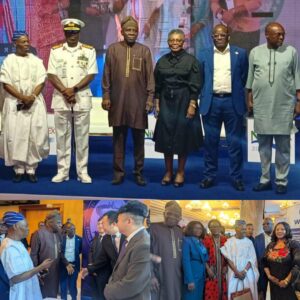
Oyetola gave the assurance on Tuesday, November 17, 2026, while declaring open the three-day Nigeria Maritime Conference and Exhibition (NIMAREX 2026) in Lagos.
Represented by the Executive Director of Operations at the Nigerian Maritime Administration and Safety Agency (NIMASA), Mr Fatai Adeyemi, the minister said the Federal Government was developing a stronger institutional and policy framework to promote transparency, coordination and sustainable growth in the maritime sector.
He said the government was committed to improving port efficiency, reducing vessel turnaround time and strengthening Nigeria's competitiveness in international shipping and trade.
Oyetola also identified fleet acquisition, deep seaport development and appropriate financing arrangements as priority areas for attracting private investment into the industry.
Government prioritises maritime security and investment
The minister described maritime security as a major priority, noting that the government was sustaining efforts to improve confidence in Nigerian waters and strengthen compliance with international maritime standards.
He urged industry stakeholders to translate discussions at the conference into practical policies, strategic partnerships and commercial opportunities capable of driving sustainable growth.
Oyetola emphasised that government alone could not deliver the desired transformation, calling for stronger collaboration among state governments, private investors, industry practitioners and development partners.
Agbakoba calls for establishment of national shipping fleet
Speaking as chairman of the occasion, Dr Olisa Agbakoba urged Nigeria to move beyond repeated discussions about maritime development and establish a functional national fleet capable of participating in international shipping.
He argued that Nigeria could not fully benefit from the global shipping business without owning and operating vessels.
Agbakoba explained that financial institutions would be more willing to support vessel acquisition when investors could demonstrate firm cargo commitments and clear prospects of profitability.
He called on the Federal Government, cargo owners and financiers to work together within months to acquire vessels, reduce dependence on foreign shipping operators and address high freight costs.
NIMAREX committee seeks stronger industry collaboration
The Chairman of the NIMAREX 2026 Planning Committee, Chief Shola Adewunmi, also called for unity among maritime stakeholders, strategic financial partnerships and collective action to strengthen the industry.
Adewunmi said Nigeria's participation in vessel ownership and operations remained below its potential despite shipping's importance to international trade and blue economy development.
He stressed that the maritime industry required cooperation beyond individual interests and institutional differences.
According to him, stakeholders must work together to build a more competitive and sustainable maritime sector.
Lagos government highlights Lekki Deep Seaport
Meanwhile, Lagos State Governor Babajide Sanwo-Olu reaffirmed his administration's commitment to providing an enabling environment for maritime businesses and investments.
Represented by his Special Assistant, Mr Oluwadamilola Emmanuel, the governor said improved port infrastructure, transportation and logistics efficiency were essential to Nigeria's international trade competitiveness.
He described the Lekki Deep Seaport as a significant development in the expansion of Nigeria's port capacity, noting that supporting infrastructure was creating opportunities for industrial and economic growth.
Sanwo-Olu said Lagos would continue working with the Nigerian Ports Authority (NPA) and other government agencies to improve traffic management and facilitate the movement of goods between ports, businesses and markets.
He urged conference participants to move beyond identifying familiar industry challenges and focus on practical solutions, viable investments and measurable commitments.
Nigeria's blue economy ambitions face implementation test
The discussions at NIMAREX 2026 have renewed attention to longstanding challenges facing Nigeria's maritime industry, particularly limited indigenous vessel ownership, financing constraints, port efficiency, maritime security and infrastructure development.
Although the Federal Government has outlined plans to strengthen the sector, the success of the proposed reforms will depend on implementation, investment commitments and effective coordination among relevant institutions.
For Nigerian businesses, the expansion of indigenous shipping capacity could create opportunities in cargo transportation, ship management, maritime services and related industries.
The challenge is to translate Nigeria's maritime potential into greater domestic participation, employment opportunities and a stronger position in regional and international trade.
Atlantic Reports: Voices. People. Facts.
Written by
Atlantic Reports Admin
Comments
- Be the first to comment.