Pope Leo XIV Warns Against Using Food as Weapon of War
By Atlantic Reports
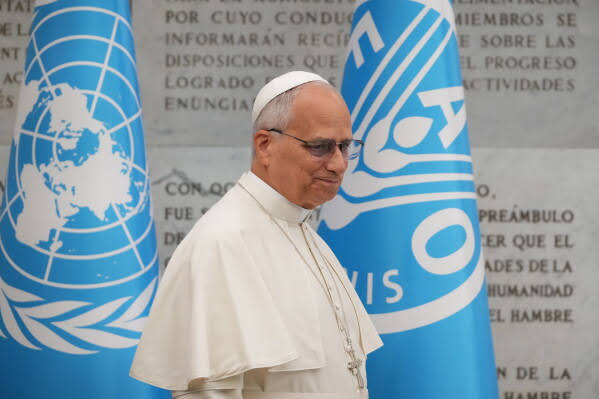
Pope Leo XIV has warned against using food as a weapon of war, a tool of geopolitical pressure or a speculative financial asset, stressing that access to adequate and safe food is a fundamental human right.
The Pope delivered the message at the 2026 World Food Day ceremony at the headquarters of the Food and Agriculture Organisation of the United Nations (FAO) in Rome, Italy. His message was read by Monsignor Fernando Chica Arellano, the Vatican’s representative to the FAO.
He said persistent hunger, despite significant technological advances, reflected shortcomings in political will and collective commitment to ensuring that people could access sufficient food.
“In an era of greater technological advancement than ever before, it is intolerable that bread should be considered a privilege rather than a contested commodity,” he said.
The Pope stressed that ensuring access to safe, adequate and sufficient food was an obligation shared by individual countries and the international community.
His remarks placed food security within a wider discussion about conflict, economic power, agricultural development and the responsibilities of governments and international institutions.
Pope calls for ethical and sustainable agricultural innovation
Pope Leo XIV cautioned against technological advancement driven solely by profit, warning that agricultural practices that depleted soil fertility or displaced farmers could not be regarded as genuine progress.
He called for increased investment in sustainable agricultural research, the restoration of degraded soils and the integration of modern technology with farmers’ traditional knowledge.
The Pope argued that innovation should respect human dignity, protect vulnerable populations and serve the common good rather than deepen existing inequalities.
“A new global food order is essential, one in which technological innovation is unconditionally subordinate to respect for God-given human dignity and the universal common good,” he said.
He warned that innovation pursued through domination and exclusion could worsen conflict, while technology guided by justice and concern for hungry people could help secure a better future.
His message highlighted the need to assess agricultural progress not only by productivity gains but also by its effects on farmers, rural communities and access to food.
FAO chief urges wider access to technology
Earlier, FAO Director-General Qu Dongyu said innovation must be people-centred and accessible, particularly to farmers and rural communities, to improve food security, livelihoods and economic development.
He identified satellite crop monitoring, early-warning systems, smart irrigation and digital platforms as examples of technologies helping farmers manage climate risks, conserve water and access markets and financial services.
However, Qu cautioned that technological advances would have limited impact if they failed to reach the people who needed them most.
“Yet, innovation alone is not enough. Its true value lies in reaching the people who need it the most, and that it will be shared and scaled,” he said.
The FAO chief noted that a significant gap remained between what scientific research could achieve and the technologies and services available to farmers.
He called for stronger investment and partnerships to ensure that innovations were adapted to local conditions and the practical needs of agricultural producers.
Climate change and conflict increase pressure on food systems
Qu said climate extremes, water scarcity and conflict were placing increasing pressure on agri-food systems, making innovation essential to producing more food with fewer resources and strengthening resilience.
He urged governments, researchers, agricultural producers and communities to work together, stressing that no single institution could achieve the transformation required.
The challenges outlined at the ceremony have implications for countries such as Nigeria, where farmers and food businesses must contend with production costs, climate-related risks, infrastructure constraints and access to modern agricultural services.
Technologies such as improved irrigation, weather forecasting and digital market platforms can help address some of these pressures, but their effectiveness depends on affordability, reliable infrastructure, practical training and access for small-scale farmers.
Food security requires more than technological progress
The messages from the Pope and the FAO director-general underscored a shared concern: technological advancement alone cannot eliminate hunger without effective policies, investment and equitable access to its benefits.
For governments, this means considering how agricultural research, environmental protection, conflict prevention and social support can work together to improve food availability and affordability.
It also means protecting farmers’ livelihoods and ensuring that modernisation does not exclude rural communities that lack the resources to adopt new technologies.
As global food systems face mounting pressures, the central challenge remains turning scientific progress and international commitments into practical improvements in food production, distribution and access for vulnerable populations.
Atlantic Reports: Voices. People. Facts.
Written by
Atlantic Reports Admin
Comments
- Be the first to comment.