Saudi Medical Team Begins Separation Surgery on Tanzanian Conjoined Twins
By Atlantic Reports
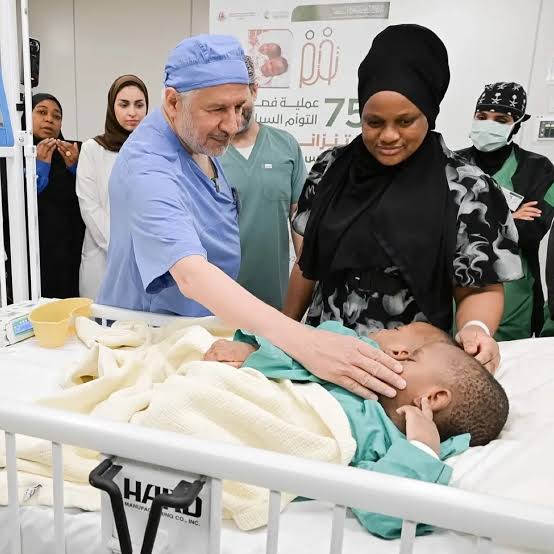
A medical team under the Saudi Conjoined Twins Programme began a separation operation on Thursday for two-year-old Tanzanian conjoined twins, Laitience and Loveness, at King Abdullah Specialist Children’s Hospital in Riyadh, Saudi Arabia.
The procedure is being conducted under the direction of Saudi Arabia’s leadership through the Ministry of National Guard, according to a statement from the programme.
Dr Abdullah Al Rabeeah, Supervisor General of the King Salman Humanitarian Aid and Relief Centre (KSrelief) and head of the programme’s medical and surgical team, said the twins arrived in Saudi Arabia on 27 January 2026.
Following their admission to the hospital, specialists conducted comprehensive medical examinations and held several consultations to assess their condition and determine an appropriate surgical plan.
Complex Medical Condition Requires Multistage Surgery
According to Al Rabeeah, the twins are joined at the pelvis and hips. They share four lower limbs, part of the lower intestines, the spinal column, lumbar vertebrae and spinal cord.
Their condition presents significant surgical challenges because of the shared anatomical structures that must be carefully separated while protecting vital functions.
The twins also underwent a skin expansion procedure over several months to prepare their bodies for the separation operation.
The surgery is scheduled to proceed through nine stages over approximately 15 hours, involving 44 consultants, specialists, nurses and technical personnel.
The medical team includes professionals in anaesthesia, paediatric surgery, paediatric neurosurgery, urology and plastic surgery.
Medical Team Estimates 70 Per Cent Success Rate
Al Rabeeah said the estimated success rate for the procedure was 70 per cent.
The estimate reflects the complexity of the operation, although the statement did not provide a detailed explanation of how the probability was calculated or the specific outcomes covered by the assessment.
Given the twins’ shared pelvic structures, intestines and spinal anatomy, the operation requires careful coordination among the different surgical specialties.
The immediate outcome will depend on the successful completion of the planned stages and the twins’ condition during and after surgery. Their longer-term recovery and functional outcomes will require further medical assessment.
Saudi Programme Marks 75th Separation Operation
The procedure marks the fourth separation operation involving conjoined twins from Tanzania and the 75th operation under the Saudi Conjoined Twins Programme, according to Al Rabeeah.
Established in 1990, the programme has cared for 160 sets of conjoined twins from 29 countries across five continents.
The programme provides specialised medical assessment and surgical care for children whose conditions require complex separation procedures.
Al Rabeeah expressed appreciation to Saudi Arabia’s King Salman bin Abdulaziz Al Saud and Crown Prince Mohammed bin Salman bin Abdulaziz Al Saud for their continued support of the initiative.
He said the support had enabled Saudi medical teams to provide specialised treatment and improve the quality of life of children receiving care through the programme.
Recovery Remains the Next Critical Stage
The start of the operation represents a major medical undertaking for the twins and their families. However, the commencement of surgery does not establish that separation has been completed successfully.
The nine-stage procedure must be followed by careful postoperative care, monitoring and rehabilitation, depending on the twins’ medical needs and surgical outcomes.
Further information from the medical team will be needed to establish whether the operation has been completed, whether both children are stable and what recovery support they may require.
Atlantic Reports: Voices. People. Facts.
Written by
Atlantic Reports Admin
Comments
- Be the first to comment.