South Korea, Nigeria Seek Deeper Investment Ties in Energy, Manufacturing, Technology
By Atlantic Reports
The Republic of Korea has reaffirmed its commitment to strengthening economic cooperation with Nigeria, with a focus on job creation, investment and technology sharing across key sectors.
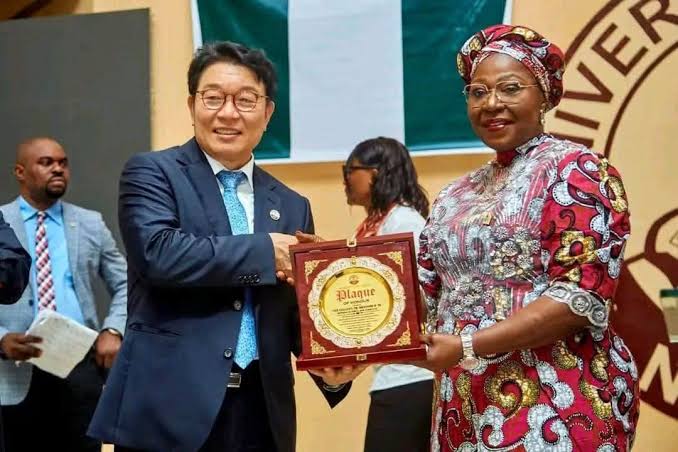
South Korea’s Ambassador to Nigeria, Jeong Yo-an, stated this on Friday night at the country’s National Day reception organised by the Korean Cultural Centre Nigeria (KCCN) in Abuja.
He said Korean companies, including Daewoo Engineering and Construction, LG, Samsung, Hyundai and Solpia, had contributed to business activities linking the two countries through employment, knowledge sharing and commercial opportunities.
Yo-an said the South Korean Embassy and the Korea Trade-Investment Promotion Agency (KOTRA) would continue promoting investment, technology transfer and local employment.
“Together, we aim to create jobs, share knowledge and expand opportunities for both countries, as well as turning potential into opportunity and opportunity into shared prosperity,” he said.
He described the partnership as an expression of Hongik Ingan, a Korean principle commonly interpreted as “to benefit all humanity”.
Nigeria seeks broader trade beyond oil and gas
Nigeria’s Minister of Foreign Affairs, Bianca Odumegwu-Ojukwu, said the reception offered an opportunity to celebrate relations between both countries and strengthen their cooperation.
Represented by the ministry’s Chief of Protocol, Ambassador Babagana Wakil, the minister said Nigeria recognised South Korea’s achievements in industrialisation, technology, manufacturing and infrastructure development.
She said these areas offered lessons and opportunities for Nigeria’s economic development.
According to her, both countries had maintained cooperation through high-level engagements, bilateral partnerships and collaboration on issues of mutual interest, including international peace, security and sustainable development.
On trade and investment, Odumegwu-Ojukwu said Nigeria wanted to expand economic relations beyond crude oil and liquefied natural gas exports.
She called for increased trade in non-oil products, including agricultural produce, and welcomed further South Korean investment in manufacturing, automobile assembly, shipbuilding and other productive sectors.
The minister said such investment could support technology transfer, employment generation and the development of local industrial capacity.
However, translating these opportunities into lasting economic benefits will depend on the scale of investment secured, the jobs created for Nigerians and the extent to which technology and expertise are transferred to local businesses and workers.
Agriculture, rice production and food security
Agriculture featured prominently in Nigeria’s priorities for expanded cooperation.
Odumegwu-Ojukwu said Nigeria was interested in South Korea’s expertise in agricultural mechanisation, improved rice production and agro-processing, particularly in efforts to strengthen food security and raise productivity.
She also reiterated Nigeria’s commitment to exploring opportunities under South Korea’s K-Rice Belt Initiative.
The initiative provides a potential avenue for cooperation in rice production, but the minister’s statement did not specify the scale of Nigeria’s participation, implementation timelines or expected production outcomes.
Further details on the programme’s practical arrangements would help establish how the proposed cooperation could benefit farmers, processors and consumers.
Digital technology, education and maritime cooperation
Both countries also expressed interest in expanding cooperation in education, digital technology, technical training, scholarships, academic exchanges and research partnerships.
The Nigerian government said stronger collaboration could help young people acquire skills relevant to employment and emerging industries.
The minister also called for closer cooperation in maritime security, shipbuilding, fisheries and technical capacity development.
She described the Nigeria-Korea Joint Commission as an important framework for advancing bilateral relations and identifying areas for further collaboration.
For Nigeria, these sectors offer opportunities to develop local expertise and broaden economic activity beyond the oil and gas industry. The impact will depend on how proposed partnerships are translated into funded programmes, commercial projects and accessible training opportunities.
Cultural ties underpin diplomatic relations
Beyond business and development, Yo-an highlighted the cultural connections between the two countries.
He recalled that Nigeria and South Korea established diplomatic relations in 1980, with their relationship growing through cooperation, mutual respect and people-to-people exchanges.
The ambassador praised Nigeria’s cultural diversity and young population, describing its people as an important national asset.
He also pointed to the popularity of Korean pop music, including BTS, Korean dramas, films and K-beauty products among Nigerian audiences.
In return, he acknowledged Nigeria’s creative industries, particularly Afrobeats and Nollywood, saying cultural exchange helped bring the two societies closer.
The ambassador also expressed gratitude to countries and international partners that supported South Korea during difficult periods in its history, noting that international cooperation had contributed to the country’s recovery and development.
The reception marked South Korea’s National Foundation Day, known as Gaecheonjeol, observed annually on 3 October. The day commemorates the traditional founding of Gojoseon, the first Korean kingdom, attributed in Korean tradition to the legendary figure Dangun Wanggeom in 2333 BC.
The event concluded with a performance by a 16-member demonstration team from Kukkiwon, the World Taekwondo Headquarters.
As Nigeria and South Korea seek closer economic relations, the central measure of progress will be the extent to which diplomatic commitments produce tangible outcomes in trade diversification, local employment, industrial development and skills acquisition.
Atlantic Reports: Voices. People. Facts.
Written by
Atlantic Reports Admin
Comments
- Be the first to comment.