Tinubu Backs 'Shaibu Doctrine', Says Army Is Shedding Old Ways
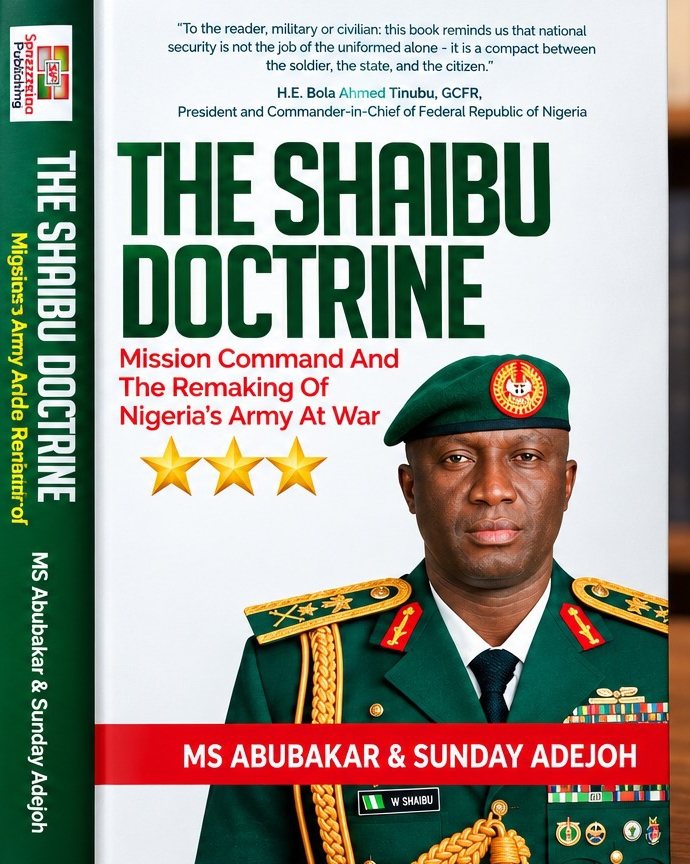
President Bola Tinubu has endorsed the leadership philosophy of the Chief of Army Staff, Lt.-Gen. Waidi Shaibu, calling it the foundation of a more adaptable, professional and combat-ready Nigerian Army.
The President gave the endorsement in his foreword to *The Shaibu Doctrine: Mission Command and the Remaking of Nigeria's Army at War*, written by Dr Muhammed Abubakar and Associate Prof. Sunday Adejoh of the Nigerian Defence Academy (NDA).
According to Tinubu, the doctrine reflects the duty of the Armed Forces to secure the country and create conditions in which democracy and development can flourish.
"As Commander-in-Chief, I have charged our Armed Forces with one mission: to secure Nigeria so that democracy and development can thrive," he wrote.
The President said Shaibu's command philosophy rests on four pillars: professionalism, adaptability, combat readiness and resilience. These, he said, now shape how the Army approaches training, equipment, operations and leadership.
He described the doctrine as a break from military conservatism, with the Army shifting from static defence to more mobile offensive operations.
Tinubu added that the reforms also place emphasis on adopting technology, producing military equipment locally, improving personnel welfare and enforcing stricter adherence to military ethics.
"These were not abstract reforms. They were choices made in the heat of battle, with lives on the line and the nation watching," he said.
Speaking to journalists about what prompted the publication, Abubakar said the book examines Shaibu's leadership philosophy, with a focus on Mission Command, troop welfare and decentralised decision-making as tools for improving operational effectiveness.
He said his professional dealings with Shaibu began when the general was Brigade Commander in Bama, Borno, and continued when he served as Theatre Commander, Operation Hadin Kai.
Those encounters, Abubakar said, gave him insight into how Shaibu managed personnel and military resources and how he kept troop morale up in difficult operational settings.
He said he and Adejoh resolved to document the philosophy systematically after Shaibu was appointed Chief of Army Staff, believing it held lessons for the Army as its operational challenges evolve.
While the President's foreword speaks of four pillars, Abubakar framed the philosophy around five, captured in the acronym PROSE: Professional Excellence, Robust Administration, Operational Readiness, Strategic Cooperation and Exemplary Leadership.
At its heart, he said, is a "Soldier-First" culture that treats personnel welfare, morale, training, dignity and empowerment as the bedrock of combat effectiveness.
Abubakar described Mission Command as a leadership style built on trust and initiative, one that empowers subordinate commanders to take decisions within their areas of responsibility.
Under the approach, he explained, senior commanders set the operational objectives, while subordinate commanders decide how best to achieve them in light of conditions on the battlefield.
He said this could cut delays in decision-making, make junior commanders more accountable and speed up the tempo of clearing and holding operations.
"The core of Mission Command is trust," Abubakar said, adding that commanders on the ground must have the authority to respond to threats promptly rather than wait for approval through several layers of command.
He cautioned, however, that decentralised decision-making can only sustain operational effectiveness if it is backed by adequate equipment, logistics, training and personnel welfare.
Abubakar also pointed to intelligence gaps, insufficient persistent air support and the need for better aerial surveillance as challenges that still need attention in Nigeria's counter-insurgency campaign.
He called for greater investment in human intelligence and closer collaboration with credible community actors and private security outfits that know conflict-prone areas well.
He also urged more persistent air support for ground troops and tighter coordination between the Nigerian Army and the Nigerian Air Force.
Strengthening Army Aviation and giving priority to long-endurance drones, the military scholar said, could improve battlefield surveillance and situational awareness, and help commanders respond faster to emerging threats.
He noted that Nigeria's complex security environment, long borders and the asymmetric tactics of armed groups demand that military strategy and capability keep adapting.
Drawing on his experience in the North-East and North-West, Abubakar said counter-insurgency cannot be won by military force alone. He called for a whole-of-government and whole-of-society approach that brings together security agencies, government institutions and local communities.
Abubakar stressed that the book is not a biography of Shaibu but an analysis of a military strategy and of the institutional changes needed to sustain operational effectiveness.
He said it aims to spark debate on aligning leadership, organisational structure and military culture with the threats posed by insurgency, terrorism and banditry.
Military expansion, fiscal discipline, personnel welfare and institutional adaptation, he said, are key considerations in building the Army's long-term capacity.
According to Abubakar, the book is meant to offer practical lessons to policymakers, military officers, cadets and Nigerians who want to understand the principles guiding the Army's leadership.
Its central message, he said, is that effective leadership requires commanders to trust their subordinates, invest in personnel, align administration with operations, promote inter-agency cooperation and lead by example.
The book is scheduled to be presented on Nov. 24, 2026, at the Nigerian Army Resource Centre, Abuja.
Written by
Atlantic Reports Admin
Comments
- Be the first to comment.