Ukraine’s Allies Urge Russia to Accept Winter Energy Ceasefire
By Atlantic Reports
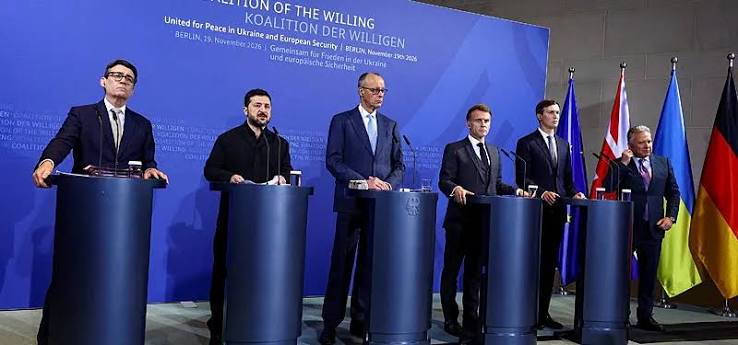
Leaders of Germany, France, the United Kingdom, Ukraine and the United States, alongside members of the Coalition of the Willing, have urged Russia to agree to a ceasefire targeting energy infrastructure for the duration of winter.
The appeal followed a meeting in Berlin, where the leaders reaffirmed their commitment to a comprehensive, just and lasting peace for Ukraine, describing the country’s security as essential to wider European stability.
In a joint statement, they condemned what they described as Russia’s systematic escalation of missile and drone attacks on Ukrainian civilians and civilian infrastructure.
Allies pledge military and financial support
The leaders pledged continued political, diplomatic, military, financial and civilian assistance to Ukraine, insisting that sustained international support would prevent Russia from outlasting Kyiv’s resistance.
They identified stronger Ukrainian air defence, particularly systems capable of intercepting ballistic missiles, as an urgent priority ahead of winter.
The statement reaffirmed NATO allies’ commitment to provide €70 billion in military equipment, assistance and training to Ukraine in 2026, with at least equivalent support pledged for 2027.
Under the European Union’s Ukraine Support Loan, another €90 billion is expected to be provided for military and financial assistance by the end of 2027.
The leaders said they would work with Ukraine and international partners, including members of the Group of Seven (G7), to meet its financial needs beyond that period. They also linked continued support to agreed reforms, particularly in the areas of the rule of law and anti-corruption.
Further sanctions planned against Russia
The coalition also pledged to intensify economic pressure on Russia through additional sanctions and measures to prevent the circumvention of existing restrictions.
Proposed measures include targeting Russian oil and gas revenues, cryptocurrency transactions and illicit financial flows, as well as disrupting the country's military-industrial complex.
The leaders also committed to continuing efforts to restrict Russia's so-called shadow fleet, which they said helps Moscow evade sanctions.
They emphasised the importance of protecting maritime security and upholding international standards established through the International Maritime Organization.
Security guarantees proposed for Ukraine
The leaders reiterated that Ukraine's security was closely connected to wider European and Euro-Atlantic stability.
They said Ukraine should receive robust, legally binding security guarantees once a ceasefire takes effect, with arrangements closely coordinated with the United States.
The proposed guarantees could include:
-
Long-term military, financial and technical support to maintain Ukraine's armed forces.
-
Participation in a US-led mechanism to monitor and verify a ceasefire.
-
A European-led Multinational Force for Ukraine, supported by the United States, to provide security reassurance on land, at sea and in the air.
-
Legally binding commitments, subject to national procedures, to respond if Russia launches another armed attack.
The leaders welcomed the ongoing military exercise, Koalicja-2026, involving members of the coalition, describing it as evidence of preparations for a possible multinational security role after a ceasefire.
They stressed that the proposed guarantees would be defensive and designed to support Ukraine's security and military capacity.
Coalition backs negotiations but rejects territorial changes by force
The leaders commended Ukrainian President Volodymyr Zelenskyy's stated willingness to accept an immediate ceasefire and participate in meaningful negotiations.
They also supported direct dialogue between Ukraine and Russia, with the participation of the United States and European representatives.
The joint statement identified ending hostilities as the immediate priority and insisted that international borders must not be changed through force.
It further maintained that Ukraine's sovereign right to determine its own security arrangements and alliances must be respected.
The leaders said Russian sovereign assets would remain immobilised until Moscow ended its war and compensated Ukraine for the damage caused.
They also argued that wider European security agreements could not be reached while Russia continued military action that, in their assessment, violated the United Nations Charter and other international agreements.
Any negotiations concerning the European Union or NATO, they added, would require the consent of the respective institutions and their member states.
Black Sea food exports included in ceasefire appeal
Beyond the proposed winter energy truce, the leaders called for a separate ceasefire arrangement to guarantee safe passage for food exports through the Black Sea.
They said freedom of navigation in the region was important for global food security, given its role in the movement of agricultural commodities.
The appeal places energy infrastructure and maritime food transport among the immediate priorities in efforts to reduce the impact of the conflict on civilians and international markets.
However, the joint statement represents the position of Ukraine and its partners. It does not establish that Russia has accepted either ceasefire proposal.
The diplomatic challenge ahead
The Berlin meeting reinforced the coalition's commitment to Ukraine while outlining a combination of military assistance, economic pressure, diplomatic engagement and proposed post-ceasefire security guarantees.
The central uncertainty remains whether Russia will accept the proposed energy and Black Sea ceasefires and whether the parties can agree on terms for ending the conflict.
For Ukraine, the immediate concern is protecting civilians and critical infrastructure during winter. For its international partners, the challenge is sustaining financial and military commitments while creating conditions for negotiations that respect Ukraine's sovereignty and territorial integrity.
Atlantic Reports: Voices. People. Facts.
Written by
Atlantic Reports Admin
Comments
- Be the first to comment.