Universities Must Develop Bankable Solutions to Local Challenges, Expert Tells Nigerian Institution
By Atlantic Reports
An infrastructure strategist and maritime lawyer, Dr Alban Igwe, has called on Nigerian universities to reposition themselves as centres of innovation capable of transforming local challenges into commercially viable solutions.
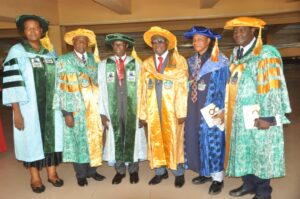
Igwe, Director-General of the Dangerous Goods Academy, Nigeria, made the call on Wednesday while delivering the 18th Convocation Lecture of Crawford University, Igbesa, Ogun State.
The lecture, titled “The Future of Crawford University: Globalising the Locals and Globalising the Global”, focused on the need to combine local knowledge with international expertise to improve research, innovation and graduate competitiveness.
Igwe argued that universities should encourage students to develop practical solutions to problems within their communities rather than concentrate exclusively on conventional academic research and traditional thesis writing.
“I am looking for a university that is not copy and paste, and does not ask you to do the traditional thesis,” he said.
He proposed that students should be encouraged to present bankable project proposals capable of attracting investment, adding that universities could support promising graduates by acting as guarantors for solutions addressing local problems.
“We don’t need to go to Harvard to solve a local problem in Igbesa. There are markets in Igbesa,” he said.
Universities urged to commercialise local research
Igwe said Nigerian universities should use global knowledge and available technology to address challenges within their immediate environments.
He challenged researchers to investigate problems such as malaria and explore indigenous medicinal resources and locally available materials that could support the development of home-grown innovations.
According to him, developing local solutions would reduce dependence on imported technologies and products, which could be more expensive.
He also advocated technology-enabled international academic partnerships that would allow Nigerian and foreign lecturers to exchange knowledge without necessarily travelling physically.
Igwe urged Crawford University to redesign its curriculum to integrate local realities with international experiences, giving students opportunities to gain exposure to other African countries, including Kenya, Egypt and South Africa.
He said such exchanges would strengthen graduates' understanding of international practices and improve their competitiveness in the global labour market.
Logistics identified as opportunity for Crawford University
The expert identified logistics and transportation as sectors through which Crawford University could distinguish itself, given Igbesa's location within an industrial environment.
He proposed the establishment of a centre for trade, logistics and supply-chain studies to connect academic research with commercial and industrial activities.
Igwe also suggested that the Lagos-Kano-Jibiya (LAKAJI) Corridor could serve as a practical research environment where students investigate trade movements, transportation challenges, supply chains and cross-border commercial regulations.
He described logistics as a major factor in national economic competitiveness, citing the World Bank's Logistics Performance Index.
Using Singapore as an example, he explained that efficient logistics could strengthen food security even in countries with limited agricultural production.
“Countries are competing by virtue of logistics only. If you want to grind any economy, just stop transport. Nobody goes anywhere,” he said.
He added that effective logistics was equally important to military operations and national security.
Proposed Crawford-LAKAJI Knowledge Corridor
Igwe proposed a Crawford-LAKAJI Knowledge Corridor that would connect the university with industries, agriculture, manufacturing, ports, technology and international markets.
Under the proposed initiative, industries would present practical challenges while students and researchers developed solutions through academic and commercial partnerships.
He said the arrangement could help transform research findings into marketable products, services and investment opportunities.
However, the proposal would require clearly defined partnerships, funding arrangements and implementation structures to translate the idea into practical outcomes.
Vice-Chancellor urges graduands to uphold university's values
Earlier, the Vice-Chancellor of Crawford University, Prof. Solomon Makinde, urged graduands to become worthy ambassadors of the institution.
He said the university had equipped them with academic knowledge, wisdom and godliness, expressing confidence in their ability to make meaningful contributions to society.
Makinde described the graduating class as Unicorn 18 and encouraged the graduands to distinguish themselves through excellence and responsible conduct.
The university's Proprietor, Rev. Isaac Adigun, also called for collective efforts to produce graduates with strong academic and moral foundations.
Adigun, who is also the District Superintendent of the Apostolic Faith Church, West and Central Africa, said academic training must be accompanied by character development.
He warned that knowledge without godliness could contribute to corruption and other societal problems.
According to him, the university has institutionalised Bible studies, prayer meetings and other activities to promote discipline, integrity and the fear of God.
He said the institution's motto, “Knowledge with Godliness”, reflected its commitment to producing responsible graduates.
Crawford University graduates 630 students
The 18th convocation produced 630 graduands, comprising 528 undergraduate and 102 postgraduate students.
Of the undergraduate graduands, 54 earned First Class Honours, 233 obtained Second Class Upper Division, 191 secured Second Class Lower Division, while 50 graduated with Third Class Honours.
The First Class and Second Class Upper graduates accounted for 54.5 per cent of the undergraduate graduating class.
The postgraduate category comprised 57 Master of Science recipients, seven Master of Business Administration graduates, 21 Postgraduate Diploma holders and 17 Doctor of Philosophy recipients.
Ibazebo Anthony Eromonsele of Computer Science and Technology and Njoku Chiamaka Jasmine of Biochemistry emerged as joint best graduating students in the regular undergraduate programme, recording a cumulative grade point average of 4.92 each.
Uzoma Perpetua Ndidiamaka of Physics with Electronics emerged as the best graduating student in the School of Part-Time Studies, with a CGPA of 4.96.
Turning academic knowledge into economic value
Igwe's proposals place emphasis on the relationship between universities, industry and local communities, particularly the need to ensure that research addresses identifiable economic and social problems.
For institutions such as Crawford University, the challenge will be to translate the proposed innovation model into sustained programmes that attract industry participation, provide funding for promising ideas and help students develop commercially viable solutions.
The broader question for Nigerian universities is how to measure academic success beyond certificates and research publications by demonstrating the practical value of knowledge through innovation, employment creation and solutions to community challenges.
Atlantic Reports: Voices. People. Facts.
Written by
Atlantic Reports Admin
Comments
- Be the first to comment.