US and Qatar Sign Critical Minerals Framework, Strengthen Defence and Economic Partnership
By Atlantic Reports
The United States and Qatar have signed a Critical Minerals Framework and reaffirmed their defence, economic and security partnership at the eighth US-Qatar Strategic Dialogue in Washington.
The agreement was announced in a joint statement published on the website of the US Embassy and Consulate in Nigeria.
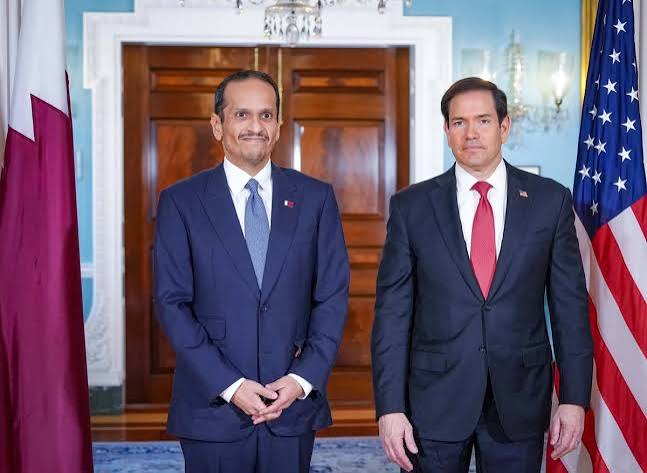
The dialogue was convened by US Secretary of State Marco Rubio and Qatar's Prime Minister and Foreign Minister, Sheikh Mohammed bin Abdulrahman Al Thani, with senior officials from both governments in attendance.
The two countries reaffirmed their strategic partnership under US President Donald Trump and Qatar's Amir, Sheikh Tamim bin Hamad Al Thani.
The critical minerals framework is intended to align national strategies, diversify supply chains and strengthen the resilience of global supplies of minerals essential to industrial production and emerging technologies.
Defence Cooperation and Regional Security
The two governments reaffirmed their commitment to Qatar's security, with Rubio emphasising the importance of the defence relationship in strengthening joint capabilities and protecting shared interests.
They also underscored the need to maintain freedom of navigation through the Strait of Hormuz, a strategic waterway for international energy shipments and maritime trade.
Both sides said safe and uninterrupted passage through the strait was important for regional security, reliable energy supplies and global economic stability.
Building on the US-Qatar Military Consultative Commission meeting in September, officials discussed ways to improve Qatar's integrated air and missile defence systems to protect its territory and critical infrastructure.
They also reviewed progress under a $38 billion US-Qatar Statement of Intent on defence cooperation.
The discussions included potential investments in critical munitions, military platforms, missile defence systems and counter-unmanned aircraft capabilities.
The two countries pledged to expand defence cooperation through equipment sales, joint military exercises, intelligence sharing and industrial collaboration.
Expanding Trade and Investment
The dialogue also focused on strengthening commercial relations and creating additional investment opportunities.
According to the joint statement, the discussions built on more than $240 billion in economic deals announced during Trump's visit to Qatar in May 2025.
Washington and Doha explored opportunities for US companies in Qatar and greater Qatari investment in the United States, including through the Qatar Investment Authority.
The US highlighted initiatives such as the US Investment Accelerator and SelectUSA, which are intended to attract and support investment.
Qatar, meanwhile, emphasised the importance of international partnerships in advancing its economic diversification agenda.
Both governments said their cooperation continued to support economic growth, employment and collaboration in energy and emerging technologies.
Technology, Energy and Critical Supply Chains
The United States welcomed Qatar's signing of the Pax Silica Declaration, alongside expanding cooperation in artificial intelligence, high-performance computing, digital infrastructure and cybersecurity.
The countries also discussed secure supply chains for energy and critical minerals.
Both sides highlighted their interest in strengthening global energy supply and resilience, including through the Golden Pass liquefied natural gas (LNG) project.
The critical minerals agreement is particularly relevant to efforts to reduce supply chain vulnerabilities and support industries dependent on reliable access to essential raw materials.
However, the joint statement did not provide details of specific mineral projects, investment commitments or implementation timelines under the new framework.
Joint Efforts Against Terrorism and Organised Crime
The two countries also pledged to deepen cooperation against terrorism, terrorist financing and transnational organised crime.
The statement highlighted collaboration between US departments responsible for homeland security, finance, justice and foreign affairs, and Qatar's Ministry of Interior, Internal Security Force, State Security Bureau and Public Prosecution Office.
Officials welcomed ongoing cooperation on international prisoner transfers and efforts to disrupt money laundering networks.
They also reviewed joint operations and initiatives against the Islamic State of Iraq and Syria (ISIS) through the Global Coalition to Defeat ISIS.
Further discussions covered intelligence sharing, customs and border security, and measures to strengthen both countries' capacity to address cross-border threats.
The statement also highlighted new joint training, cooperation and investment involving the FBI's Redstone Arsenal headquarters and Qatar's Ministry of Interior.
Regional Conflicts and Diplomatic Engagement
The dialogue addressed several regional and international issues, including Gaza, Iran, Syria, Lebanon, Afghanistan, the Democratic Republic of the Congo, the Sahel, Rwanda, Somalia, Bolivia and Haiti.
Rubio thanked Qatar's leadership for its role in international mediation and efforts to advance peace and stability.
He also acknowledged Qatar's continued support for Haiti, including a $30 million pledge to the United Nations Trust Fund for the Gang Suppression Force.
Sheikh Mohammed commended Trump's diplomatic efforts to pursue agreements aimed at resolving regional conflicts, describing US engagement as important to creating conditions for lasting peace.
Education, Culture and 55 Years of Relations
The two countries also reaffirmed their commitment to cooperation in education, culture and sports as they prepare to mark 55 years of diplomatic relations.
They recognised Qatar's role in hosting leading US academic institutions, particularly through Education City.
Both governments expressed interest in expanding partnerships among American universities, Qatari institutions and private businesses to support research, innovation and workforce development.
They also highlighted their shared interests in international sporting events, including the 2026 FIFA World Cup, which the United States is co-hosting.
The joint statement said discussions on defence, security, counterterrorism, law enforcement and cultural cooperation would continue into early 2027.
Strategic Partnership Faces Implementation Test
The latest agreement broadens cooperation between Washington and Doha across minerals, defence, energy, technology and security.
Its practical significance will depend on how the commitments translate into specific projects, investment flows, stronger supply chains and measurable security outcomes.
For Qatar, the partnership supports its efforts to diversify its economy and strengthen its strategic relationships. For the United States, it reinforces cooperation with a key Gulf partner at a time of continuing regional tensions and competition over strategic resources.
Atlantic Reports: Voices. People. Facts.
Written by
Atlantic Reports Admin
Comments
- Be the first to comment.