US Citizenship Rules Offer Shorter Naturalisation Routes for Spouses, Military Personnel and Childre
By Atlantic Reports
United States immigration law provides several routes to naturalisation that allow eligible foreign nationals to become citizens earlier than under the general five-year residency requirement.
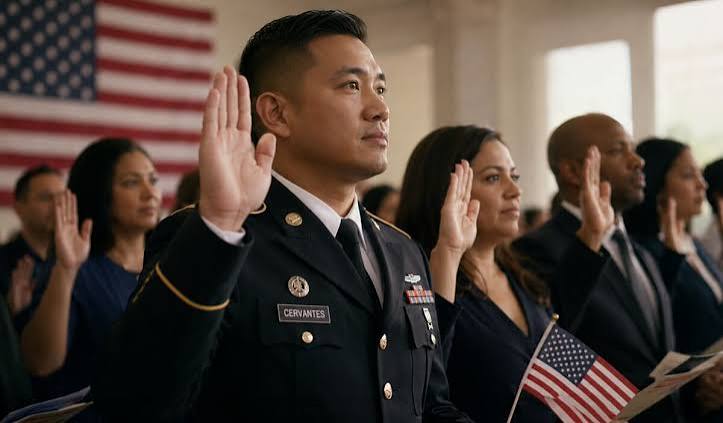
The provisions cover certain spouses of US citizens, people who have served honourably in the US armed forces and children who acquire citizenship through a parent.
The rules are contained in the Immigration and Nationality Act (INA) and administered by US Citizenship and Immigration Services (USCIS).
Spouses of US citizens may apply after three years
Under Section 319(a) of the INA, an eligible foreign national married to a US citizen may apply for naturalisation after three years as a lawful permanent resident, rather than waiting the standard five years.
Applicants must have lived in marital union with their US citizen spouses throughout the three years immediately before filing their applications.
They must also remain married until they take the Oath of Allegiance and become citizens. However, USCIS guidance clarifies that the requirement to live together applies to the three years before filing, not throughout the entire application-processing period.
Applicants must demonstrate at least 18 months of physical presence in the United States during the three-year period and maintain continuous residence as required by the law.
They must also satisfy the English-language and US civics requirements, as well as the applicable good-moral-character standard.
Military service provides separate citizenship routes
Foreign nationals who have served honourably in the US armed forces may qualify under Sections 328 and 329 of the INA.
Under Section 328, a person who has completed at least one year of honourable military service may apply for naturalisation through a special provision. Applicants must generally hold lawful permanent resident status, although additional conditions may apply depending on when they left military service.
Some residence and physical-presence requirements may be reduced or waived.
Section 329 covers eligible current or former military personnel who served honourably during designated periods of hostilities. This route can allow qualifying applicants to naturalise without meeting the usual US residence or physical-presence requirements.
Applicants must generally demonstrate good moral character, knowledge of English and US civics, and attachment to the principles of the US Constitution. Certain exemptions may apply under the military provisions.
Children may acquire citizenship through US citizen parents
Children of US citizens may also qualify for citizenship without following the standard five-year naturalisation process.
The law distinguishes between citizenship acquired at birth and citizenship acquired after birth but before the child turns 18.
Under Section 320 of the INA, a child born outside the United States may automatically acquire citizenship after birth if:
-
At least one parent is a US citizen, including an adoptive parent.
-
The child is under 18 years old.
-
The child has lawful permanent resident status.
-
The child resides in the United States in the legal and physical custody of the US citizen parent.
USCIS also recognises specific exceptions to the US residence requirement for certain children of military personnel and government employees stationed abroad.
Section 322 provides another route for eligible children living outside the United States. It requires a US citizen parent, or in qualifying circumstances a US citizen grandparent, to satisfy specified physical-presence requirements.
The child must also be temporarily present in the United States following lawful admission when the application is approved, subject to the applicable statutory requirements.
Children of eligible US military personnel living abroad may also benefit from provisions allowing parts of the citizenship process to be completed outside the country.
Applicants urged to check official requirements
Although these provisions offer alternatives to the general naturalisation route, eligibility depends on individual circumstances, immigration history, family relationships and compliance with statutory conditions.
USCIS requires applicants to follow the relevant application procedures and provide supporting evidence. Most naturalisation applicants must also complete an interview and meet applicable English and civics requirements, unless exempted.
The agency explains that applicants become US citizens only after taking the Oath of Allegiance, where an oath is required.
The detailed requirements and application procedures are available through the official US Citizenship and Immigration Services website.
Atlantic Reports: Voices. People. Facts.
Written by
Atlantic Reports Admin
Comments
- Be the first to comment.