US, Russia and China Agree to Dialogue on Nuclear Risks and Proliferation
By Atlantic Reports
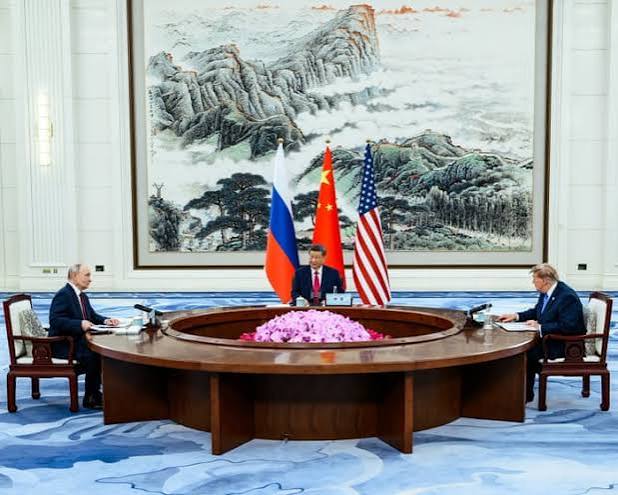
The United States, Russia and China have agreed to engage in dialogue on reducing nuclear risks and preventing the spread of nuclear weapons following a trilateral summit in Shenzhen, China.
US President Donald Trump, Chinese President Xi Jinping and Russian President Vladimir Putin announced the commitment in a joint statement issued on Thursday after approximately 90 minutes of talks at Qilin Mountain Villa.
The meeting, held on the sidelines of the Asia-Pacific Economic Cooperation (APEC) summit, marked the first trilateral summit involving the leaders of the three nuclear-armed powers.
The joint statement affirmed that nuclear war must never be fought and called for dialogue on preventing nuclear proliferation.
Nuclear arms control takes centre stage
In his opening remarks, Trump said the three countries were in a unique position to discuss reducing the number of nuclear weapons globally and lowering the risk of their use.
His comments indicated an interest in bringing China into nuclear arms control discussions traditionally dominated by Washington and Moscow.
Trump also reiterated his opposition to Iran acquiring nuclear weapons.
Xi called for a comprehensive ban and the eventual elimination of nuclear weapons, describing a world without them as the ultimate objective.
He also proposed regular high-level exchanges among the three countries and the establishment of a crisis management system to prevent tensions from escalating.
Xi warned that conflicts between major powers could create wider international instability.
He urged the leaders to communicate before taking action on sensitive international issues and to avoid crossing one another's stated red lines. His remarks also reflected China's longstanding position on issues involving its core interests, including Taiwan.
Ukraine and regional security
Putin said the three countries shared interests in resolving regional conflicts, including the war in Ukraine.
He also referred to their historical positions as major victorious powers in the Second World War and founding members of the United Nations.
According to China's Xinhua News Agency, the leaders exchanged views on the Korean Peninsula. However, no detailed public remarks on North Korea's nuclear programme were reported during the summit.
Wider agreements cover UN reform and trade
Beyond nuclear security, the joint statement outlined cooperation in three other areas.
These included expanding the production and supply of refined petroleum products, opposing what the leaders described as abuse of the International Criminal Court's jurisdiction, and pursuing reform of the United Nations.
The agreements suggest that the discussions extended beyond arms control to economic and institutional interests shared by the three powers.
Questions over the wider international order
The summit has also raised questions about the role of countries and regions not directly represented in discussions involving decisions with wider security implications.
Although the leaders pledged dialogue on nuclear risks, the joint statement did not establish specific disarmament targets, a timetable for negotiations or a detailed mechanism for implementing the commitment.
The absence of such details leaves open questions about how the proposed dialogue will translate into concrete arms control measures.
For the international community, the significance of the meeting will depend less on the declaration itself than on whether the three governments sustain negotiations, manage their strategic differences and make measurable progress towards reducing nuclear threats.
Atlantic Reports: Voices. People. Facts.
Written by
Atlantic Reports Admin
Comments
- Be the first to comment.