WAHO Seeks Harmonised Health Training Standards Across West Africa
By Atlantic Reports
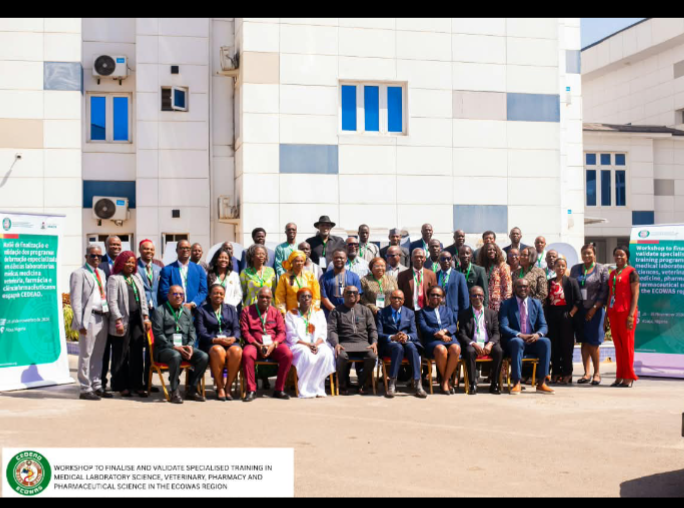
The call was made at a three-day regional workshop in Abuja to finalise and validate specialised training curricula in the four disciplines.
The Coordinating Minister of Health and Social Welfare, Prof. Muhammad Pate, represented by Nigeria’s Liaison Officer to WAHO, Dr Dakum Benji, said harmonised curricula would establish common standards and help produce skilled professionals capable of responding to the region’s growing health challenges.
He described medical laboratory scientists, veterinary doctors, pharmacists and pharmaceutical scientists as essential to healthcare delivery, particularly in disease diagnosis, prevention, treatment and medicine safety.
Pate said medical laboratory scientists needed advanced competencies in molecular testing, quality assurance, biosafety and digital health to improve diagnostic accuracy and patient outcomes.
He also highlighted the importance of veterinary medicine to human health, noting that around 75 per cent of emerging infectious diseases originate from animals.
On pharmacy and pharmaceutical sciences, he said professionals in the fields played critical roles in ensuring medicine quality, safety and appropriate use, while supporting local pharmaceutical manufacturing and efforts to combat counterfeit drugs.
He urged participants to validate the proposed curricula and align professional training with international standards.
Regional cooperation and professional mobility
Prof. Dossim Sika, representing the Dean of Faculties, commended WAHO for addressing regional health challenges through a coordinated approach.
She called for stronger collaboration among training institutions, professional associations and colleges, urging stakeholders to put the health needs of West African populations above territorial interests.
Sika encouraged participants to use the workshop to deepen cooperation in medical laboratory sciences, pharmacy and pharmaceutical sciences within the One Health framework.
Similarly, Prof. Awa Seck, representing the ECOWAS Chairman, described the exercise as an important step towards developing a skilled health workforce capable of responding to increasing regional healthcare demands.
She said WAHO had prioritised human resources for health and that the proposed curricula followed consultations involving experts, training institutions and professional colleges.
Seck said the programmes must meet high scientific and professional standards while reflecting the realities of West African countries.
She expressed hope that the workshop would produce innovative and harmonised curricula that could strengthen cooperation and build more resilient health systems.
The President-elect of the Regional Council of Health Professions Education, Prof. Mulbah John, said curriculum harmonisation would promote professional mobility and improve quality assurance across higher education institutions.
He said common training benchmarks would strengthen cooperation among member states and help health professionals respond more effectively to existing and emerging challenges.
WAHO highlights gaps in diagnostic services
The Director-General of WAHO, Prof. Palokinam Pitché, represented by the organisation’s Head of Training and Human Resources for Health, Prof. Joseph Olorunda, stressed the importance of reliable diagnostic services in effective healthcare delivery.
Olorunda said medical laboratory scientists and pharmacists played complementary roles in diagnosis, treatment and patient care.
He called for the integration of diagnostic services into national health plans and universal health coverage programmes.
He also raised concerns about inadequate investment in laboratory infrastructure across low- and middle-income countries, saying many health facilities lacked access to basic diagnostic tests.
According to him, this has forced some healthcare providers to rely on empirical and syndromic treatment when laboratory confirmation is unavailable.
Citing a study conducted across 10 sub-Saharan African countries, Olorunda said only two per cent of healthcare facilities surveyed could perform at least eight basic diagnostic tests.
He called for sustainable laboratory networks and increased investment in infrastructure and professional training to expand access to quality diagnostics.
Olorunda also highlighted veterinary medicine’s contribution to controlling diseases that spread between animals and humans, protecting food security and advancing the One Health approach.
Proposed curricula to meet international standards
The WAHO representative urged participants to develop competency-based specialised training programmes that would support the movement of qualified health professionals across the region.
He said the curricula should also strengthen accreditation and cooperation among hospitals, laboratories, training institutions and research centres.
WAHO Programme Officer for Pharmacy and Allied Health, Dr Olusegun Adeoye, said the workshop was designed to align and validate postgraduate training curricula in veterinary medicine, medical laboratory sciences, pharmacy and pharmaceutical sciences with international standards and best practices.
He added that the exercise would address the recognition of professional diplomas and their equivalencies across ECOWAS member states.
If successfully adopted and implemented, the harmonised standards could make it easier for qualified professionals to work across national borders while improving consistency in health education and professional practice.
However, their impact will depend on the ability of member states and training institutions to adopt the curricula, meet accreditation requirements and invest in the facilities and resources needed to deliver the programmes.
Atlantic Reports: Voices. People. Facts.
Written by
Atlantic Reports Admin
Comments
- Be the first to comment.