WMO Warns Strong El Niño Could Push Global Temperatures to New Record in 2027
By Atlantic Reports
The World Meteorological Organisation (WMO) has warned that 2027 could become the hottest year on record if a developing strong El Niño combines with the continuing effects of human-induced climate change.
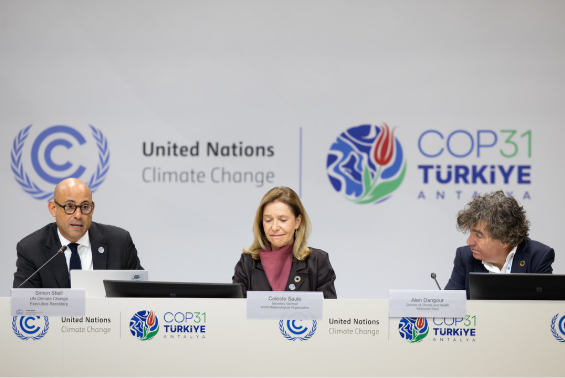
The organisation's Secretary-General, Celeste Saulo, gave the warning on Monday, 9 November 2026, while presenting the State of the Climate Update 2026 at the 31st United Nations Climate Change Conference (COP31) in Antalya, Türkiye.
Saulo said the past 12 years had been the warmest on record, with the four most recent years, including 2026, ranking as the four hottest.
According to her, global average temperatures between January and September 2026 were approximately 1.47 degrees Celsius above pre-industrial levels.
Strong El Niño raises concern over 2027 heat
Saulo described the developing 2026/2027 El Niño as unusually strong, warning that its effects could intensify global temperatures in the coming year.
El Niño is a natural climate phenomenon characterised by warmer-than-average sea surface temperatures in the central and eastern tropical Pacific Ocean. It can influence weather patterns and increase global average temperatures.
The WMO chief said sea surface temperatures in the tropical Pacific were forecast to approach four times the 0.5-degree threshold used to identify the phenomenon.
“Indeed, this 2026/2027 El Niño is off the charts. It is different from any El Niño that we have monitored,” she said.
She explained that El Niño generally has its strongest influence on global temperatures in the year following its development, raising concerns about another temperature record in 2027.
Rising ocean heat threatens coastal communities
Saulo also disclosed that ocean heat had reached record levels for the 10th consecutive year, while global sea levels had risen to unprecedented levels.
She warned that these developments were increasing risks for approximately 900 million people living in low-lying coastal areas.
The WMO chief said extreme heat, tropical cyclones and intense rainfall were exposing millions of people to dangerous weather conditions.
She cited heatwaves across India, Pakistan, other parts of Asia and North America, alongside tens of thousands of estimated excess deaths in Europe.
“The human and economic cost is unacceptably high,” she said.
Saulo urged governments attending COP31 to strengthen global climate observation systems and provide adequate funding for early-warning mechanisms.
She noted that the number of countries reporting multi-hazard early-warning systems had increased from 56 in 2015 to 136 in 2025.
“We cannot afford to fly blind,” she said, emphasising the importance of sustained climate monitoring to anticipate risks and protect lives.
UN climate chief links climate change to health emergency
Also speaking at the news conference, UN Climate Change Executive Secretary Simon Stiell described the climate crisis as a major global health emergency.
He said extreme heat, air pollution and climate-related disasters were placing increasing pressure on health systems.
Stiell cited estimates that heatwaves during the northern hemisphere's summer had caused about 50,000 deaths across Europe, while hundreds of millions of people in southern Asia had been exposed to extreme heat.
“The climate crisis is now a global health crisis of pandemic proportions,” he said.
He highlighted the particular risks facing pregnant women, newborn babies and maternal health, linking worsening climate impacts to continued fossil fuel consumption and deforestation.
Stiell said health would remain a central issue at COP31, building on discussions and commitments made at COP30 in Belém, Brazil.
He called on countries to accelerate electrification and the adoption of cleaner energy, warning that continued dependence on fossil fuels would increase costs for households, businesses and governments.
Wellcome highlights deaths linked to heat and pollution
The Director of Climate and Health at Wellcome, Dr Alan Dangour, said fossil fuel-related air pollution and extreme heat were estimated to cause more than three million deaths annually.
He warned that climate change was already affecting communities through extreme temperatures, drought and changing water conditions, with consequences for food security, sanitation and livelihoods.
Dangour identified cleaner energy, electrification, heat early-warning systems and climate adaptation measures as available responses.
He also disclosed that the Climate and Health Funders Coalition had awarded more than 225 million dollars in its first year to support interventions targeting extreme heat, air pollution, climate-sensitive infectious diseases and data systems.
According to him, the coalition, established at COP30 with an initial joint commitment of 300 million dollars from Wellcome and more than 35 philanthropic organisations, had attracted an additional 150 million dollars in funding commitments.
He urged governments and businesses to place public health at the centre of climate policies, with particular attention to children, pregnant women, outdoor workers and older people.
“We must change course and put the health and wellbeing of people at the heart of our response to climate change,” he said.
Climate action and the cost of delayed response
The warnings at COP31 underline the growing connection between climate change, public health, economic stability and the safety of vulnerable communities.
For countries such as Nigeria, the implications extend beyond rising temperatures to include pressure on food production, water resources, coastal settlements, public health services and livelihoods.
However, the scale of future impacts will depend on the strength of climate adaptation measures, the effectiveness of early-warning systems and the pace of the global transition towards cleaner energy.
As delegates deliberate at COP31, the challenge remains how to translate climate commitments and funding announcements into practical protection for communities already experiencing the effects of extreme weather.
Atlantic Reports: Voices. People. Facts.
Written by
Atlantic Reports Admin
Comments
- Be the first to comment.