World Bank unveils data-driven plan to fund small businesses
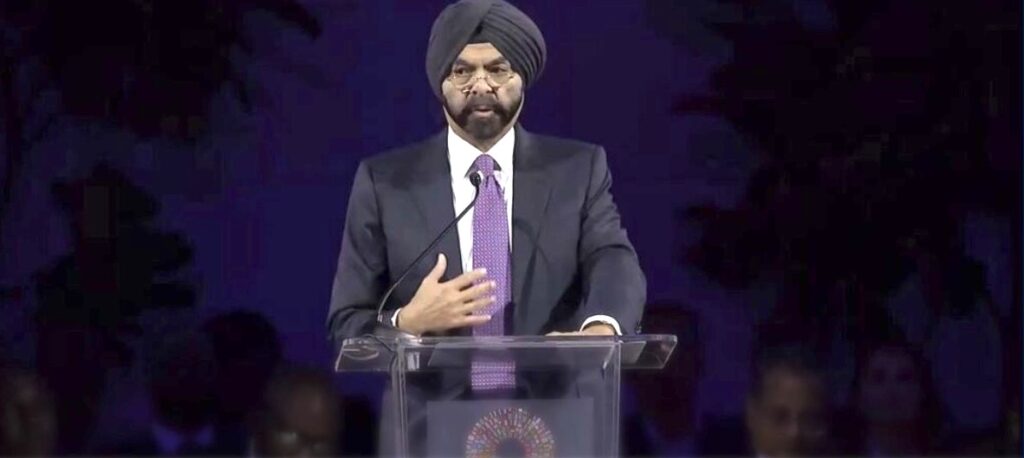
The World Bank Group has unveiled a new strategy to widen access to finance for micro, small and medium enterprises (MSMEs) in developing countries, with digital technology and data at its core.
The group said the plan would use data-driven solutions to help small businesses grow and create jobs.
Ajay Banga, President of the World Bank Group, announced the strategy on Tuesday in Bangkok, Thailand, at the "MSME Finance: Leveraging Data for Jobs" session, one of the Bank's flagship events at the 2026 IMF-World Bank Group Annual Meetings.
According to Banga, the strategy rests on making MSMEs visible, connected, enabled and funded, so that small businesses can overcome structural barriers to finance, expand their operations and hire more workers.
Banga said MSMEs accounted for 90 per cent of firms and employed 75 per cent of workers in developing countries, making them central to economic growth and job creation.
He warned that the employment challenge would deepen over the next 15 years, when 1.2 billion young people in developing countries would reach working age, while only about 420 million jobs were expected to be created.
How well those young people find work, start businesses and build sustainable livelihoods, he said, would shape the strength of economies, trade and social stability in the years ahead.
Banga said the World Bank Group was channelling financing into infrastructure, governance and private capital mobilisation to lay the foundations businesses need to grow and employ more people.
In the previous year, he said, the institution committed 40 billion dollars to infrastructure and 24 billion dollars to improving governance, together accounting for more than half of its financing.
He named energy and infrastructure, agribusiness, primary healthcare, tourism and value-added manufacturing as five sectors with strong potential for job creation, and stressed that small businesses were at the heart of all of them.
"MSMEs are the backbone of all five of these. They cannot create jobs without funding. They cannot create jobs without the right capacity building," he said.
Banga said MSMEs in developing countries faced an annual financing gap of more than four trillion dollars. He blamed high lending costs, collateral requirements, regulatory constraints and limited credit information.
Banks, he explained, often demand real estate and other hard assets as collateral, which many small businesses do not have, while the small size of their loans makes lending to them costly for financial institutions.
Digitalisation, he said, could help close the gap by allowing lenders to assess businesses on their cash flows and transaction records rather than relying only on traditional collateral.
"Digital payments, electronic invoicing and access to tax and utility payment records can establish reliable credit histories for small businesses.
"The World Bank will also support digital platforms that connect MSMEs to customers, suppliers, logistics, professional services and financing, while helping governments simplify business registration, licensing and regulatory processes," he said.
Over the previous three years, Banga said, the institution had supported 35 countries to cut bureaucratic bottlenecks, 10 to improve insolvency frameworks and seven to reform procurement and competition regulations in support of MSMEs.
He said the group had also invested in more than 100 fintech companies and aggregators, and was exploring equity investments, loans backed by MSME receivables and risk-sharing arrangements to expand lending to underserved businesses.
According to Banga, the World Bank Group mobilised 112 billion dollars in private capital in 2025, alongside 120 billion dollars from its own balance sheet.
He said that was still not enough.
"More investment is needed, particularly in fragile and conflict-affected countries. The 112 billion dollars mobilised in private capital has not been enough because MSMEs are not just part of these economies; they are the backbone.
"We must reach the roadside mechanic in Nairobi, the seamstress in Lagos, and the exporter in Dakar; entrepreneurs that the traditional model was never designed to serve.
"We cannot do this alone. We must build an ecosystem of fast payment systems, stronger local financial institutions, trusted intermediaries, and risk-sharing mechanisms that unlock private investment where it is needed most," Banga said.
Written by
Atlantic Reports Admin
Comments
- Be the first to comment.